
通过连通性测量所捕获的大脑中的奖赏网络。
Reward networks in the brain as captured by connectivity measures.
作者信息
Camara Estela, Rodriguez-Fornells Antoni, Ye Zheng, Münte Thomas F
机构信息
Departament de Ciencies Fisiològiques, University of Barcelona Barcelona, Spain.
出版信息
Front Neurosci. 2009 Dec 15;3(3):350-62. doi: 10.3389/neuro.01.034.2009. eCollection 2009.
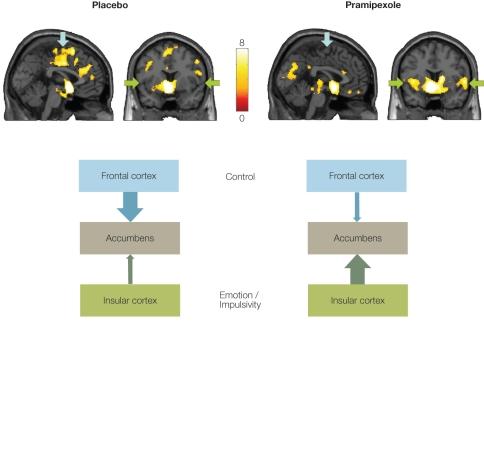
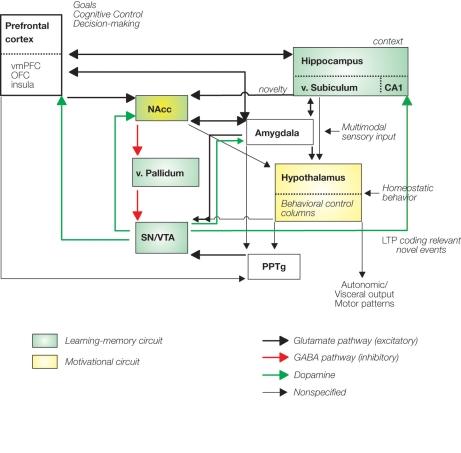
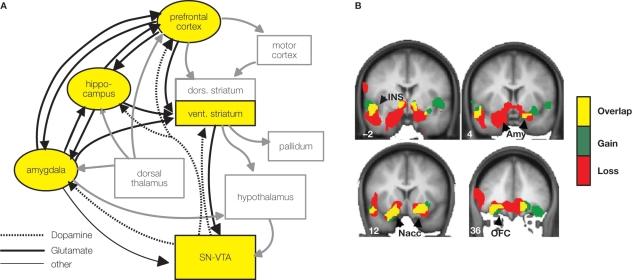
An assortment of human behaviors is thought to be driven by rewards including reinforcement learning, novelty processing, learning, decision making, economic choice, incentive motivation, and addiction. In each case the ventral tegmental area/ventral striatum (nucleus accumbens) (VTA-VS) system has been implicated as a key structure by functional imaging studies, mostly on the basis of standard, univariate analyses. Here we propose that standard functional magnetic resonance imaging analysis needs to be complemented by methods that take into account the differential connectivity of the VTA-VS system in the different behavioral contexts in order to describe reward based processes more appropriately. We first consider the wider network for reward processing as it emerged from animal experimentation. Subsequently, an example for a method to assess functional connectivity is given. Finally, we illustrate the usefulness of such analyses by examples regarding reward valuation, reward expectation and the role of reward in addiction.
人们认为,包括强化学习、新奇性处理、学习、决策、经济选择、激励动机和成瘾在内的一系列人类行为是由奖励驱动的。在每种情况下,腹侧被盖区/腹侧纹状体(伏隔核)(VTA-VS)系统都被功能成像研究认为是关键结构,主要基于标准的单变量分析。在此我们提出,标准功能磁共振成像分析需要辅以能够考虑VTA-VS系统在不同行为背景下的差异连接性的方法,以便更恰当地描述基于奖励的过程。我们首先考虑从动物实验中得出的更广泛的奖励处理网络。随后,给出了一种评估功能连接性的方法示例。最后,我们通过奖励估值、奖励预期以及奖励在成瘾中的作用的示例来说明此类分析的有用性。
 Zotero 插件