Andrade Felipe, Darrah Erika, Gucek Marjan, Cole Robert N, Rosen Antony, Zhu Xiaoming
Division of Rheumatology, Johns Hopkins University School of Medicine, Baltimore, Maryland 21224, USA.
Arthritis Rheum. 2010 Jun;62(6):1630-40. doi: 10.1002/art.27439.
To address mechanisms that control the activity of human peptidyl arginine deiminase type 4 (PAD-4).
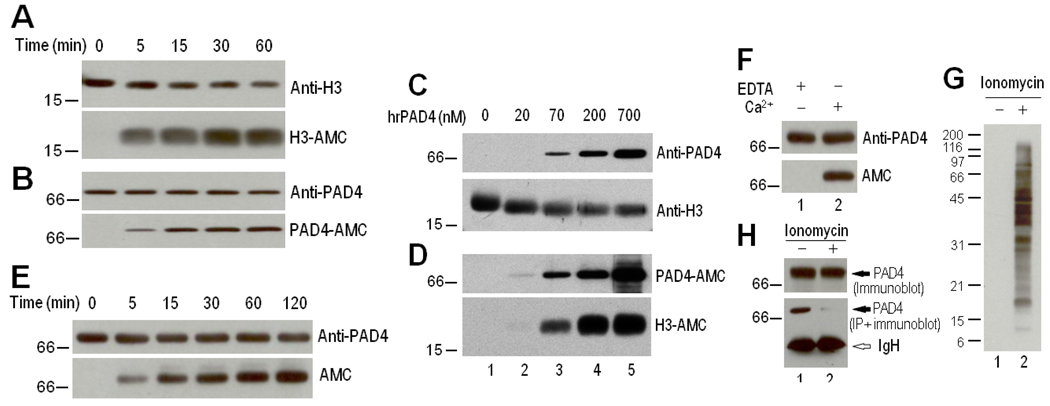
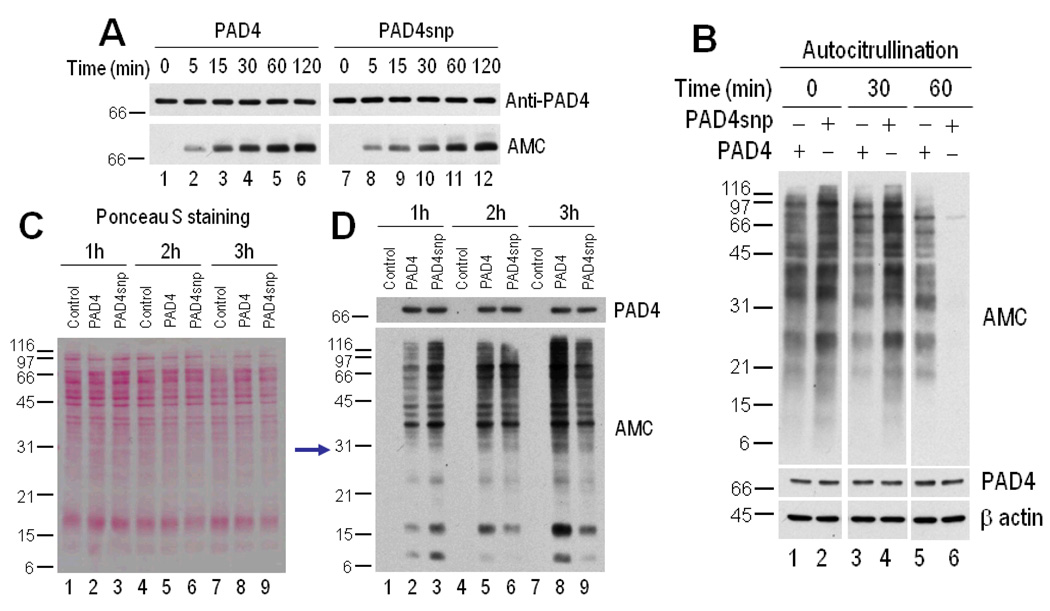
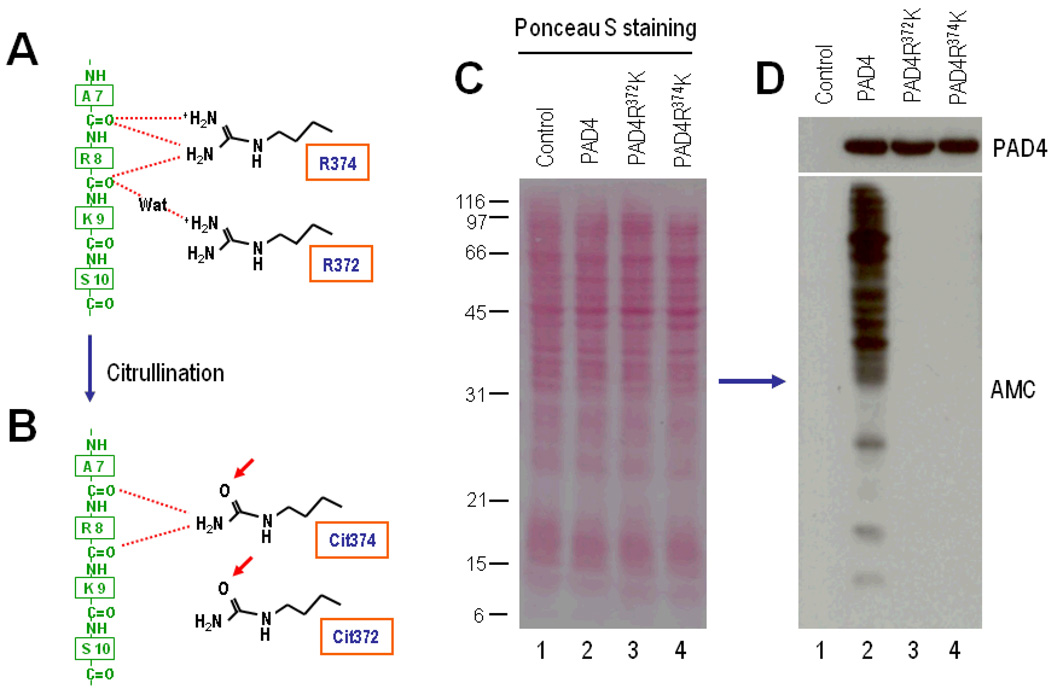
PAD-4 autocitrullination was determined by anti-modified citrulline immunoblotting, using purified recombinant and endogenous PAD-4 from activated human primary neutrophils and cell lines expressing PAD-4. The citrullination sites in PAD-4 were determined by mass spectrometry. Mechanisms of autocitrullination-induced inactivation and the functional consequences of autocitrullination in PAD-4 polymorphic variants were addressed using purified components and cell lines expressing PAD-4 wild-type, PAD-4 mutant, and PAD-4 polymorphic variants relevant to rheumatoid arthritis (RA).
PAD-4 is autocitrullinated in vitro and during activation of primary cells and cell lines expressing PAD-4. Interestingly, this modification inactivated the function of the enzyme. The efficiency of inactivation differed among genetically defined PAD-4 variants relevant to RA. PAD-4 was citrullinated at 10 sites, which are clustered into 3 distinct regions, including a cluster of arginines around the active site cleft where Arg-372 and -374 were identified as the potential autocitrullination targets that inactivate the enzyme. Autocitrullination also modified the structure of PAD-4, abrogating its recognition by multiple rabbit antibodies, but augmenting its recognition by human anti-PAD-4 autoantibodies.
Our findings suggest that autocitrullination regulates the production of citrullinated proteins during cell activation, and that this is affected by structural polymorphisms in PAD-4. Autocitrullination also influences PAD-4 structure and immune response.
探讨调控人4型肽基精氨酸脱亚氨酶(PAD - 4)活性的机制。
采用抗瓜氨酸化修饰免疫印迹法测定PAD - 4的自身瓜氨酸化,所用材料包括从活化的人原代中性粒细胞和表达PAD - 4的细胞系中纯化的重组及内源性PAD - 4。通过质谱法确定PAD - 4中的瓜氨酸化位点。利用纯化的组分以及表达PAD - 4野生型、PAD - 4突变体和与类风湿关节炎(RA)相关的PAD - 4多态性变体的细胞系,研究自身瓜氨酸化诱导失活的机制以及PAD - 4多态性变体中自身瓜氨酸化的功能后果。
PAD - 4在体外以及原代细胞和表达PAD - 4的细胞系活化过程中发生自身瓜氨酸化。有趣的是,这种修饰使该酶的功能失活。与RA相关的基因定义的PAD - 4变体之间失活效率有所不同。PAD - 4在10个位点发生瓜氨酸化,这些位点聚集成3个不同区域,包括活性位点裂隙周围的一簇精氨酸,其中精氨酸 - 372和 - 374被确定为使酶失活的潜在自身瓜氨酸化靶点。自身瓜氨酸化还改变了PAD - 4的结构,消除了多种兔抗体对其的识别,但增强了人抗PAD - 4自身抗体对它的识别。
我们的研究结果表明,自身瓜氨酸化在细胞活化过程中调节瓜氨酸化蛋白的产生,并且这受到PAD - 4结构多态性的影响。自身瓜氨酸化还影响PAD - 4结构和免疫反应。