London School of Hygiene and Tropical Medicine, London, UK.
Emerg Infect Dis. 2010 Mar;16(3):392-9. doi: 10.3201/eid1603.090732.
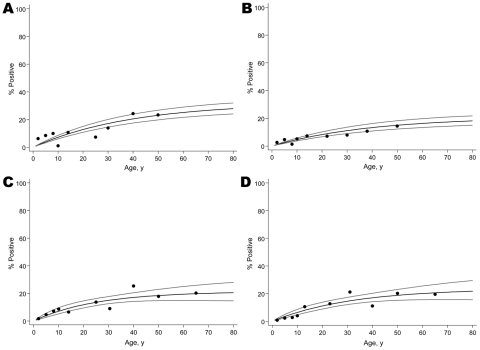
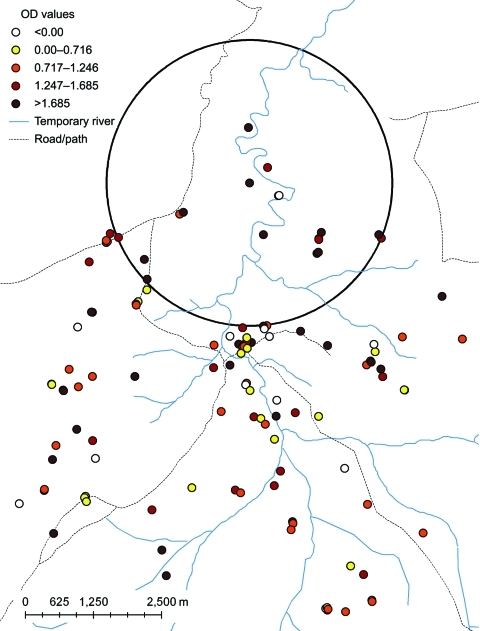
Areas in which malaria is not highly endemic are suitable for malaria elimination, but assessing transmission is difficult because of lack of sensitivity of commonly used methods. We evaluated serologic markers for detecting variation in malaria exposure in Somalia. Plasmodium falciparum or P. vivax was not detected by microscopy in cross-sectional surveys of samples from persons during the dry (0/1,178) and wet (0/1,128) seasons. Antibody responses against P. falciparum or P. vivax were detected in 17.9% (179/1,001) and 19.3% (202/1,044) of persons tested. Reactivity against P. falciparum was significantly different between 3 villages (p<0.001); clusters of seroreactivity were present. Distance to the nearest seasonal river was negatively associated with P. falciparum (p = 0.028) and P. vivax seroreactivity (p = 0.016). Serologic markers are a promising tool for detecting spatial variation in malaria exposure and evaluating malaria control efforts in areas where transmission has decreased to levels below the detection limit of microscopy.
在疟疾非高度流行的地区,适合进行疟疾消除,但由于常用方法的敏感性不足,评估传播情况较为困难。我们评估了血清学标志物,以检测索马里疟疾暴露的变化。在对旱季(0/1178)和雨季(0/1128)的人群样本进行的横断面调查中,显微镜未检测到间日疟原虫或卵形疟原虫。在 1001 名检测者中,17.9%(179 人)和 19.3%(202 人)检测到针对恶性疟原虫或间日疟原虫的抗体反应。针对恶性疟原虫的反应在 3 个村庄之间存在显著差异(p<0.001);存在血清反应性的聚类。到最近季节性河流的距离与恶性疟原虫(p=0.028)和间日疟原虫的血清反应性(p=0.016)呈负相关。血清学标志物是一种很有前途的工具,可用于检测疟疾暴露的空间变化,并评估在传播已降至显微镜检测下限以下的地区的疟疾控制工作。