Unité de Parasitologie, Département d'Infectiologie de Terrain, Institut de Recherche Biomédicale des Armées, Marseille, France.
Malar J. 2012 Nov 28;11:395. doi: 10.1186/1475-2875-11-395.
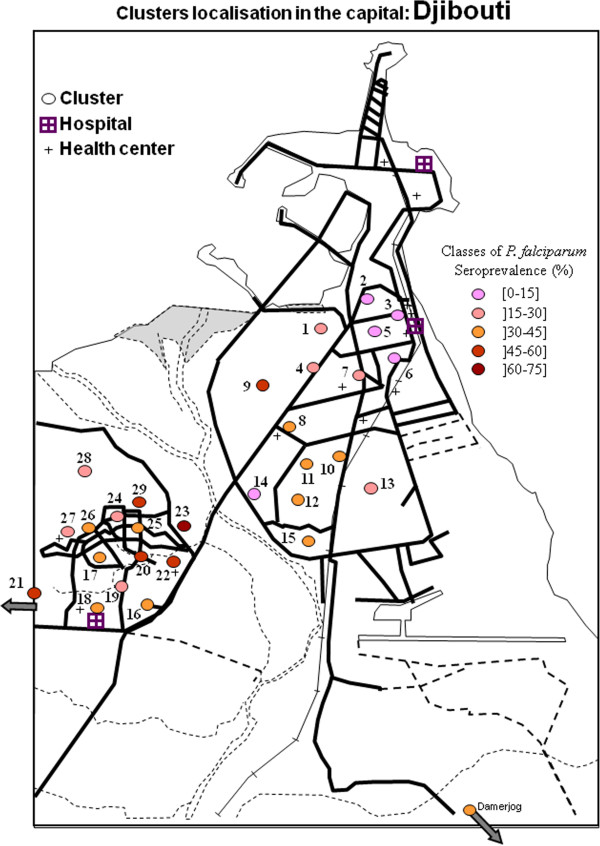
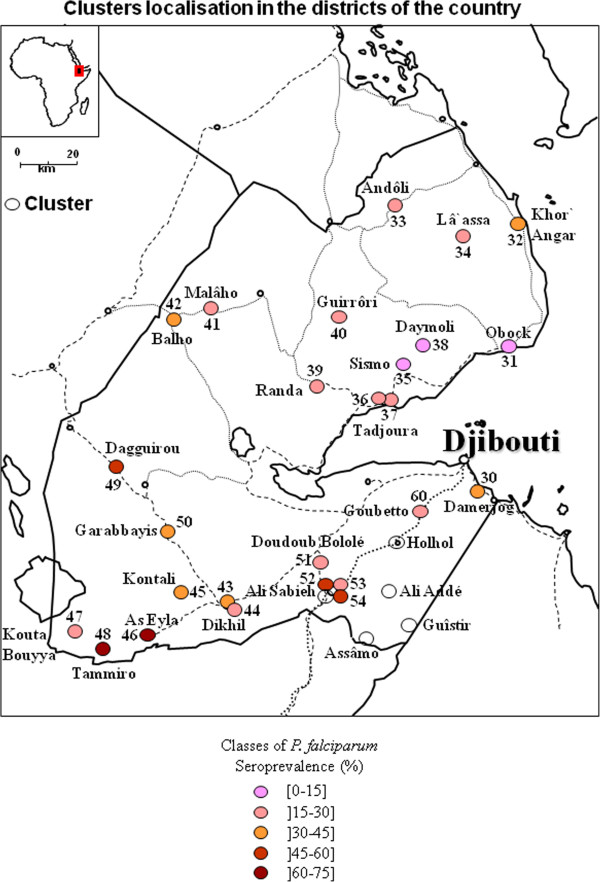
Formerly known as a hypoendemic malaria country, the Republic of Djibouti declared the goal of pre-eliminating malaria in 2006. The aim of the present study was to evaluate the prevalence of Plasmodium falciparum, Plasmodium vivax and mixed infections in the Djiboutian population by using serological tools and to identify potential determinants of the disease and hotspots of malaria transmission within the country.
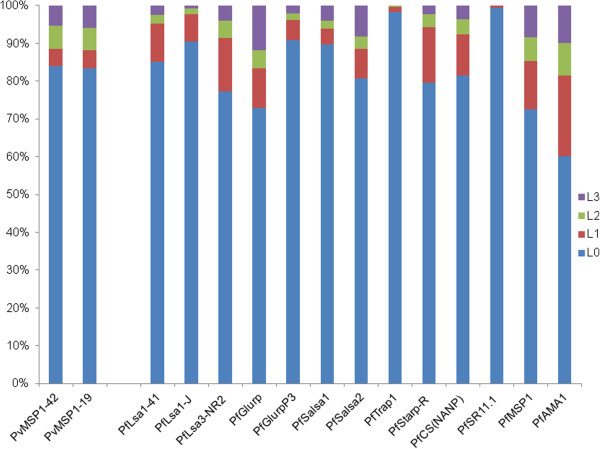
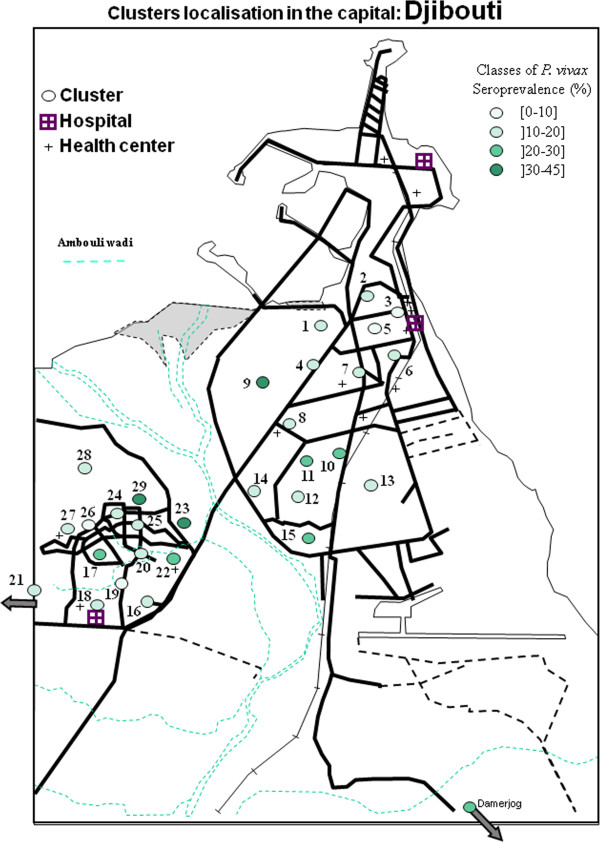
The prevalence of P. falciparum and P. vivax within the districts of the capital city and the rest of the Republic of Djibouti were assessed using 13 and 2 serological markers, respectively. The relationship between the immune humeral response to P. falciparum and P. vivax and variables such as age, gender, wealth status, urbanism, educational level, distance to rivers/lakes, living area, having fever in the last month, and staying in a malaria-endemic country more than one year was estimated and analysed by questionnaires administered to 1910 Djiboutians. Multivariate ordinal logistic regression models of the immune humeral response were obtained for P. falciparum and P. vivax.
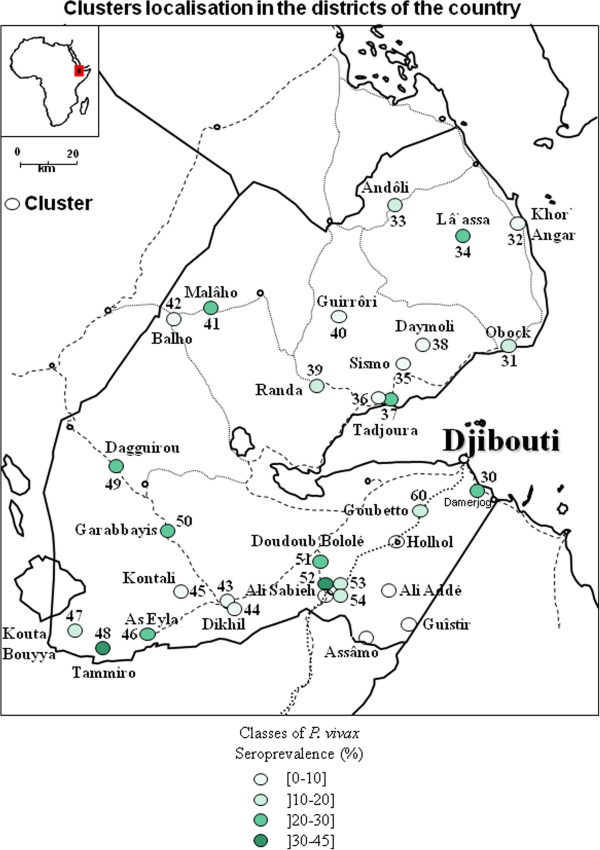
The P. falciparum and P. vivax seroprevalence rates were 31.5%, CI95% [29.4-33.7] and 17.5%, CI95% [15.8-19.3], respectively. Protective effects against P. falciparum and P. vivax were female gender, educational level, and never having visited a malaria-endemic area for more than one year. For P. falciparum only, a protective effect was observed for not having a fever in the last month, living more than 1.5 km away from lakes and rivers, and younger ages.
This is the first study that assessed the seroprevalence of P. vivax in the Republic of Djibouti. It is necessary to improve knowledge of this pathogen in order to create an effective elimination programme. As supported by recent observations on the subject, the Republic of Djibouti has probably demonstrated a real decrease in the transmission of P. falciparum in the past seven years, which should encourage authorities to improve efforts toward elimination.
吉布提共和国曾是疟疾低度流行国家,于 2006 年宣布消除疟疾目标。本研究旨在通过血清学工具评估吉布提人群中恶性疟原虫、间日疟原虫和混合感染的流行情况,并确定疾病的潜在决定因素和国内疟疾传播的热点。
采用 13 种血清学标记物评估首都和吉布提共和国其他地区恶性疟原虫的流行情况,采用 2 种血清学标记物评估间日疟原虫的流行情况。采用问卷调查 1910 名吉布提人,评估并分析对恶性疟原虫和间日疟原虫的免疫体液反应与年龄、性别、财富状况、城市化程度、教育程度、到河流/湖泊的距离、居住区域、上月发热和在疟疾流行国家居住超过 1 年等变量之间的关系。采用多变量有序逻辑回归模型对恶性疟原虫和间日疟原虫的免疫体液反应进行分析。
恶性疟原虫和间日疟原虫的血清阳性率分别为 31.5%(95%CI95%[29.4-33.7])和 17.5%(95%CI95%[15.8-19.3])。对恶性疟原虫和间日疟原虫具有保护作用的因素分别为女性、教育程度和从未在疟疾流行地区居住超过 1 年。仅对恶性疟原虫而言,保护作用还包括上月无发热、居住在离湖泊和河流 1.5 公里以上的地方以及年龄较小。
这是第一项评估吉布提共和国间日疟原虫血清阳性率的研究。为了制定有效的消除计划,有必要提高对这种病原体的认识。正如最近对该主题的观察结果所支持的那样,过去七年吉布提共和国恶性疟原虫传播可能确实有所下降,这应鼓励当局加强努力以实现消除疟疾的目标。