Institute of Crop Science/The National Key Facility for Crop Gene Resources and Genetic Improvement, Chinese Academy of Agricultural Sciences, 12 Zhongguancun South Street, Beijing 100081, China.
J Exp Bot. 2010 Jun;61(6):1567-81. doi: 10.1093/jxb/erq035. Epub 2010 Mar 4.
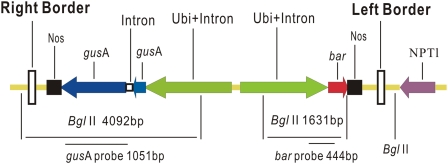
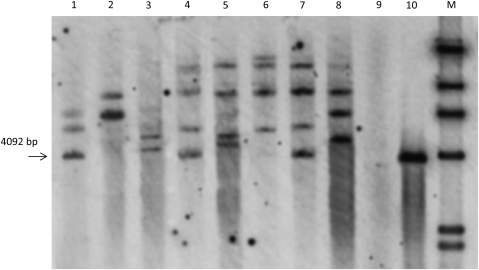
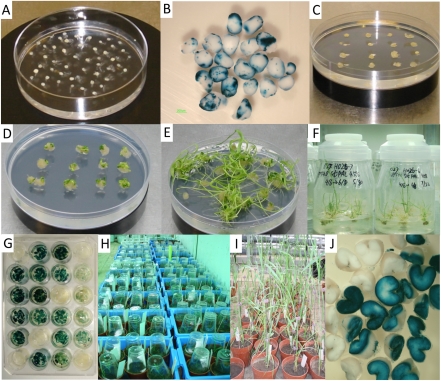
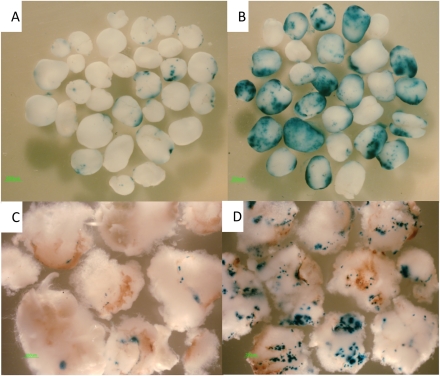
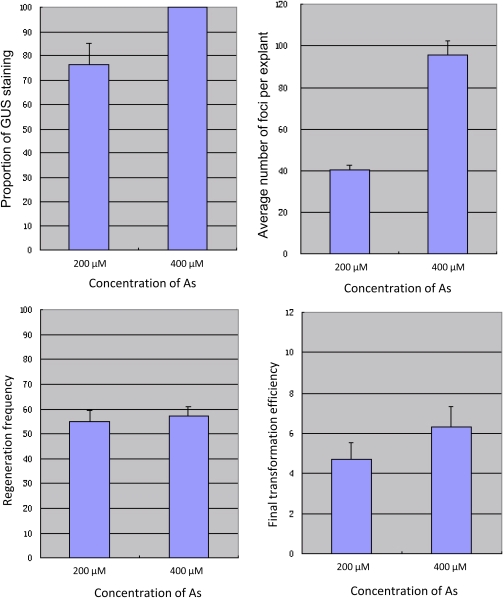
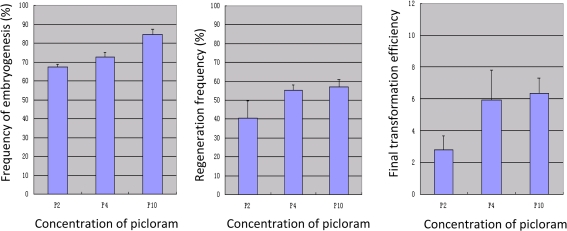
An efficient Agrobacterium-mediated durum wheat transformation system has been developed for the production of 121 independent transgenic lines. This improved system used Agrobacterium strain AGL1 containing the superbinary pGreen/pSoup vector system and durum wheat cv Stewart as the recipient plant. Acetosyringone at 400 microM was added to both the inoculation and cultivation medium, and picloram at 10 mg l(-1) and 2 mg l(-1) was used in the cultivation and induction medium, respectively. Compared with 200 microM in the inoculation and cultivation media, the increased acetosyringone concentration led to significantly higher GUS (beta-glucuronidase) transient expression and T-DNA delivery efficiency. However, no evident effects of acetosyringone concentration on regeneration frequency were observed. The higher acetosyringone concentration led to an improvement in average final transformation efficiency from 4.7% to 6.3%. Furthermore, the concentration of picloram in the co-cultivation medium had significant effects on callus induction and regeneration. Compared with 2 mg l(-1) picloram in the co-cultivation medium, increasing the concentration to 10 mg l(-1) picloram resulted in improved final transformation frequency from 2.8% to 6.3%, with the highest frequency of 12.3% reached in one particular experiment, although statistical analysis showed that this difference in final transformation efficiency had a low level of significance. Stable integration of foreign genes, their expression, and inheritance were confirmed by Southern blot analyses, GUS assay, and genetic analysis. Analysis of T(1) progeny showed that, of the 31 transgenic lines randomly selected, nearly one-third had a segregation ratio of 3:1, while the remainder had ratios typical of two or three independently segregating loci.
已开发出一种高效的农杆菌介导的硬质小麦转化系统,用于生产 121 个独立的转基因系。该改良系统使用含有超级二元 pGreen/pSoup 载体系统的农杆菌菌株 AGL1 和硬质小麦 cv Stewart 作为受体植物。在接种和培养培养基中添加 400μM 的乙酰丁香酮,在培养和诱导培养基中分别使用 10mg l(-1)和 2mg l(-1)的百草枯。与接种和培养培养基中的 200μM 相比,增加乙酰丁香酮浓度可显著提高 GUS(β-葡萄糖醛酸酶)瞬时表达和 T-DNA 传递效率。然而,未观察到乙酰丁香酮浓度对再生频率有明显影响。较高的乙酰丁香酮浓度可将平均最终转化效率从 4.7%提高到 6.3%。此外,共培养培养基中百草枯的浓度对愈伤组织诱导和再生有显著影响。与共培养培养基中 2mg l(-1)的百草枯相比,将浓度提高到 10mg l(-1)百草枯可使最终转化频率从 2.8%提高到 6.3%,在一个特定实验中达到最高频率 12.3%,尽管统计分析表明最终转化效率的差异具有低水平的显著性。通过 Southern blot 分析、GUS 测定和遗传分析证实了外源基因的稳定整合、表达和遗传。对 T(1)代后代的分析表明,在随机选择的 31 个转基因系中,近三分之一具有 3:1 的分离比,其余的具有典型的两个或三个独立分离的基因座的分离比。