Department of Thoracic/Head and Neck Medical Oncology, University of Texas MD Anderson Cancer Center, Houston, Texas 77030, USA.
Cancer Res. 2010 Mar 15;70(6):2171-9. doi: 10.1158/0008-5472.CAN-09-2533. Epub 2010 Mar 9.
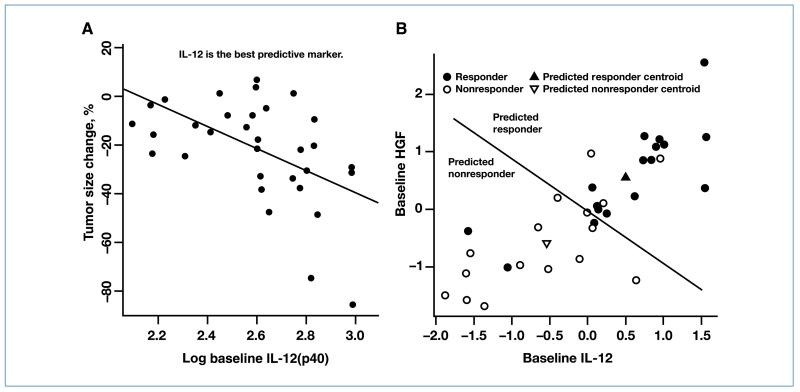
There is an unmet need for pharmacodynamic and predictive biomarkers for antiangiogenic agents. Recent studies have shown that soluble vascular endothelial growth factor receptor 2 (sVEGFR2), VEGF, and several other soluble factors may be modulated by VEGF pathway inhibitors. We conducted a broad profiling of cytokine and angiogenic factors (CAF) to investigate the relationship between baseline CAF levels, CAF changes during treatment, and tumor shrinkage in early-stage non-small cell lung cancer (NSCLC) patients treated with pazopanib, an oral angiogenesis inhibitor targeting VEGFR, platelet-derived growth factor receptor, and c-kit. Plasma samples were collected before treatment and on the last day of therapy from 33 patients with early-stage NSCLC participating in a single-arm phase II trial. Levels of 31 CAFs were measured by suspension bead multiplex assays or ELISA and correlated with change in tumor volume. Pazopanib therapy was associated with significant changes of eight CAFs; sVEGFR2 showed the largest decrease, whereas placental growth factor underwent the largest increase. Increases were also observed in stromal cell-derived factor-1alpha, IP-10, cutaneous T-cell-attracting chemokine, monokine induced by IFN-gamma, tumor necrosis factor-related apoptosis-inducing ligand, and IFN-alpha. Posttreatment changes in plasma sVEGFR2 and interleukin (IL)-4 significantly correlated with tumor shrinkage. Baseline levels of 11 CAFs significantly correlated with tumor shrinkage, with IL-12 showing the strongest association. Using multivariate classification, a baseline CAF signature consisting of hepatocyte growth factor and IL-12 was associated with tumor response to pazopanib and identified responding patients with 81% accuracy. These data suggest that CAF profiling may be useful for identifying patients likely to benefit from pazopanib, and merit further investigation in clinical trials.
针对抗血管生成药物,存在着对药效动力学和预测性生物标志物的未满足需求。最近的研究表明,可溶性血管内皮生长因子受体 2(sVEGFR2)、VEGF 和其他几种可溶性因子可能会受到 VEGF 通路抑制剂的调节。我们对细胞因子和血管生成因子(CAF)进行了广泛的分析,以研究基线 CAF 水平、治疗期间 CAF 的变化与接受口服血管生成抑制剂帕唑帕尼治疗的早期非小细胞肺癌(NSCLC)患者肿瘤缩小之间的关系。该抑制剂靶向 VEGFR、血小板衍生生长因子受体和 c-kit。从参加单臂 II 期试验的 33 例早期 NSCLC 患者中采集治疗前和治疗最后一天的血浆样本。通过悬浮珠多重分析或 ELISA 测量了 31 种 CAF 的水平,并与肿瘤体积的变化相关联。帕唑帕尼治疗与 8 种 CAF 的显著变化相关;sVEGFR2 下降最大,而胎盘生长因子增加最大。基质细胞衍生因子-1α、IP-10、皮肤 T 细胞趋化因子、IFN-γ诱导的单核细胞因子、肿瘤坏死因子相关凋亡诱导配体和 IFN-α也有增加。治疗后血浆 sVEGFR2 和白细胞介素(IL)-4 的变化与肿瘤缩小显著相关。11 种 CAF 的基线水平与肿瘤缩小显著相关,IL-12 相关性最强。使用多元分类,由肝细胞生长因子和 IL-12 组成的基线 CAF 特征与帕唑帕尼的肿瘤反应相关,并以 81%的准确率识别出有反应的患者。这些数据表明,CAF 分析可能有助于识别可能从帕唑帕尼中受益的患者,值得在临床试验中进一步研究。