Department of Ecology, Evolution, and Organismal Biology, Iowa State University, Ames, IA 50011, USA.
BMC Evol Biol. 2010 Mar 10;10:72. doi: 10.1186/1471-2148-10-72.
Parallel evolution can occur when common environmental factors exert similar selective forces on morphological variation in populations in different geographic localities. Competition can also generate morphological shifts, and if competing species co-occur in multiple geographic regions, then repeated instances of competitively-driven morphological divergence (character displacement) can occur. Despite the importance of character displacement for inferring the role of selection in morphological evolution however, replicated instances of sympatric morphological divergence are understudied.
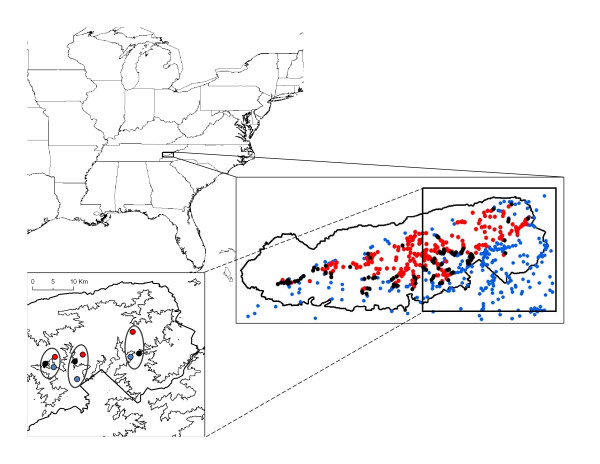
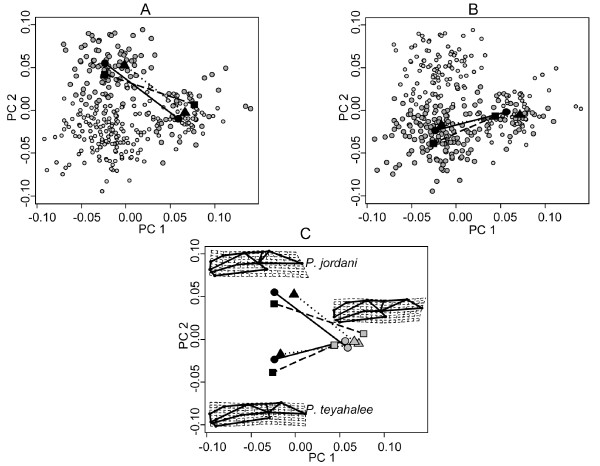
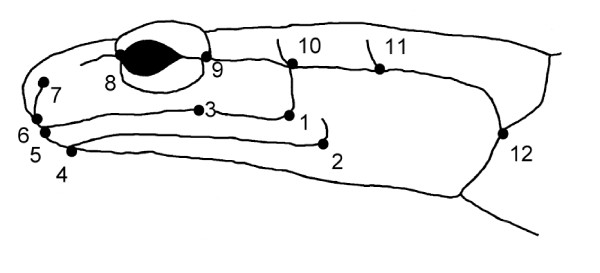
I tested the hypothesis that interspecific competition generated patterns of parallel morphological divergence in multiple geographic locations where two competing salamander species, Plethodon jordani and P. teyahalee, come into contact. I used geometric morphometrics to characterize head shape and found ecological character displacement in sympatric localities on each of three distinct mountains (geographic transects), where sympatric specimens displayed greater cranial differences and an increase in cranial robustness as compared to allopatric specimens. Using a recently developed analytical procedure, I also found that the observed morphological evolution within each species was consistent among transects; both in the total amount of morphological change as well as the direction of evolution in the morphological data space. This provided strong statistical evidence of parallel morphological evolution within species across replicate geographic transects.
The results presented here reveal that the morphological evolution of each species followed a common evolutionary path in each transect. Because dispersal between sympatric locations among transects is unlikely, these findings suggest that the repeated instances of character displacement have evolved in situ. They also suggest that selection from competitive interactions plays an important role in initiating sympatric morphological divergence in these species, and drives parallel sympatric morphological divergence between species.
当共同的环境因素对不同地理区域的种群形态变异施加相似的选择压力时,就会发生平行进化。竞争也可以产生形态变化,如果竞争物种在多个地理区域共存,那么就会发生多次竞争驱动的形态分歧(特征替代)。然而,尽管特征替代对于推断选择在形态进化中的作用很重要,但对同域形态分歧的重复实例研究较少。
我检验了这样一个假设,即种间竞争在两个竞争的蝾螈物种 Plethodon jordani 和 P. teyahalee 接触的多个地理区域产生了平行形态分歧的模式。我使用几何形态计量学来描述头部形状,并在三个不同山脉(地理横切)的每一个同域地点发现了生态特征替代,同域标本的头骨差异较大,头骨粗壮度增加,而与异域标本相比。使用最近开发的分析程序,我还发现每个物种内观察到的形态进化在横切之间是一致的;无论是在形态变化的总量上,还是在形态数据空间中的进化方向上。这为物种在重复的地理横切中平行的形态进化提供了强有力的统计证据。
这里呈现的结果表明,每个物种的形态进化在每个横切中都遵循一个共同的进化路径。由于横切之间同域地点之间的扩散不太可能,这些发现表明,特征替代的重复实例已经在原地进化。它们还表明,来自竞争相互作用的选择在这些物种中启动同域形态分歧,并驱动物种之间的平行同域形态分歧方面发挥了重要作用。