Department of Biological Sciences, University of Illinois, Chicago, IL 60607, USA.
Mol Biol Cell. 2010 May 1;21(9):1449-61. doi: 10.1091/mbc.e09-11-0927. Epub 2010 Mar 10.
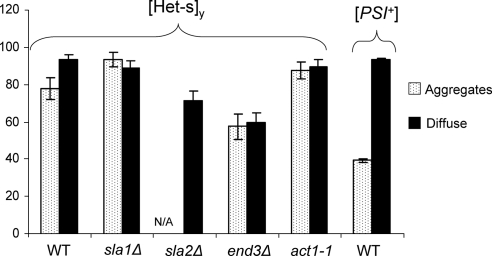
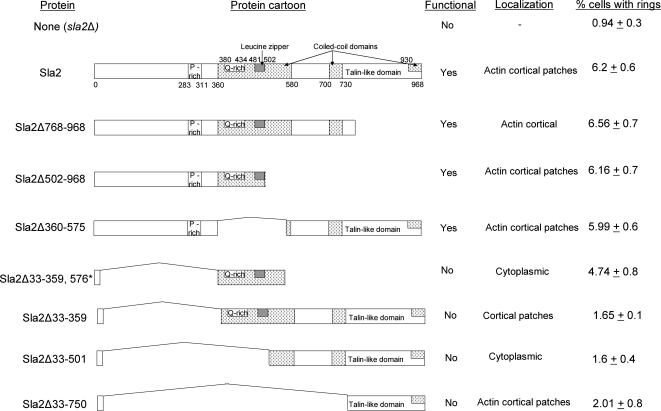
Various proteins, like the infectious yeast prions and the noninfectious human Huntingtin protein (with expanded polyQ), depend on a Gln or Asn (QN)-rich region for amyloid formation. Other prions, e.g., mammalian PrP and the [Het-s] prion of Podospora anserina, although still able to form infectious amyloid aggregates, do not have QN-rich regions. Furthermore, [Het-s] and yeast prions appear to differ dramatically in their amyloid conformation. Despite these differences, a fusion of the Het-s prion domain to GFP (Het-sPrD-GFP) can propagate in yeast as a prion called Het-s. We analyzed the properties of two divergent prions in yeast: Het-s and the native yeast prion [PSI(+)] (prion form of translational termination factor Sup35). Curiously, the induced appearance and transmission of [PSI(+)] and Het-s aggregates is remarkably similar. Overexpression of tagged prion protein (Sup35-GFP or Het-sPrD-GFP) in nonprion cells gives rise to peripheral, and later internal, ring/mesh-like aggregates. The cells with these ring-like aggregates give rise to daughters with one (perivacuolar) or two (perivacuolar and juxtanuclear) dot-like aggregates per cell. These line, ring, mesh, and dot aggregates are not really the transmissible prion species and should only be regarded as phenotypic markers of the presence of the prions. Both [PSI(+)] and Het-s first appear in daughters as numerous tiny dot-like aggregates, and both require the endocytic protein, Sla2, for ring formation, but not propagation.
各种蛋白质,如传染性酵母朊病毒和非传染性人类亨廷顿蛋白(带有扩展的 polyQ),依赖于富含 Gln 或 Asn(QN)的区域来形成淀粉样纤维。其他朊病毒,例如哺乳动物 PrP 和 Podospora anserina 的 [Het-s] 朊病毒,虽然仍然能够形成感染性淀粉样聚集物,但没有富含 QN 的区域。此外,[Het-s] 和酵母朊病毒在其淀粉样纤维构象上似乎有很大的不同。尽管存在这些差异,但将 [Het-s] 朊病毒结构域与 GFP 融合(Het-sPrD-GFP)可以在酵母中作为一种称为 Het-s 的朊病毒进行传播。我们分析了酵母中两种不同朊病毒的特性:Het-s 和天然酵母朊病毒 [PSI(+)](翻译终止因子 Sup35 的朊病毒形式)。奇怪的是,[PSI(+)] 和 Het-s 聚集物的诱导出现和传递非常相似。在非朊病毒细胞中过表达标记的朊病毒蛋白(Sup35-GFP 或 Het-sPrD-GFP)会导致周围的,后来是内部的环/网状样聚集物。带有这些环状聚集物的细胞会产生具有一个(液泡周围)或两个(液泡周围和核周)点状聚集物的子细胞。这些线状、环状、网状和点状聚集物不是真正可传播的朊病毒,只能被视为朊病毒存在的表型标记。[PSI(+)] 和 Het-s 最初都以大量微小点状聚集物的形式出现在子细胞中,两者都需要内吞蛋白 Sla2 形成环,但不需要其进行传播。