Vincentz M, Caboche M
Laboratoire de Biologie cellulaire, INRA, Centre de Versailles, France.
EMBO J. 1991 May;10(5):1027-35. doi: 10.1002/j.1460-2075.1991.tb08041.x.
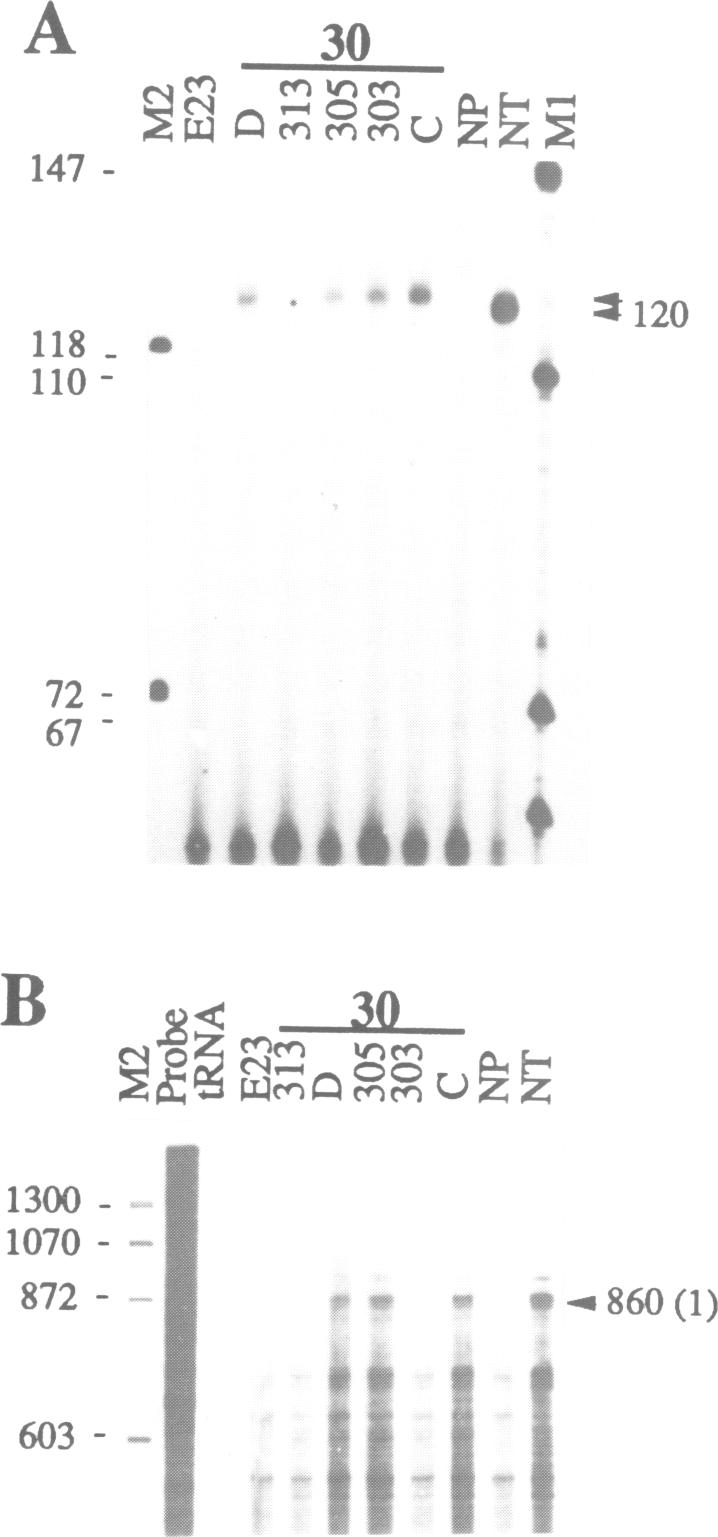
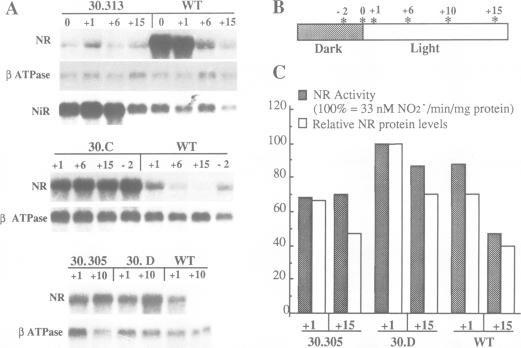
A nitrate reductase (NR) deficient mutant of Nicotiana plumbaginifolia totally impaired in the production of NR transcript and protein was restored for NR activity by transformation with a chimaeric NR gene. This gene was composed of a full-length tobacco NR cDNA fused to the CaMV 35S promoter and to termination signals from the tobacco NR gene. The transgenic plants we obtained were viable and fertile and expressed from one-fifth to three times the wild-type NR activity in their leaves. The analysis of chimeric NR gene expression in these plants showed, by comparison with wild-type plants, that the regulation of NR gene expression by light, nitrate and circadian rhythm takes place at the transcriptional level. However, unlike nitrate, light was required for the accumulation of NR protein in transgenic plants, suggesting that NR expression is also controlled at the translational and/or post-translational level.
用一个嵌合的硝酸还原酶(NR)基因转化完全丧失NR转录本和蛋白质产生能力的烟草(Nicotiana plumbaginifolia)NR缺陷突变体,可使其恢复NR活性。该基因由一个与CaMV 35S启动子融合并带有烟草NR基因终止信号的全长烟草NR cDNA组成。我们获得的转基因植株能够存活且可育,其叶片中表达的NR活性是野生型的五分之一到三倍。与野生型植株相比,对这些植株中嵌合NR基因表达的分析表明,光、硝酸盐和昼夜节律对NR基因表达的调控发生在转录水平。然而,与硝酸盐不同的是,光对于转基因植株中NR蛋白质的积累是必需的,这表明NR表达在翻译和/或翻译后水平也受到控制。