Hes Frederik J, Höppener Jo Wm, Luijt Rob B van der, Lips Cornelis Jm
Leiden University Medical Center, Center for Human and Clinical Genetics, Leiden.
Hered Cancer Clin Pract. 2005 Nov 15;3(4):171-8. doi: 10.1186/1897-4287-3-4-171.
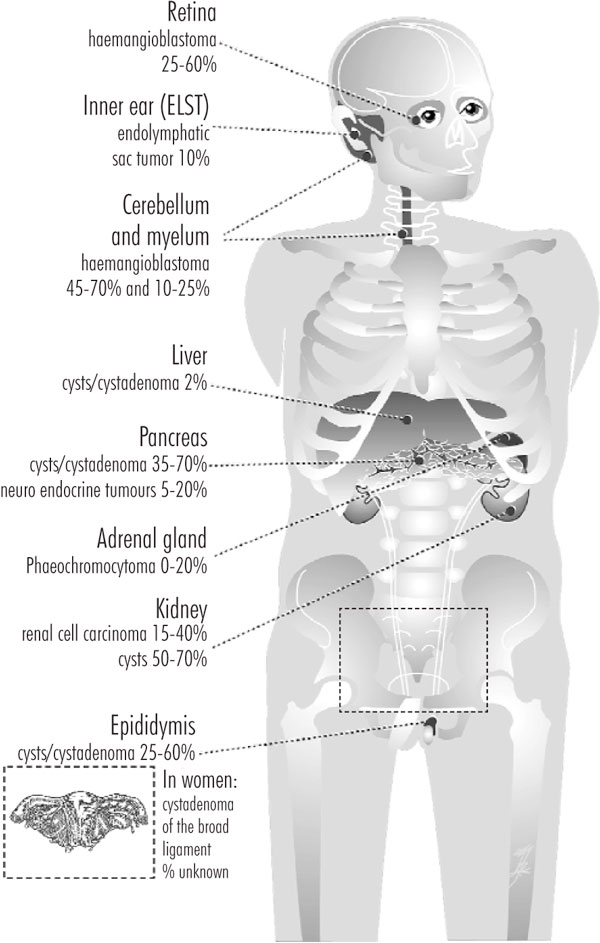
A germline mutation in the Von-Hippel Lindau (VHL) gene predisposes carriers to development of abundantly vascularised tumours in the retina, cerebellum, spine, kidney, adrenal gland and pancreas. Most VHL patients die from the consequences of cerebellar haemangioblastoma or renal cell carcinoma. The VHL gene is a tumour suppressor gene and is involved in angiogenesis by regulation of the activity of hypoxia-inducible factor 1-alpha (HIF1-alpha). Clinical diagnosis of VHL can be confirmed by molecular genetic analysis of the VHL gene, which is informative in virtually all VHL families. A patient with (suspicion for) VHL is an indication for genetic counselling and periodical examination.
冯-希佩尔-林道(VHL)基因的种系突变使携带者易患视网膜、小脑、脊柱、肾脏、肾上腺和胰腺中血管丰富的肿瘤。大多数VHL患者死于小脑成血管细胞瘤或肾细胞癌的后果。VHL基因是一种肿瘤抑制基因,通过调节缺氧诱导因子1-α(HIF1-α)的活性参与血管生成。VHL的临床诊断可通过对VHL基因的分子遗传学分析来证实,这在几乎所有VHL家族中都具有参考价值。疑似患有VHL的患者需要进行遗传咨询和定期检查。