Division of Surgical Science, Department of Surgery, Columbia University, 630 W 168th St, P&S 17-401, New York, NY 10032, USA.
Circ Res. 2010 Mar 19;106(5):842-53. doi: 10.1161/CIRCRESAHA.109.212217.
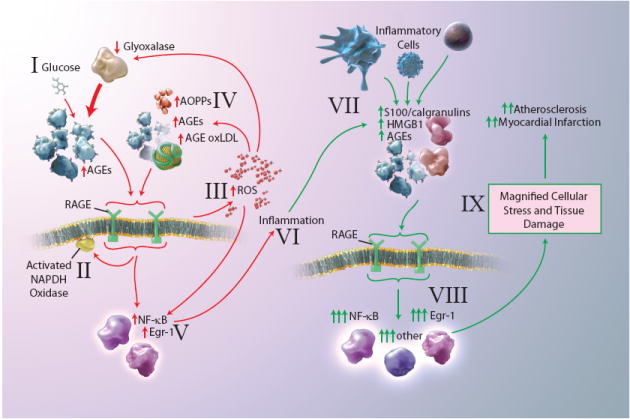
The immunoglobulin superfamily molecule RAGE (receptor for advanced glycation end product) transduces the effects of multiple ligands, including AGEs (advanced glycation end products), advanced oxidation protein products, S100/calgranulins, high-mobility group box-1, amyloid-beta peptide, and beta-sheet fibrils. In diabetes, hyperglycemia likely stimulates the initial burst of production of ligands that interact with RAGE and activate signaling mechanisms. Consequently, increased generation of proinflammatory and prothrombotic molecules and reactive oxygen species trigger further cycles of oxidative stress via RAGE, thus setting the stage for augmented damage to diabetic tissues in the face of further insults. Many of the ligand families of RAGE have been identified in atherosclerotic plaques and in the infarcted heart. Together with increased expression of RAGE in diabetic settings, we propose that release and accumulation of RAGE ligands contribute to exaggerated cellular damage. Stopping the vicious cycle of AGE-RAGE and RAGE axis signaling in the vulnerable heart and great vessels may be essential in controlling and preventing the consequences of diabetes.
免疫球蛋白超家族分子 RAGE(晚期糖基化终产物受体)转导多种配体的作用,包括 AGEs(晚期糖基化终产物)、高级氧化蛋白产物、S100/钙粒蛋白、高迁移率族盒-1、β-淀粉样肽和β-片层纤维。在糖尿病中,高血糖可能会刺激与 RAGE 相互作用并激活信号转导机制的配体的初始爆发。因此,促炎和促血栓形成分子以及活性氧的增加生成通过 RAGE 引发进一步的氧化应激循环,从而为面对进一步的损伤时糖尿病组织的增强损伤奠定基础。RAGE 的许多配体家族已在动脉粥样硬化斑块和梗死的心脏中被识别。与糖尿病环境中 RAGE 表达增加一起,我们提出 RAGE 配体的释放和积累有助于细胞损伤的加剧。在易受影响的心脏和大血管中停止 AGE-RAGE 和 RAGE 轴信号的恶性循环可能对于控制和预防糖尿病的后果至关重要。