Department of Clinical Laboratory, Nanfang Hospital, Southern Medical University, Guangzhou, PR China.
J Exp Clin Cancer Res. 2010 Mar 24;29(1):27. doi: 10.1186/1756-9966-29-27.
Circulating bone marrow-derived endothelial progenitor cells (EPCs) have been reported to participate in tumor angiogenesis and growth; however, the role of circulating EPCs in tumor progression is controversial. The role of circulating EPCs in ovarian cancer progression and angiogenesis has not yet been investigated.
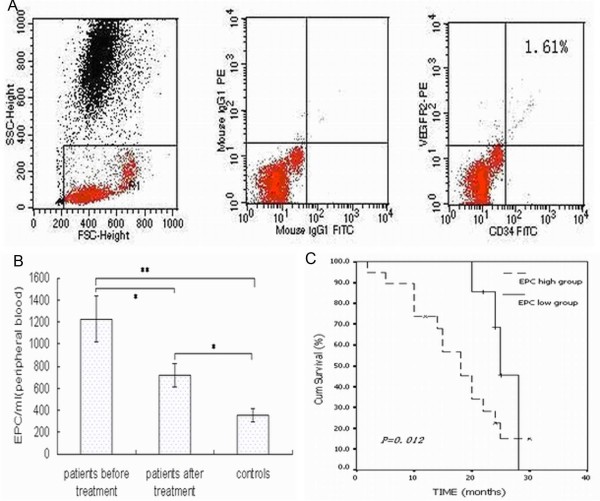
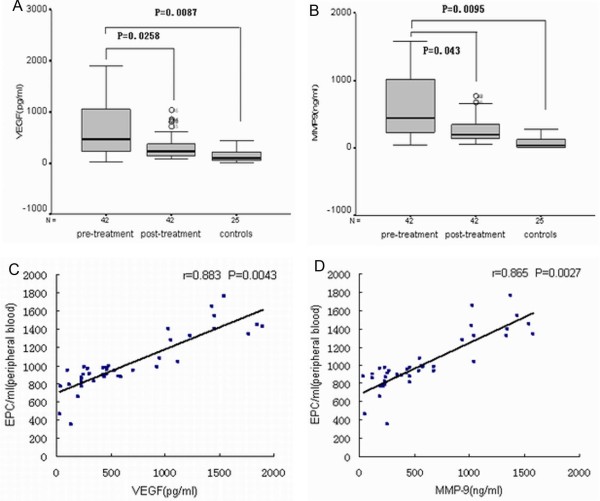
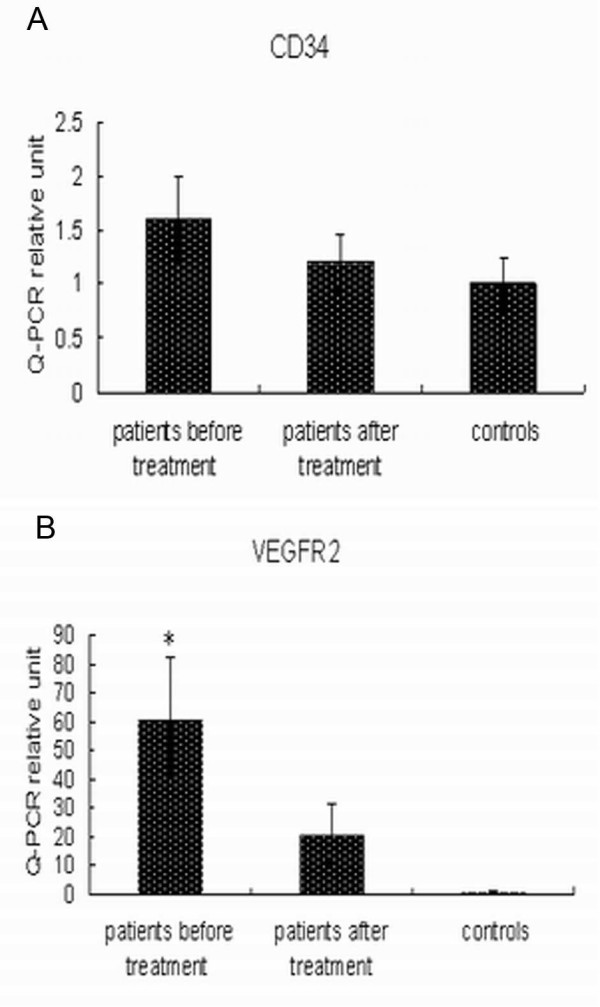
The number of circulating EPCs in the peripheral blood in 25 healthy volunteers and 42 patients with ovarian cancer was determined by flow cytometry. EPCs were defined by co-expression of CD34 and vascular endothelial growth factor receptor 2 (VEGFR2). In addition, we determined CD34 and VEGFR2 mRNA levels by real-time reverse transcription-polymerase chain reaction. Plasma levels of vascular endothelial growth factor (VEGF) and matrix metalloproteinase-9 (MMP-9) were determined by enzyme-linked immunosorbent assay.
Circulating levels of EPCs were significantly increased in ovarian cancer patients, correlating with tumor stage and residual tumor size. Higher levels of EPCs were detected in patients with stage III and IV ovarian cancer than in patients with stage I and II disease. After excision of the tumor, EPCs levels rapidly declined. Residual tumor size greater than 2 cm was associated with significantly higher levels of EPCs. In addition, high circulating EPCs correlated with poor overall survival. Pretreatment CD34 mRNA levels were not significantly increased in ovarian cancer patients compared with healthy controls; however, VEGFR2 expression was increased, and plasma levels of VEGF and MMP-9 were also elevated.
Our results demonstrate the clinical relevance of circulating EPCs in ovarian cancer. EPCs may be a potential biomarker to monitor ovarian cancer progression and angiogenesis and treatment response.
循环骨髓来源的内皮祖细胞 (EPCs) 已被报道参与肿瘤血管生成和生长;然而,循环 EPCs 在肿瘤进展中的作用仍存在争议。循环 EPCs 在卵巢癌进展和血管生成中的作用尚未得到研究。
通过流式细胞术测定 25 名健康志愿者和 42 名卵巢癌患者外周血中循环 EPC 的数量。EPC 通过 CD34 和血管内皮生长因子受体 2 (VEGFR2) 的共表达来定义。此外,我们通过实时逆转录-聚合酶链反应测定 CD34 和 VEGFR2 mRNA 水平。通过酶联免疫吸附试验测定血管内皮生长因子 (VEGF) 和基质金属蛋白酶-9 (MMP-9) 的血浆水平。
卵巢癌患者循环 EPCs 水平显著升高,与肿瘤分期和残留肿瘤大小相关。III 期和 IV 期卵巢癌患者的 EPCs 水平高于 I 期和 II 期疾病患者。肿瘤切除后,EPCs 水平迅速下降。残留肿瘤大小大于 2cm 与 EPCs 水平显著升高相关。此外,高循环 EPCs 与总生存期较差相关。与健康对照组相比,卵巢癌患者的预处理 CD34 mRNA 水平没有显著升高;然而,VEGFR2 表达增加,VEGF 和 MMP-9 的血浆水平也升高。
我们的结果表明循环 EPCs 在卵巢癌中的临床相关性。EPCs 可能是监测卵巢癌进展和血管生成以及治疗反应的潜在生物标志物。