Endocrinology Unit, Centre for Cardiovascular Science, Queen's Medical Research Institute, University of Edinburgh, 47 Little France Crescent, Edinburgh EH16 4TJ, UK.
J Hepatol. 2010 May;52(5):705-11. doi: 10.1016/j.jhep.2009.10.037. Epub 2010 Mar 4.
BACKGROUND & AIMS: Suppression of the hypothalamic-pituitary-adrenal axis occurs in cirrhosis and cholestasis and is associated with increased concentrations of bile acids. We investigated whether this was mediated through bile acids acting to impair steroid clearance by inhibiting glucocorticoid metabolism by 5beta-reductase.
The effect of bile acids on glucocorticoid metabolism was studied in vitro in hepatic subcellular fractions and hepatoma cells, allowing quantitation of the kinetics and transcript abundance of 5beta-reductase. Metabolism was subsequently examined in vivo in rats following dietary manipulation or bile duct ligation. Finally, glucocorticoid metabolism was assessed in humans with obstructive jaundice.
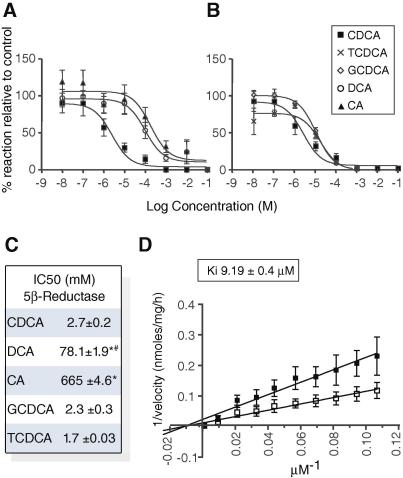
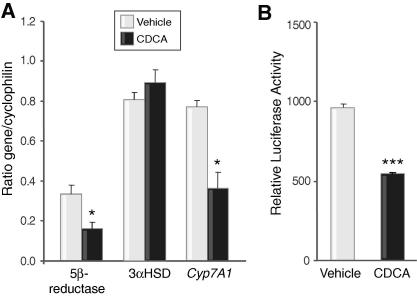
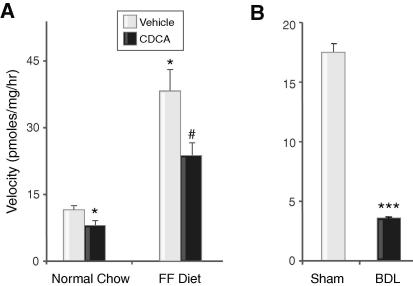
In rat hepatic cytosol, chenodeoxycholic acid competitively inhibited 5beta-reductase (K(i) 9.19+/-0.40 microM) and reduced its transcript abundance (in H4iiE cells) and promoter activity (reporter system, HepG2 cells). In Wistar rats, dietary chenodeoxycholic acid (1% w/w chow) inhibited hepatic 5beta-reductase activity, reduced urinary excretion of 3alpha,5beta-tetrahydrocorticosterone and reduced adrenal weight. Conversely, a fat-free diet suppressed bile acid levels and increased hepatic 5beta-reductase activity, supplementation of the fat-free diet with CDCA reduced 5beta-reductase activity, and urinary 3alpha,5beta-reduced corticosterone. Cholestasis in rats suppressed hepatic 5beta-reductase activity and transcript abundance. In eight women with obstructive jaundice, relative urinary excretion of 3alpha,5beta-tetrahydrocortisol was significantly lower than in healthy controls.
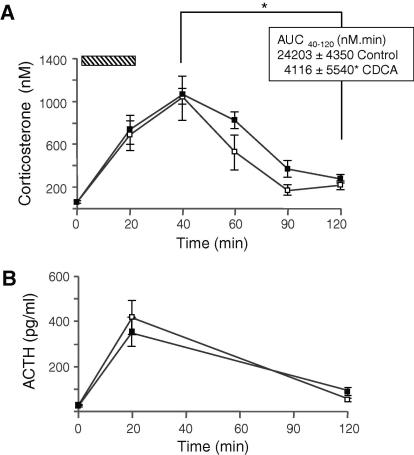
These data suggest a novel role for bile acids in inhibiting hepatic glucocorticoid clearance, of sufficient magnitude to suppress hypothalamic-pituitary-adrenal axis activity. Elevated hepatic bile acids may account for adrenal insufficiency in liver disease.
在肝硬化和胆汁淤积中,下丘脑-垂体-肾上腺轴受到抑制,并且与胆汁酸浓度升高有关。我们研究了这种情况是否是通过胆汁酸作用于通过 5β-还原酶抑制糖皮质激素代谢来损害类固醇清除来介导的。
在肝亚细胞部分和肝癌细胞中进行了体外研究,以研究胆汁酸对糖皮质激素代谢的影响,从而可以定量研究 5β-还原酶的动力学和转录丰度。随后在大鼠中通过饮食操作或胆管结扎检查了体内的代谢情况。最后,在患有阻塞性黄疸的患者中评估了糖皮质激素的代谢。
在大鼠肝胞质溶胶中,鹅脱氧胆酸竞争性地抑制 5β-还原酶(K(i)9.19+/-0.40 microM)并降低其转录丰度(在 H4iiE 细胞中)和启动子活性(报告系统,HepG2 细胞)。在 Wistar 大鼠中,饮食中鹅脱氧胆酸(1%w / w 饲料)抑制了肝 5β-还原酶活性,减少了 3α,5β-四氢皮质酮的尿排泄并减轻了肾上腺的重量。相反,低脂饮食会降低胆汁酸水平并增加肝 5β-还原酶活性,低脂饮食中补充 CDCA 会降低 5β-还原酶活性,并减少尿 3α,5β-还原皮质酮。大鼠的胆汁淤积抑制了肝 5β-还原酶活性和转录丰度。在 8 名患有阻塞性黄疸的妇女中,3α,5β-四氢皮质醇的相对尿排泄量明显低于健康对照组。
这些数据表明胆汁酸在抑制肝内糖皮质激素清除方面具有新的作用,其作用足以抑制下丘脑-垂体-肾上腺轴的活性。升高的肝胆汁酸可能是肝病中肾上腺功能不全的原因。