Department of Human Resources for Health, WHO, Geneva.
Hum Resour Health. 2010 Mar 30;8:7. doi: 10.1186/1478-4491-8-7.
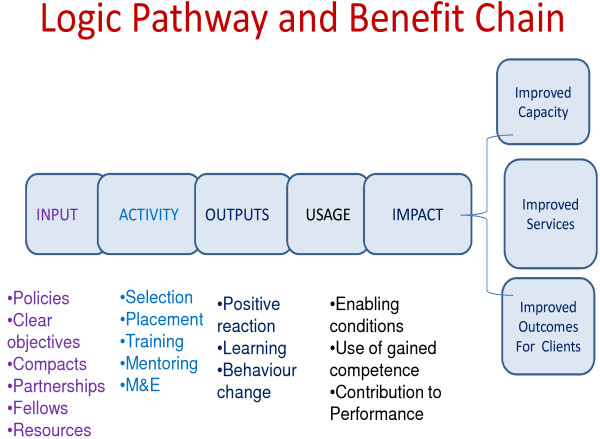
The United Nations (UN) System's agencies have been criticized for not adequately assessing the impact of their training and fellowship programmes. Critics point out that beyond documentation of the number of fellows that underwent training, and their immediate reaction to the experience, it is necessary to ascertain that fellows are using what they have learned, and most importantly that their institution and country are benefiting from the significant investments made in the fellowship programmes.This paper presents an evaluation framework that was adopted by the 17th Meeting of the UN System Senior Fellowship Officers convened in London in 2008 in response to this challenge. It is arranged in three sections. First, the assumptions and constraints concerning impact evaluation of training are presented. Second, a framework for evaluating the impact of training in the context of UN System programmes is proposed. Third, necessary conditions and supportive measures to enable implementation of the impact evaluation framework are identified.The critical message emerging from this review is the importance of constructing a 'performance story' based on key milestones associated with the design and implementation of fellowship programmes as a way of assessing the contribution of different components of the fellowship programmes to institutional outcomes.
联合国(UN)系统各机构因未能充分评估其培训和研究金计划的影响而受到批评。批评者指出,除了记录接受培训的研究金获得者人数及其对该经历的直接反应外,有必要确定研究金获得者是否正在利用所学知识,最重要的是,其所在机构和国家是否从研究金计划中获得了大量投资所带来的益处。本文介绍了 2008 年在伦敦举行的第 17 次联合国系统高级研究金干事会议为应对这一挑战而通过的评估框架。该框架分为三个部分。第一,介绍了培训影响评估的假设和限制条件。第二,提出了在联合国系统方案背景下评估培训影响的框架。第三,确定了实施影响评估框架所需的必要条件和支持措施。从这次审查中得出的关键信息是,根据与研究金方案设计和实施相关的关键里程碑构建“绩效故事”的重要性,这是评估研究金方案不同组成部分对机构成果的贡献的一种方式。