Department of Epidemiology University of Michigan, Ann Arbor, MI 48109, USA.
BMC Immunol. 2010 Mar 30;11:18. doi: 10.1186/1471-2172-11-18.
The Mtb72f subunit vaccine for tuberculosis, currently in clinical trials, is hoped to provide improved protection compared to the current BCG vaccine. It is not clear, however, whether Mtb72f would be equally protective in the different human populations suffering from a high burden of tuberculosis. Previous work by Hebert and colleagues demonstrated that the PPE18 protein of Mtb72f had significant variability in a sample of clinical M. tuberculosis isolates. However, whether this variation might impact the efficacy of Mtb72f in the context of the microbial and host immune system interactions remained to be determined. The present study assesses Mtb72f's predicted efficacy in people with different DRB1 genotypes to predict whether the vaccine will protect against diverse clinical strains of M. tuberculosis in a diverse host population.
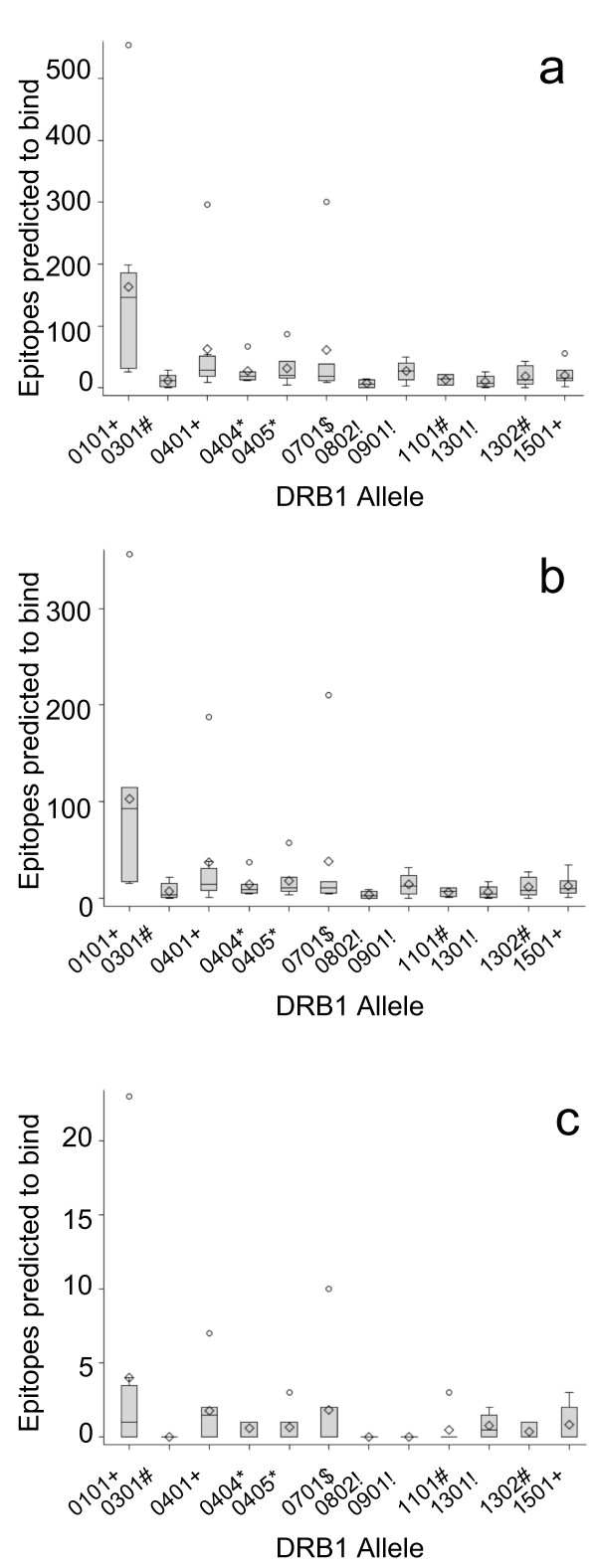
We evaluated the binding of epitopes in the vaccine to different alleles of the human DRB1 Class II MHC protein using freely available epitope prediction programs and compared protein sequences from clinical isolates to the sequences included in the Mtb72f vaccine. This analysis predicted that the Mtb72f vaccine would be less effective for several DRB1 genotypes, due either to limited vaccine epitope binding to the DRB1 proteins or to binding primarily by unconserved PPE18 epitopes. Furthermore, we found that these less-protective DRB1 alleles are found at a very high frequency in several populations with a high burden of tuberculosis.
Although the Mtb72f vaccine candidate has shown promise in animal and clinical trials thus far, it may not be optimally effective in some genotypic backgrounds. Due to variation in both M. tuberculosis protein sequences and epitope-binding capabilities of different HLA alleles, certain human populations with a high burden of tuberculosis may not be optimally protected by the Mtb72f vaccine. The efficacy of the Mtb72f vaccine should be further examined in these particular populations to determine whether additional protective measures might be necessary for these regions.
目前正在临床试验中的结核分枝杆菌 Mtb72f 亚单位疫苗有望提供比目前的卡介苗疫苗更好的保护效果。然而,目前尚不清楚 Mtb72f 在患有高负担结核病的不同人群中是否同样具有保护作用。Hebert 及其同事的先前研究表明,Mtb72f 的 PPE18 蛋白在一组临床结核分枝杆菌分离株中存在显著的变异性。然而,这种变异性是否会影响 Mtb72f 在微生物和宿主免疫系统相互作用背景下的功效仍有待确定。本研究评估了 Mtb72f 在不同 DRB1 基因型人群中的预测功效,以预测该疫苗是否能在不同宿主人群中对多样化的临床结核分枝杆菌菌株提供保护。
我们使用免费的表位预测程序评估了疫苗中表位与人类 DRB1 类 II MHC 蛋白的不同等位基因的结合情况,并将临床分离株的蛋白序列与 Mtb72f 疫苗中的序列进行了比较。这项分析预测,由于疫苗表位与 DRB1 蛋白结合的有限性或主要通过非保守的 PPE18 表位结合,Mtb72f 疫苗对几种 DRB1 基因型的效果会降低。此外,我们发现这些保护作用较低的 DRB1 等位基因在一些结核病负担高的人群中频率非常高。
尽管 Mtb72f 疫苗候选物迄今为止在动物和临床试验中表现出了前景,但在某些基因型背景下可能无法达到最佳效果。由于结核分枝杆菌蛋白序列和不同 HLA 等位基因的表位结合能力存在差异,某些结核病负担高的人群可能无法被 Mtb72f 疫苗得到最佳保护。需要在这些特定人群中进一步研究 Mtb72f 疫苗的功效,以确定这些地区是否需要额外的保护措施。