Research Institute MOVE, Faculty of Human Movement Sciences, VU University Amsterdam, Van der Boechorststraat 9, NL-1081 BT, Amsterdam, The Netherlands.
Ann Biomed Eng. 2010 Aug;38(8):2588-93. doi: 10.1007/s10439-010-0018-2. Epub 2010 Mar 31.
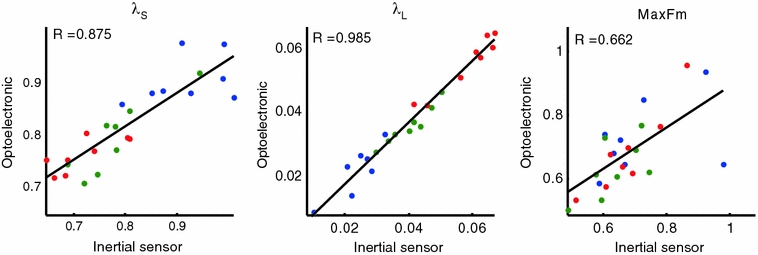
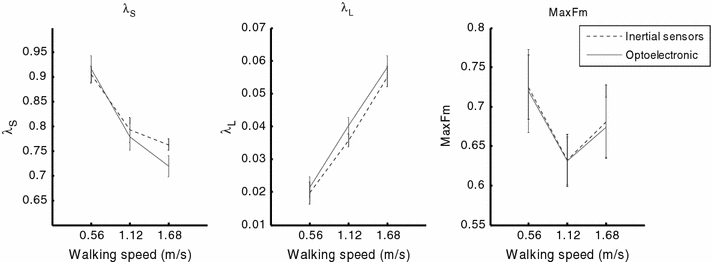
Recently, two methods for quantifying the stability of a dynamical system have been applied to human locomotion: local stability (quantified by finite time maximum Lyapunov exponents, lambda(s) and lambda(L)) and orbital stability (quantified by maximum Floquet multipliers, MaxFm). In most studies published to date, data from optoelectronic measurement systems were used to calculate these measures. However, using wireless inertial sensors may be more practical as they are easier to use, also in ambulatory applications. While inertial sensors have been employed in some studies, it is unknown whether they lead to similar stability estimates as obtained with optoelectronic measurement systems. In the present study, we compared stability measures of human walking estimated from an optoelectronic measurement system with those calculated from an inertial sensor measurement system. Subjects walked on a treadmill at three different speeds while kinematics were recorded using both measurement systems. From the angular velocities and linear accelerations, lambda(s), lambda(L), and MaxFm were calculated. Both measurement systems showed the same effects of walking speed for all variables. Estimates from both measurement systems correlated high for lambda(s) and lambda(L,) (R > 0.85) but less strongly for MaxFm (R = 0.66). These results indicate that inertial sensors constitute a valid alternative for an optoelectronic measurement system when assessing dynamic stability in human locomotion, and may thus be used instead, which paves the way to studying gait stability during natural, everyday walking.
最近,有两种方法被应用于量化动力学系统的稳定性,分别是局部稳定性(通过有限时间最大 Lyapunov 指数 lambda(s) 和 lambda(L) 来量化)和轨道稳定性(通过最大 Floquet 乘数 MaxFm 来量化)。在迄今为止发表的大多数研究中,使用光电测量系统的数据来计算这些指标。然而,使用无线惯性传感器可能更为实用,因为它们更容易使用,也适用于日常活动。虽然在一些研究中已经使用了惯性传感器,但尚不清楚它们是否会导致与光电测量系统获得的相似的稳定性估计。在本研究中,我们比较了使用光电测量系统和惯性传感器测量系统估计的人体行走稳定性指标。受试者在跑步机上以三种不同的速度行走,同时使用两种测量系统记录运动学数据。从角速度和线性加速度中,计算出 lambda(s)、lambda(L) 和 MaxFm。两种测量系统对于所有变量的速度效应都显示出相同的效果。来自两种测量系统的估计对于 lambda(s) 和 lambda(L) 具有高度相关性(R > 0.85),但对于 MaxFm 的相关性较弱(R = 0.66)。这些结果表明,在评估人体运动中的动态稳定性时,惯性传感器是光电测量系统的有效替代方案,因此可以替代使用,这为研究自然日常行走中的步态稳定性铺平了道路。