Department of Neurology, School of Medicine, University of California, Davis, USA.
Neurobiol Aging. 2012 Jan;33(1):83-95. doi: 10.1016/j.neurobiolaging.2010.01.021. Epub 2010 Apr 1.
Trajectories of cognitive decline among elderly individuals are heterogeneous, and markers that have high reliability for predicting cognitive trajectories across a broad spectrum of the elderly population have yet to be identified.
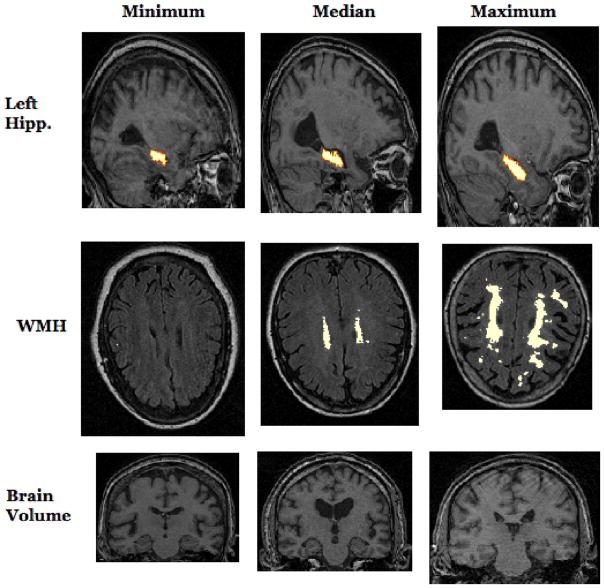
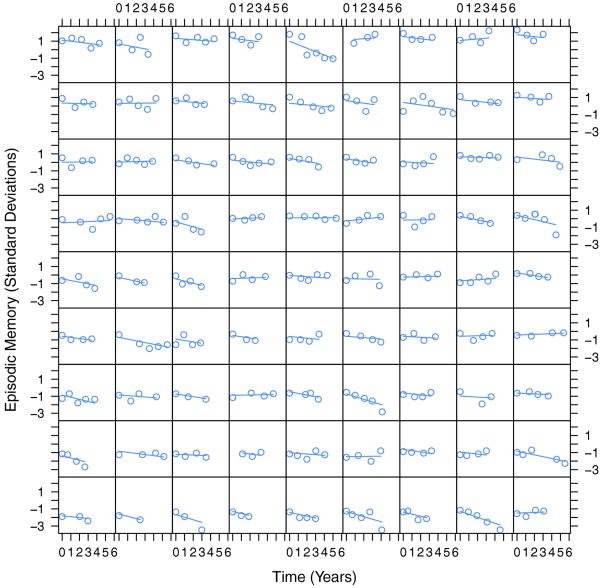
This study examined the utility of a variety of MRI-based brain measures, obtained at baseline, as predictors of subsequent declines in domain-specific measures of cognitive function in a cohort of 307 community-dwelling elderly individuals with varying degrees of cognitive impairment who were diverse across several relevant demographic variables and were evaluated yearly. Psychometrically matched measures of cognition were used to assess episodic memory, semantic memory, and executive function. Relationships between baseline MRI measures, including the volumes of the brain, hippocampus, and white matter hyperintensities (WMH), and cognitive trajectories were assessed in mixed effects regression models that modeled MRI effects on cognitive performance at baseline and rate of change as well as interindividual variability in cognitive baseline and rate of change.
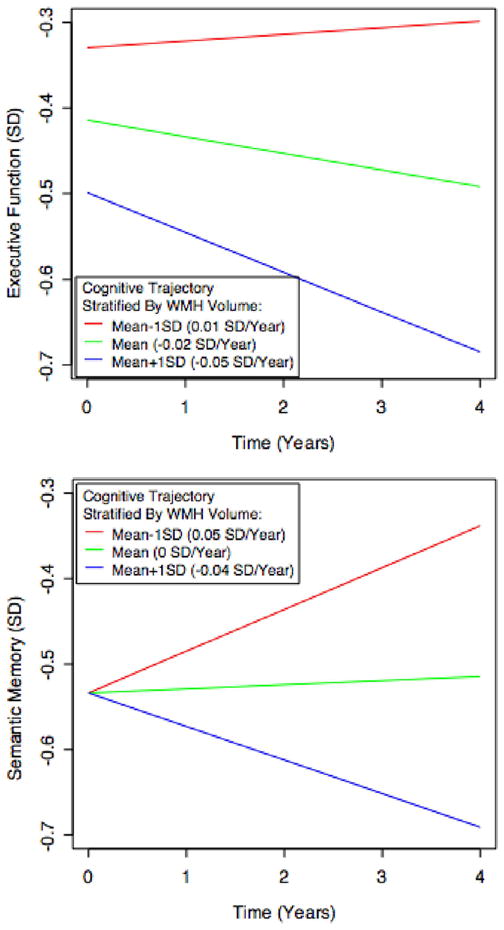
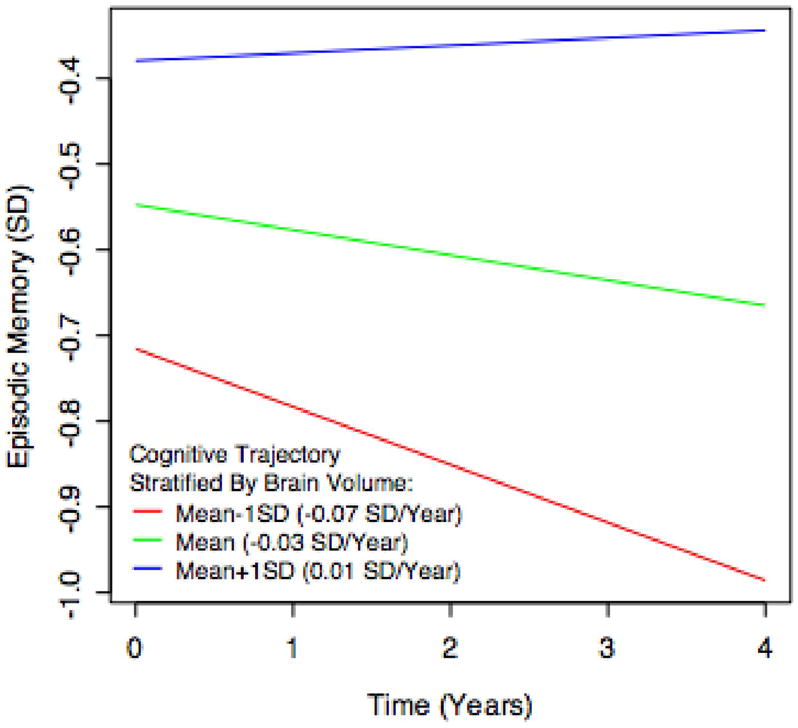
Greater baseline brain volume predicted slower subsequent rate of decline in episodic memory and smaller WMH volume predicted slower subsequent rate of decline in executive function and semantic memory. Baseline hippocampal volume, while strongly related to baseline cognitive function, was not predictive of subsequent change in any of the cognitive domains.
Baseline measures of brain structure and tissue pathology predicted rate of cognitive decline in a diverse and carefully characterized cohort, suggesting that they may provide summary measures of pre-existing neuropathological damage or the capacity of the brain to compensate for the impact of subsequent neuropathology on cognition. Conventional MRI measures may have use for predicting cognitive outcomes in highly heterogeneous elderly populations.
老年人认知能力下降的轨迹存在异质性,尚未确定具有广泛老年人群体预测认知轨迹的高可靠性标志物。
本研究在认知功能障碍程度不同的 307 名社区居住的老年人队列中,检查了各种基线 MRI 脑测量值作为预测随后特定领域认知功能下降的指标的效用,这些老年人在多个相关人口统计学变量上存在差异,并每年进行评估。使用心理测量匹配的认知测量来评估情景记忆、语义记忆和执行功能。使用混合效应回归模型评估基线 MRI 测量值(包括大脑、海马体和白质高信号(WMH)的体积)与认知轨迹之间的关系,该模型对基线和变化率的 MRI 对认知表现的影响以及认知基线和变化率的个体间变异性进行建模。
更大的基线大脑体积预测情景记忆的后续下降速度较慢,而更大的 WMH 体积预测执行功能和语义记忆的后续下降速度较慢。虽然基线海马体体积与基线认知功能密切相关,但不能预测任何认知领域的后续变化。
大脑结构和组织病理学的基线测量值可预测不同且经过精心描述的队列的认知下降速度,这表明它们可能提供预先存在的神经病理学损伤或大脑补偿随后神经病理学对认知影响的能力的综合测量值。常规 MRI 测量值可能可用于预测高度异质的老年人群的认知结果。