Niyazi Maximilian, Caversaccio Marco-Domenico, Dubach Patrick, Geretschläger Andreas, Arnold Andreas, Belka Claus, Aebersold Daniel M, Blumstein Norbert M
Department of Radiation Oncology, Ludwig-Maximilians-University München, Marchioninistr. 15, 81377 München, Germany.
Case Rep Med. 2010;2010:321835. doi: 10.1155/2010/321835. Epub 2010 Mar 28.
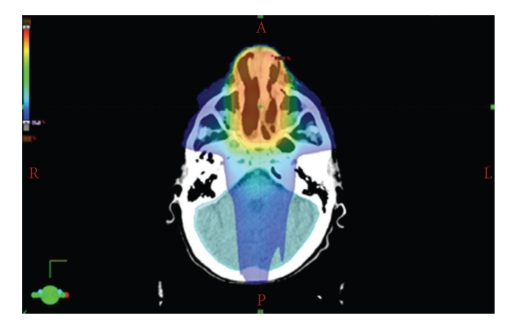
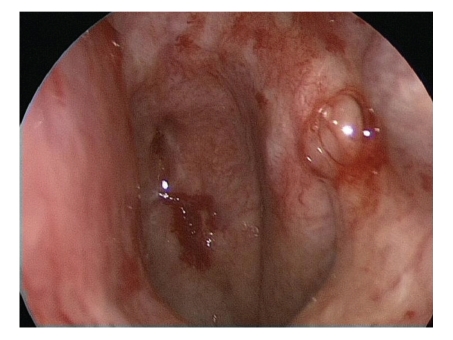
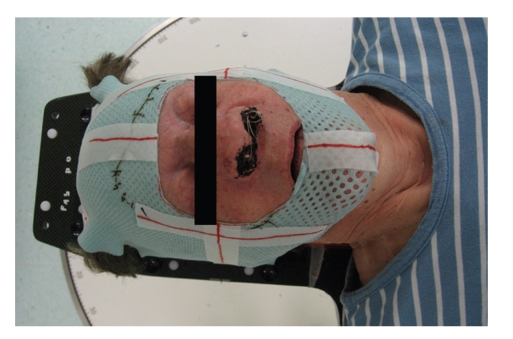
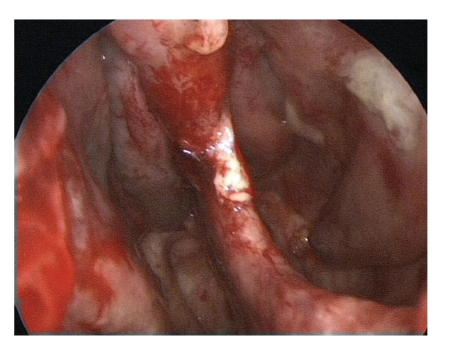
We present a case of a Rendu-Osler-Weber disease patient with recurrent life threatening epistaxis demanding multiple blood transfusions despite of repetitive endoscopic laser and electrocoagulations, endovascular embolisation, septodermoplasty, and long-term intranasal dressings. As alternative treatment modalities repeatedly failed and the patient became almost permanently dependent on nasal dressing, we performed a highly conformal intensity-modulated radiotherapy of the nasal cavity; a total dose of 50 Gy in 2 Gy single fractions was applied. The therapy was very well tolerated, no acute toxicities occurred. Two weeks after the last radiation dose had been applied, the nasal dressing could be removed without problems. Endoscopical control revealed an almost avascular white mucosa without any trace of bleeding spots; previously existing hemangiomas and crusts had disappeared. After a 1-year-follow up, the patient had no significant recurrent epistaxis.
我们报告一例患有遗传性出血性毛细血管扩张症(Rendu-Osler-Weber病)的患者,该患者反复发生危及生命的鼻出血,尽管多次接受内镜激光和电凝治疗、血管内栓塞、鼻中隔成形术以及长期鼻腔填塞,但仍需多次输血。由于其他治疗方式反复失败,且患者几乎永久性依赖鼻腔填塞,我们对鼻腔进行了高剂量适形调强放疗;单次分割剂量为2Gy,总剂量为50Gy。该治疗耐受性良好,未出现急性毒性反应。在最后一次放疗剂量施用两周后,鼻腔填塞物可顺利取出。内镜检查显示黏膜几乎无血管,呈白色,无任何出血点痕迹;先前存在的血管瘤和痂皮已消失。经过1年的随访,患者无明显复发性鼻出血。