Barrow Neurological Institute and St. Joseph's Hospital & Medical Center, Phoenix, Arizona 85013, USA.
J Neurochem. 2010 Jul;114(1):130-41. doi: 10.1111/j.1471-4159.2010.06728.x. Epub 2010 Apr 2.
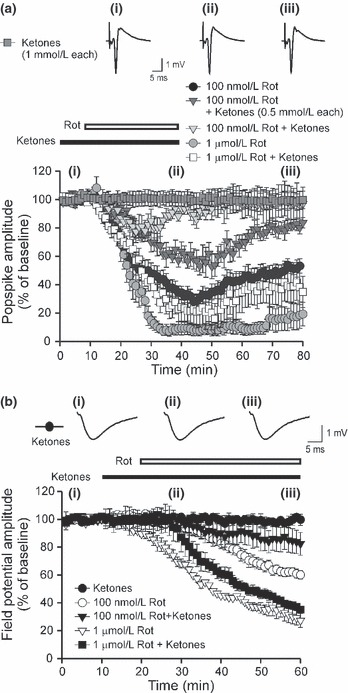
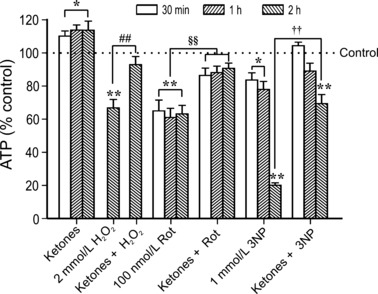
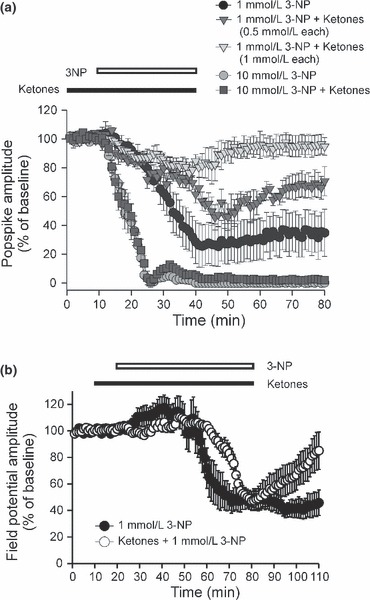
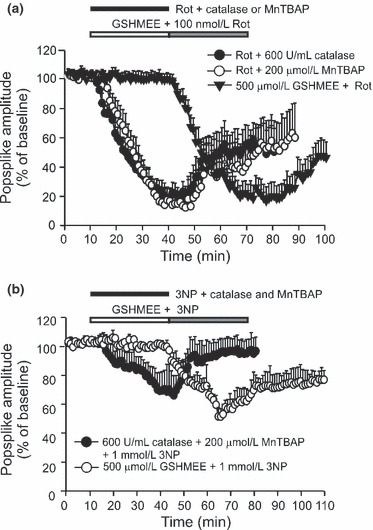
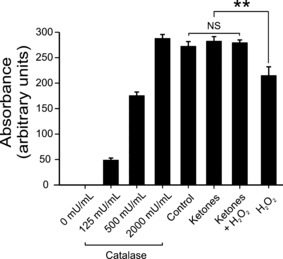
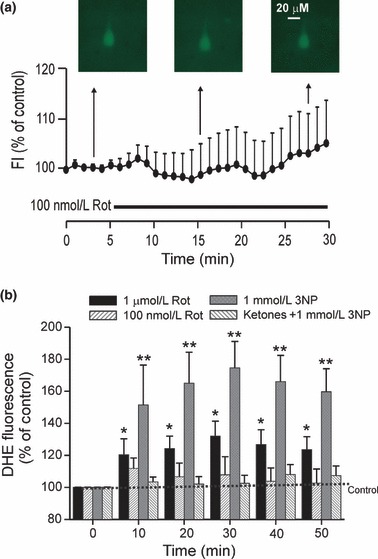
Ketones have previously shown beneficial effects in models of neurodegenerative disorders, particularly against associated mitochondrial dysfunction and cognitive impairment. However, evidence of a synaptic protective effect of ketones remains lacking. We tested the effects of ketones on synaptic impairment induced by mitochondrial respiratory complex (MRC) inhibitors using electrophysiological, reactive oxygen species (ROS) imaging and biochemical techniques. MRC inhibitors dose-dependently suppressed both population spike (PS) and field potential amplitudes in the CA1 hippocampus. Pre-treatment with ketones strongly prevented changes in the PS, whereas partial protection was seen in the field potential. Rotenone (Rot; 100 nmol/L), a MRC I inhibitor, suppressed synaptic function without altering ROS levels and PS depression by Rot was unaffected by antioxidants. In contrast, antioxidant-induced PS recovery against the MRC II inhibitor 3-nitropropionic acid (3-NP; 1 mmol/L) was similar to the synaptic protective effects of ketones. Ketones also suppressed ROS generation induced by 3-NP. Finally, ketones reversed the decreases in ATP levels caused by Rot and 3-NP. In summary, our data demonstrate that ketones can preserve synaptic function in CA1 hippocampus induced by MRC dysfunction, likely through an antioxidant action and enhanced ATP generation.
酮体先前已显示出在神经退行性疾病模型中具有有益作用,特别是针对相关的线粒体功能障碍和认知障碍。然而,酮体对突触的保护作用的证据仍然缺乏。我们使用电生理、活性氧(ROS)成像和生化技术测试了酮体对线粒体呼吸复合物(MRC)抑制剂引起的突触损伤的影响。MRC 抑制剂呈剂量依赖性抑制 CA1 海马区的群体峰(PS)和场电位幅度。酮体预处理强烈阻止 PS 的变化,而在场电位中则观察到部分保护。MRC I 抑制剂鱼藤酮(Rot;100nmol/L)抑制突触功能而不改变 ROS 水平,并且抗氧化剂对 Rot 引起的 PS 抑制没有影响。相比之下,抗氧化剂诱导的 3-硝基丙酸(3-NP;1mmol/L)MRC II 抑制剂引起的 PS 恢复与酮体的突触保护作用相似。酮体还抑制了 3-NP 诱导的 ROS 生成。最后,酮体逆转了 Rot 和 3-NP 引起的 ATP 水平下降。总之,我们的数据表明,酮体可以通过抗氧化作用和增强的 ATP 生成来维持 MRC 功能障碍引起的 CA1 海马区的突触功能。