CIRAD, UR Multiplication Végétative, Av, Agropolis, 34398 Montpellier Cedex 5, France.
BMC Plant Biol. 2010 Apr 13;10:65. doi: 10.1186/1471-2229-10-65.
The genus Musa is a large species complex which includes cultivars at diploid and triploid levels. These sterile and vegetatively propagated cultivars are based on the A genome from Musa acuminata, exclusively for sweet bananas such as Cavendish, or associated with the B genome (Musa balbisiana) in cooking bananas such as Plantain varieties. In M. acuminata cultivars, structural heterozygosity is thought to be one of the main causes of sterility, which is essential for obtaining seedless fruits but hampers breeding. Only partial genetic maps are presently available due to chromosomal rearrangements within the parents of the mapping populations. This causes large segregation distortions inducing pseudo-linkages and difficulties in ordering markers in the linkage groups. The present study aims at producing a saturated linkage map of M. acuminata, taking into account hypotheses on the structural heterozygosity of the parents.
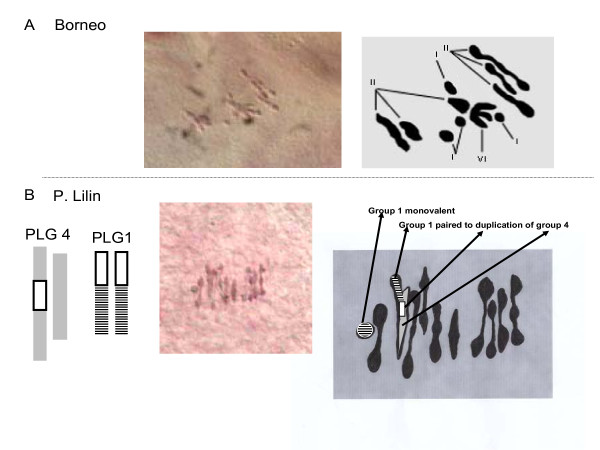
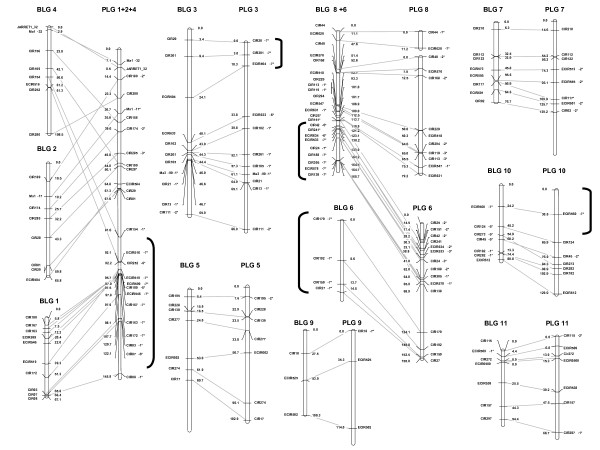
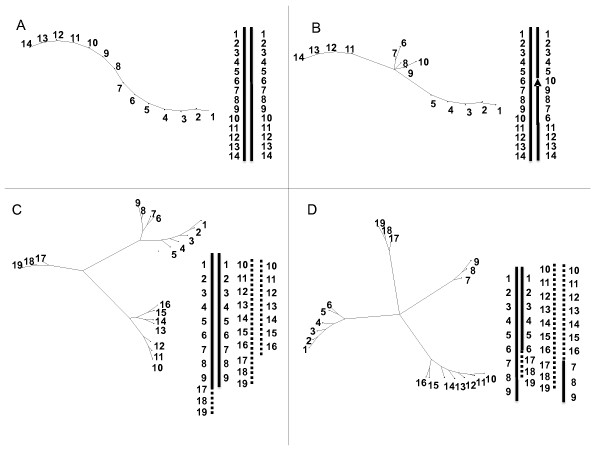
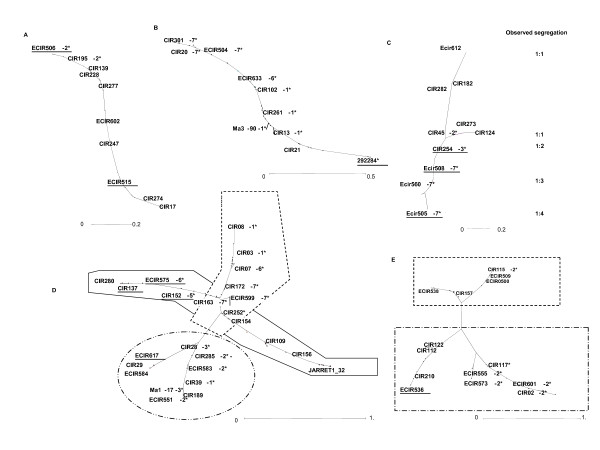
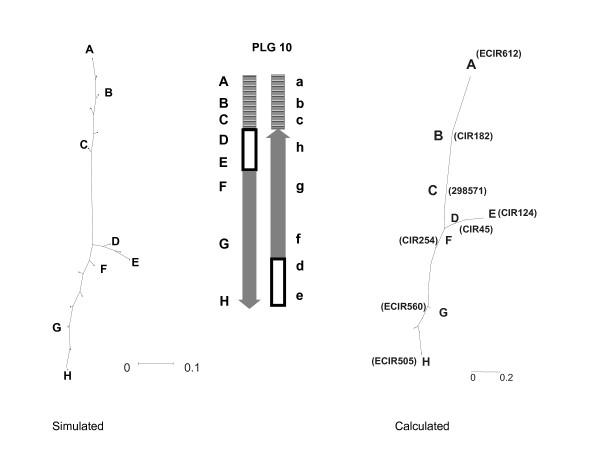
An F1 progeny of 180 individuals was obtained from a cross between two genetically distant accessions of M. acuminata, 'Borneo' and 'Pisang Lilin' (P. Lilin). Based on the gametic recombination of each parent, two parental maps composed of SSR and DArT markers were established. A significant proportion of the markers (21.7%) deviated (p < 0.05) from the expected Mendelian ratios. These skewed markers were distributed in different linkage groups for each parent. To solve some complex ordering of the markers on linkage groups, we associated tools such as tree-like graphic representations, recombination frequency statistics and cytogenetical studies to identify structural rearrangements and build parsimonious linkage group order. An illustration of such an approach is given for the P. Lilin parent.
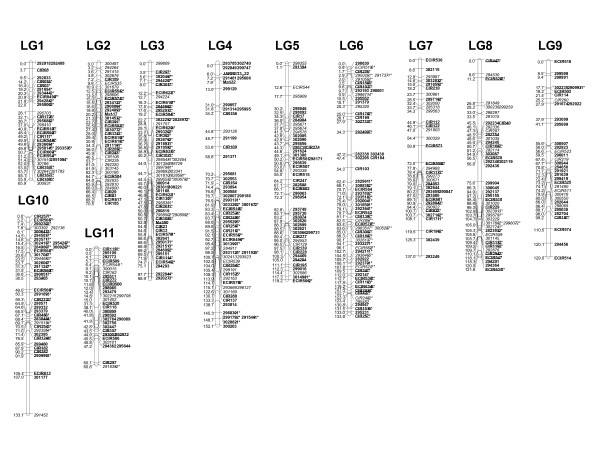
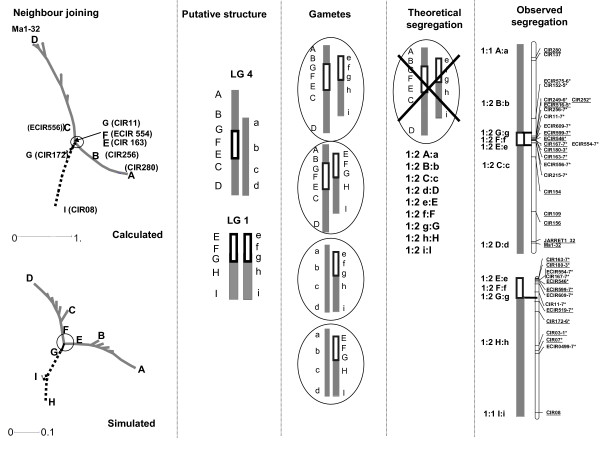
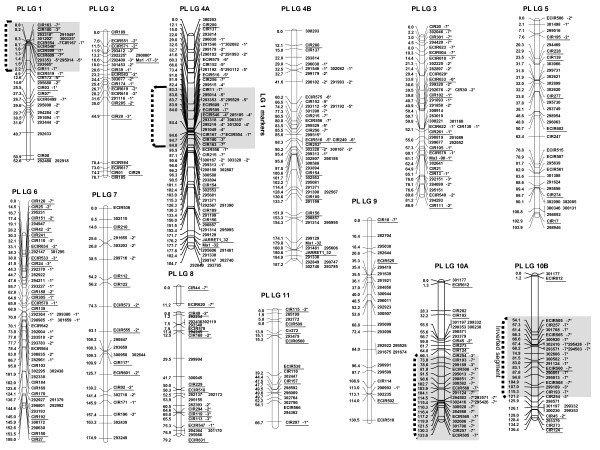
We propose a synthetic map with 11 linkage groups containing 489 markers (167 SSRs and 322 DArTs) covering 1197 cM. This first saturated map is proposed as a "reference Musa map" for further analyses. We also propose two complete parental maps with interpretations of structural rearrangements localized on the linkage groups. The structural heterozygosity in P. Lilin is hypothesized to result from a duplication likely accompanied by an inversion on another chromosome. This paper also illustrates a methodological approach, transferable to other species, to investigate the mapping of structural rearrangements and determine their consequences on marker segregation.
大蕉属是一个大型种的复杂群体,包括二倍体和三倍体水平的品种。这些不育的和营养繁殖的品种是基于 Musa acuminata 的 A 基因组,仅用于甜香蕉,如卡文迪什香蕉,或与 B 基因组(Musa balbisiana)相关联,用于烹饪香蕉,如 Plantain 品种。在 M. acuminata 品种中,结构杂合性被认为是不育的主要原因之一,这对于获得无核果实是必要的,但阻碍了繁殖。由于图谱群体的亲本中存在染色体重排,目前只有部分遗传图谱可用。这导致了大的分离偏倚,诱导了伪连锁,并在连锁群中对标记进行排序困难。本研究旨在构建 M. acuminata 的饱和连锁图谱,同时考虑到亲本结构杂合性的假设。
从两个遗传上相距较远的 M. acuminata 品种“Borneo”和“Pisang Lilin”(P. Lilin)杂交产生的 180 个个体的 F1 后代。基于每个亲本的配子重组,建立了由 SSR 和 DArT 标记组成的两个亲本图谱。相当比例的标记(21.7%)偏离(p <0.05)了预期的孟德尔比例。这些偏倚的标记在每个亲本的不同连锁群中分布。为了解决一些标记在连锁群上的复杂排序问题,我们结合了树状图形表示、重组频率统计和细胞遗传学研究等工具,以识别结构重排并构建简约的连锁群顺序。以 P. Lilin 亲本为例,给出了这样一种方法的说明。
我们提出了一个包含 489 个标记(167 个 SSRs 和 322 个 DArTs)的 11 个连锁群的综合图谱,覆盖 1197 cM。这个第一个饱和图谱被提议作为进一步分析的“参考 Musa 图谱”。我们还提出了两个完整的亲本图谱,并对位于连锁群上的结构重排进行了解释。推测 P. Lilin 的结构杂合性是由可能伴随着另一个染色体上的倒位的重复引起的。本文还说明了一种方法学方法,可转移到其他物种,以研究结构重排的作图并确定它们对标记分离的影响。