Nanni P, Azzarello G, Tessarollo L, De Giovanni C, Lollini P L, Nicoletti G, Scotlandi K, Landuzzi L, Panozzo M, D'Andrea E
Institute of Cancerology, University of Bologna, Italy.
Br J Cancer. 1991 May;63(5):736-42. doi: 10.1038/bjc.1991.165.
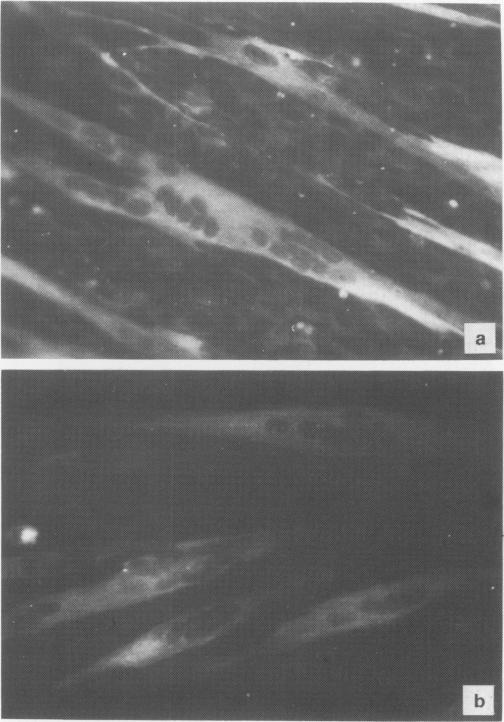
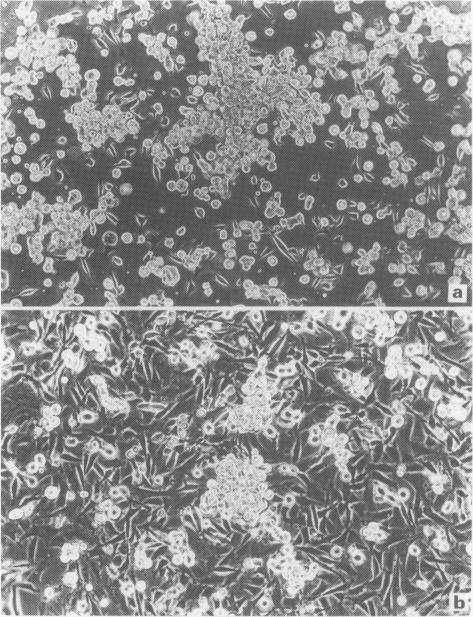
In vitro cultures and clonal derivatives have been established from rat rhabdomyosarcomas induced by Moloney-Murine Sarcoma Virus (MSV) or by nickel sulfide; differentiation ability has been studied as expression of desmin, embryonic and adult myosin isoforms, alpha-actin isoforms and cellular fusion. The two rhabdomyosarcoma models showed different levels of myogenic differentiation. Multinucleated myotube-like structures were frequently observed in cultures derived from nickel-induced tumours. Desmin was present in 50-80% of cells and embryonic myosin in up to 10%. In MSV-tumour-derived cultures and in their metastases or clonal derivatives two cell types are present in different ratios: spindle-shaped cells, adherent to plastic surfaces, and rounded cells, loosely attached or floating free in the medium. These cultures showed features of myogenic differentiation (10-80% desmin-positive cells), but embryonic myosin expression and production of multinucleated myotube-like structures were very rare events. Cultures from autochthonous lymph node and lung metastatic cells showed similar patterns of differentiation. Retinoic acid increased differentiated features (myotube formation and embryonic myosin expression) only in nickel-induced rhabdomyosarcoma cells. The two models described here mimic the heterogeneity in differentiation pattern found among human rhabdomyosarcomas. Myogenic differentiation ability was retained at a good level by nickel-induced tumours, whereas it was strongly impaired in MSV-induced tumours.
已从由莫洛尼鼠肉瘤病毒(MSV)或硫化镍诱导的大鼠横纹肌肉瘤中建立了体外培养物和克隆衍生物;已将分化能力作为结蛋白、胚胎和成人肌球蛋白同工型、α-肌动蛋白同工型和细胞融合的表达进行了研究。这两种横纹肌肉瘤模型显示出不同水平的肌源性分化。在源自镍诱导肿瘤的培养物中经常观察到多核肌管样结构。50 - 80%的细胞中存在结蛋白,高达10%的细胞中存在胚胎肌球蛋白。在源自MSV肿瘤的培养物及其转移灶或克隆衍生物中,两种细胞类型以不同比例存在:附着于塑料表面的梭形细胞和松散附着或游离于培养基中的圆形细胞。这些培养物显示出肌源性分化的特征(10 - 80%的结蛋白阳性细胞),但胚胎肌球蛋白表达和多核肌管样结构的产生是非常罕见的事件。来自原位淋巴结和肺转移细胞的培养物显示出相似的分化模式。视黄酸仅在镍诱导横纹肌肉瘤细胞中增加了分化特征(肌管形成和胚胎肌球蛋白表达)。这里描述的两种模型模拟了人类横纹肌肉瘤中发现的分化模式的异质性。镍诱导的肿瘤能较好地保持肌源性分化能力,而MSV诱导的肿瘤中这种能力则受到严重损害。