Department of Pathology, New York University Langone School of Medicine, New York, New York, United States of America.
PLoS One. 2010 Apr 21;5(4):e10254. doi: 10.1371/journal.pone.0010254.
The V3 loop of the HIV-1 envelope (Env) glycoprotein gp120 was identified as the "principal neutralizing domain" of HIV-1, but has been considered too variable to serve as a neutralizing antibody (Ab) target. Structural and immunochemical data suggest, however, that V3 contains conserved elements which explain its role in binding to virus co-receptors despite its sequence variability. Despite this evidence of V3 conservation, the ability of anti-V3 Abs to neutralize a significant proportion of HIV-1 isolates from different subtypes (clades) has remained controversial.
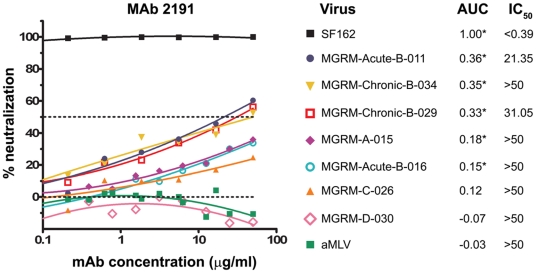
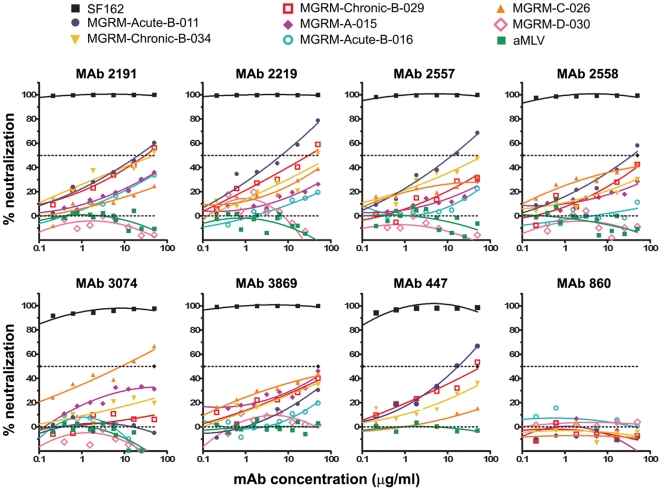
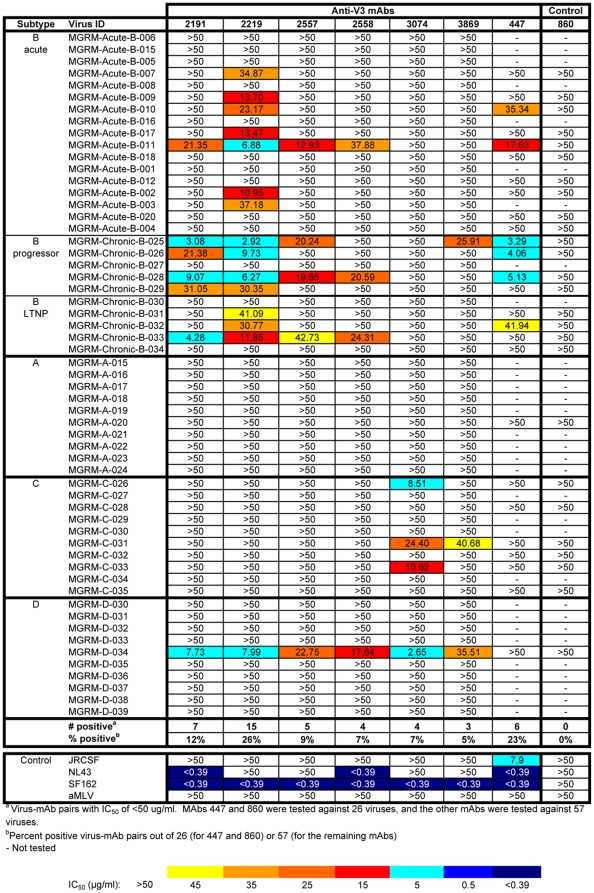
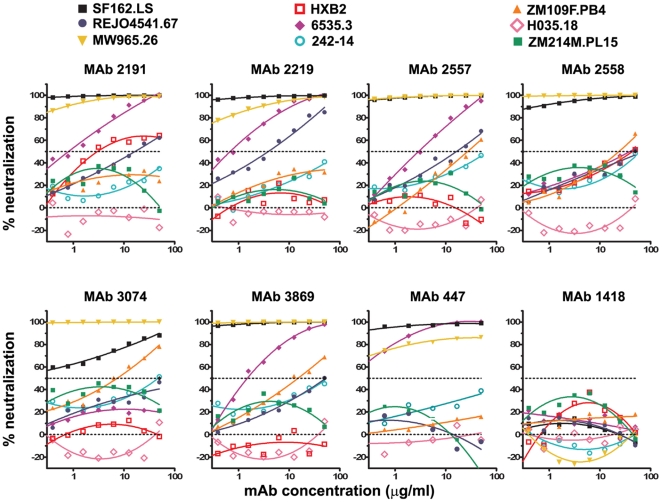
HIV-1 neutralization experiments were conducted in two independent laboratories to test human anti-V3 monoclonal Abs (mAbs) against pseudoviruses (psVs) expressing Envs of diverse HIV-1 subtypes from subjects with acute and chronic infections. Neutralization was defined by 50% inhibitory concentrations (IC(50)), and was statistically assessed based on the area under the neutralization titration curves (AUC).
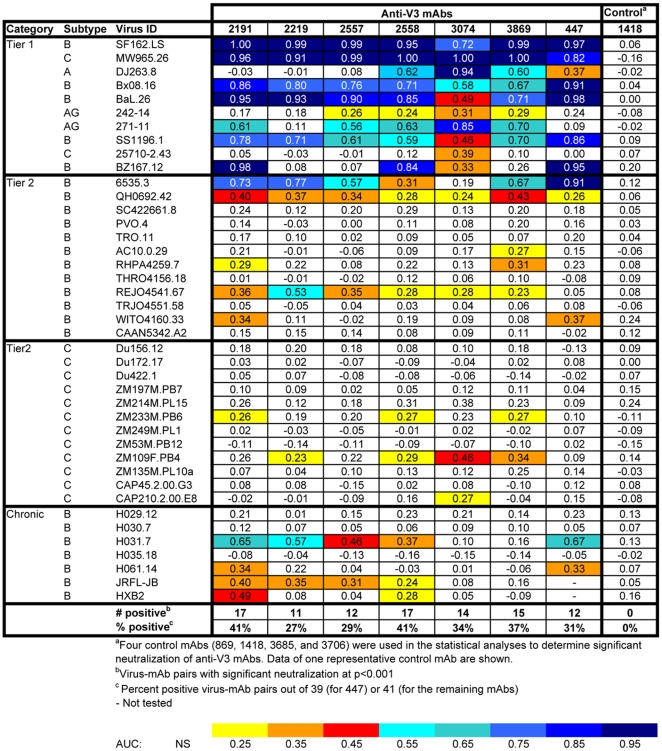
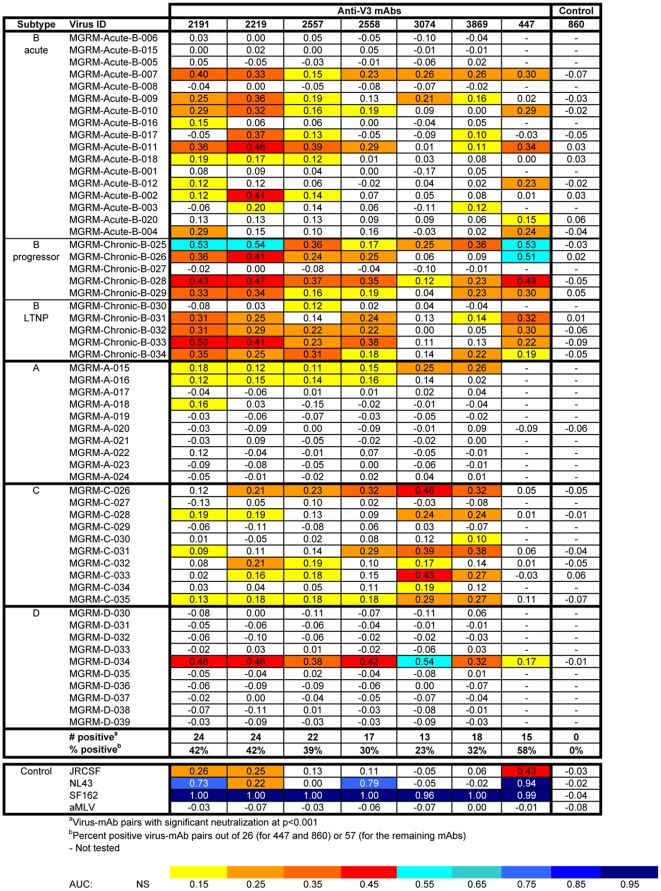
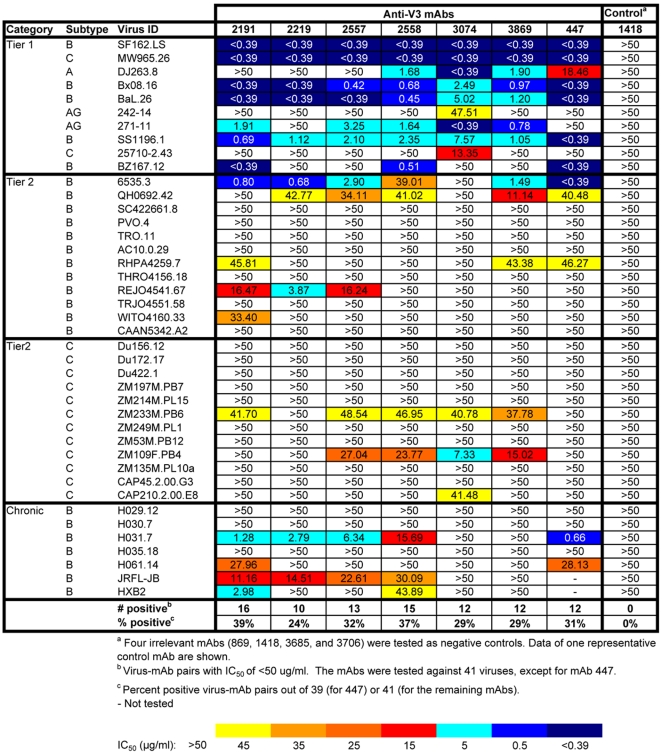
Using AUC analyses, statistically significant neutralization was observed by >or=1 anti-V3 mAbs against 56/98 (57%) psVs expressing Envs of diverse subtypes, including subtypes A, AG, B, C and D. Even when the 10 Tier 1 psVs tested were excluded from the analysis, significant neutralization was detected by >or=1 anti-V3 mAbs against 46/88 (52%) psVs from diverse HIV-1 subtypes. Furthermore, 9/24 (37.5%) Tier 2 viruses from the clade B and C standard reference panels were neutralized by >or=1 anti-V3 mAbs. Each anti-V3 mAb tested was able to neutralize 28-42% of the psVs tested. By IC(50) criteria, 40/98 (41%) psVs were neutralized by >or=1 anti-V3 mAbs.
Using standard and new statistical methods of data analysis, 6/7 anti-V3 human mAbs displayed cross-clade neutralizing activity and revealed that a significant proportion of viruses can be neutralized by anti-V3 Abs. The new statistical method for analysis of neutralization data provides many advantages to previously used analyses.
HIV-1 包膜(Env)糖蛋白 gp120 的 V3 环被确定为 HIV-1 的“主要中和结构域”,但由于其序列高度可变,被认为不适合作为中和抗体(Ab)的靶标。然而,结构和免疫化学数据表明,V3 包含保守的元素,这些元素解释了它在与病毒共受体结合方面的作用,尽管其序列存在变异性。尽管有证据表明 V3 具有保守性,但抗 V3 Ab 对来自不同亚型(谱系)的大量 HIV-1 分离株的中和能力仍存在争议。
在两个独立的实验室中进行 HIV-1 中和实验,以测试来自急性和慢性感染个体的抗 V3 人源单克隆 Ab(mAb)对表达多种 HIV-1 亚型Env 的假病毒(psV)的作用。中和作用通过 50%抑制浓度(IC(50))来定义,并基于中和滴定曲线下面积(AUC)进行统计学评估。
使用 AUC 分析,对表达多种亚型Env 的 98 个 psV 中的 56 个(57%),观察到了由 1 种或多种抗 V3 mAb 引起的具有统计学意义的中和作用,其中包括亚型 A、AG、B、C 和 D。即使将 10 个测试的 Tier 1 psV 从分析中排除,对来自多种 HIV-1 亚型的 88 个 psV 中的 46 个(52%),也检测到了由 1 种或多种抗 V3 mAb 引起的具有统计学意义的中和作用。此外,对来自 B 和 C 谱系标准参考面板的 24 个 Tier 2 病毒中的 9 个(37.5%),由 1 种或多种抗 V3 mAb 中和。每个测试的抗 V3 mAb 能够中和 28%至 42%的测试 psV。根据 IC(50)标准,有 41%(40/98)的 psV 被 1 种或多种抗 V3 mAb 中和。
使用标准和新的数据分析统计方法,6/7 种抗 V3 人源 mAb 显示出跨谱系中和活性,并表明相当比例的病毒可以被抗 V3 Ab 中和。用于中和数据分析的新统计方法与以前使用的分析方法相比具有许多优势。