Division of Infectious Diseases, Washington University School of Medicine, St Louis, Missouri 63110, USA.
Infect Control Hosp Epidemiol. 2010 Jun;31(6):584-91. doi: 10.1086/652530.
Staphylococcus aureus is an important cause of infection in intensive care unit (ICU) patients. Colonization with methicillin-resistant S. aureus (MRSA) is a risk factor for subsequent S. aureus infection. However, MRSA-colonized patients may have more comorbidities than methicillin-susceptible S. aureus (MSSA)-colonized or noncolonized patients and therefore may be more susceptible to infection on that basis.
To determine whether MRSA-colonized patients who are admitted to medical and surgical ICUs are more likely to develop any S. aureus infection in the ICU, compared with patients colonized with MSSA or not colonized with S. aureus, independent of predisposing patient risk factors.
Prospective cohort study.
A 24-bed surgical ICU and a 19-bed medical ICU of a 1,252-bed, academic hospital.
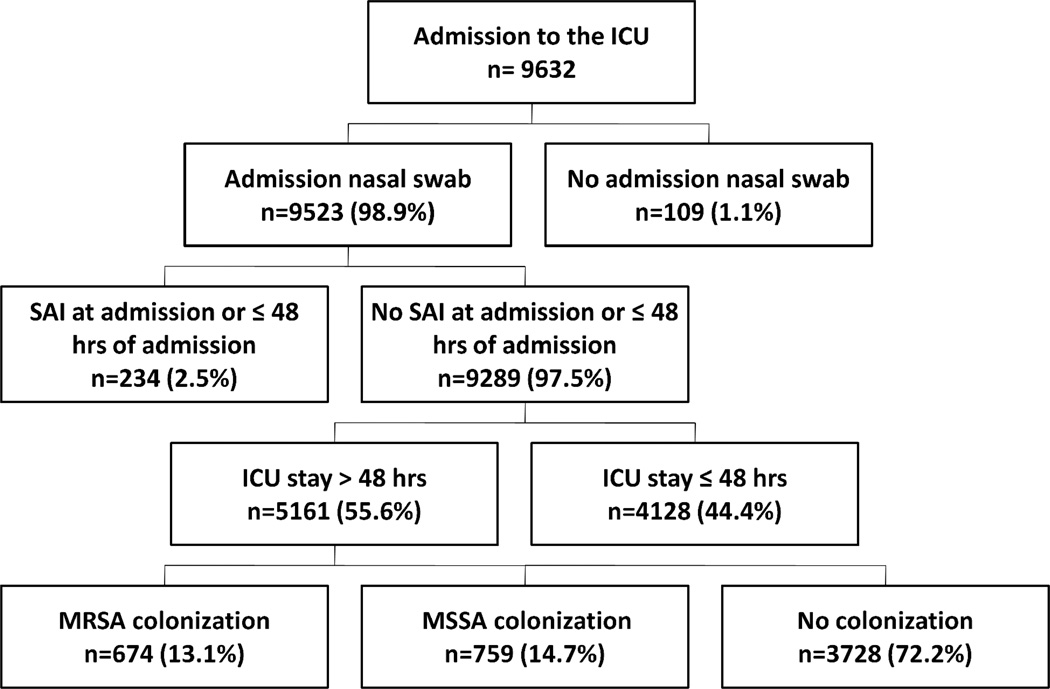
A total of 9,523 patients for whom nasal swab samples were cultured for S. aureus at ICU admission during the period from December 2002 through August 2007.
Patients in the ICU for more than 48 hours were examined for an ICU-acquired S. aureus infection, defined as development of S. aureus infection more than 48 hours after ICU admission.
S. aureus colonization was present at admission for 1,433 (27.8%) of 5,161 patients (674 [47.0%] with MRSA and 759 [53.0%] with MSSA). An ICU-acquired S. aureus infection developed in 113 (2.19%) patients, of whom 75 (66.4%) had an infection due to MRSA. Risk factors associated with an ICU-acquired S. aureus infection included MRSA colonization at admission (adjusted hazard ratio, 4.70 [95% confidence interval, 3.07-7.21]) and MSSA colonization at admission (adjusted hazard ratio, 2.47 [95% confidence interval, 1.52-4.01]).
ICU patients colonized with S. aureus were at greater risk of developing a S. aureus infection in the ICU. Even after adjusting for patient-specific risk factors, MRSA-colonized patients were more likely to develop S. aureus infection, compared with MSSA-colonized or noncolonized patients.
金黄色葡萄球菌是重症监护病房(ICU)患者感染的重要原因。耐甲氧西林金黄色葡萄球菌(MRSA)定植是金黄色葡萄球菌感染的危险因素。然而,MRSA 定植的患者可能比耐甲氧西林金黄色葡萄球菌(MSSA)定植或未定植的患者有更多的合并症,因此可能更容易基于此而发生感染。
确定与定植 MSSA 或未定植金黄色葡萄球菌的患者相比,入住内科和外科 ICU 的 MRSA 定植患者是否更有可能在 ICU 中发生任何金黄色葡萄球菌感染,而不考虑易患患者的风险因素。
前瞻性队列研究。
一家拥有 1252 张床位的学术医院的 24 张床位外科 ICU 和 19 张床位内科 ICU。
2002 年 12 月至 2007 年 8 月期间,共有 9523 名患者在 ICU 入住期间接受了金黄色葡萄球菌鼻拭子培养。
入住 ICU 超过 48 小时的患者检查 ICU 获得性金黄色葡萄球菌感染,定义为 ICU 入住后超过 48 小时发生金黄色葡萄球菌感染。
5161 名患者(674 名[47.0%]为 MRSA 和 759 名[53.0%]为 MSSA)在入院时存在金黄色葡萄球菌定植。113 名(2.19%)患者发生 ICU 获得性金黄色葡萄球菌感染,其中 75 名(66.4%)感染为 MRSA。与 ICU 获得性金黄色葡萄球菌感染相关的危险因素包括入院时 MRSA 定植(调整后的危害比,4.70 [95%置信区间,3.07-7.21])和入院时 MSSA 定植(调整后的危害比,2.47 [95%置信区间,1.52-4.01])。
金黄色葡萄球菌定植的 ICU 患者发生 ICU 金黄色葡萄球菌感染的风险更高。即使在调整了患者特定的风险因素后,与 MSSA 定植或未定植的患者相比,MRSA 定植的患者发生金黄色葡萄球菌感染的可能性仍然更高。