Lineberger Comprehensive Cancer Center, University of North Carolina at Chapel Hill, Chapel Hill, NC 27599, USA.
Bioinformatics. 2010 Jun 15;26(12):1572-3. doi: 10.1093/bioinformatics/btq170. Epub 2010 Apr 28.
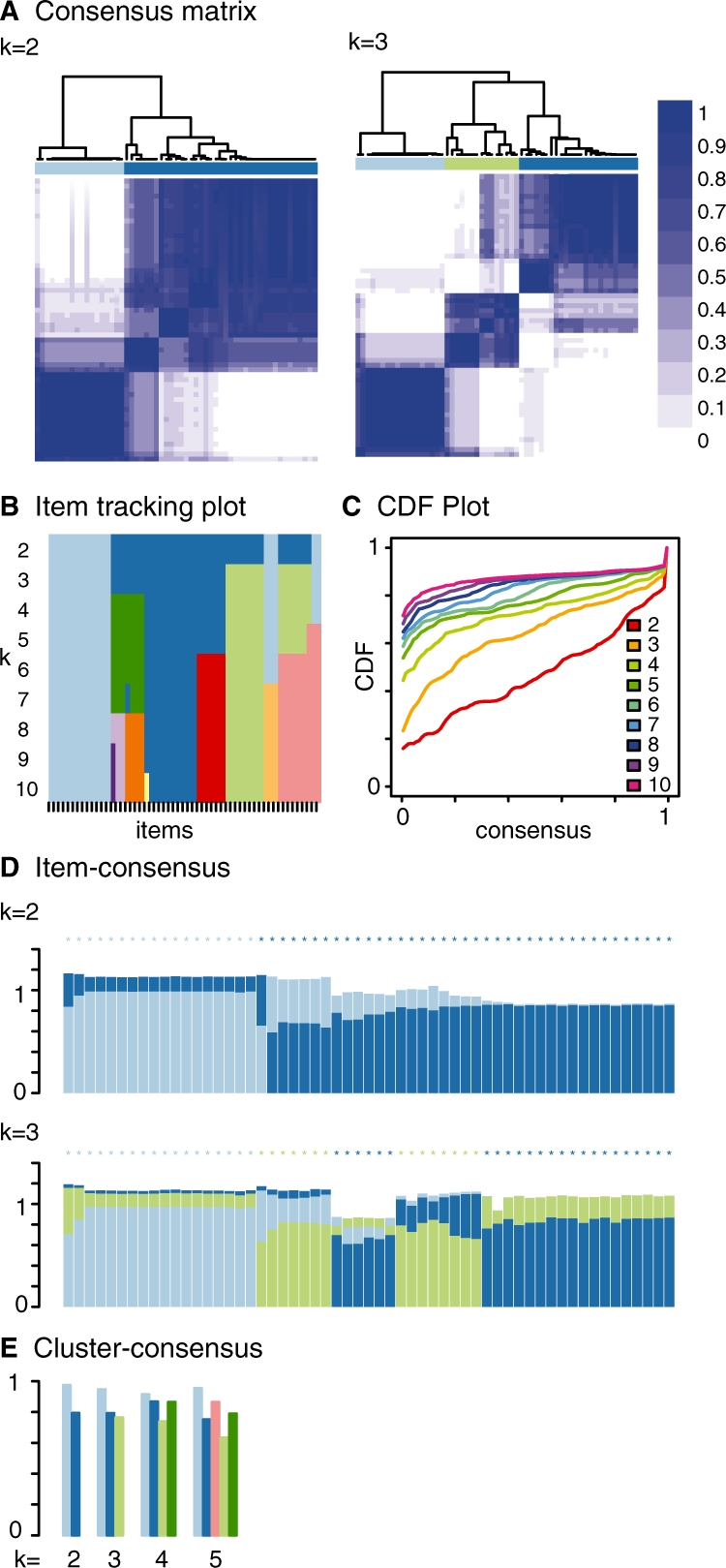
Unsupervised class discovery is a highly useful technique in cancer research, where intrinsic groups sharing biological characteristics may exist but are unknown. The consensus clustering (CC) method provides quantitative and visual stability evidence for estimating the number of unsupervised classes in a dataset. ConsensusClusterPlus implements the CC method in R and extends it with new functionality and visualizations including item tracking, item-consensus and cluster-consensus plots. These new features provide users with detailed information that enable more specific decisions in unsupervised class discovery.
ConsensusClusterPlus is open source software, written in R, under GPL-2, and available through the Bioconductor project (http://www.bioconductor.org/).
Supplementary data are available at Bioinformatics online.
无监督分类发现是癌症研究中非常有用的技术,其中可能存在具有生物学特征的内在群体,但这些群体未知。共识聚类(CC)方法为估计数据集的无监督类数量提供了定量和可视化稳定性证据。ConsensusClusterPlus 在 R 中实现了 CC 方法,并通过新功能和可视化扩展了它,包括项目跟踪、项目一致性和聚类一致性图。这些新功能为用户提供了详细信息,使他们能够在无监督分类发现中做出更具体的决策。
ConsensusClusterPlus 是开源软件,用 R 编写,遵循 GPL-2,并可通过 Bioconductor 项目(http://www.bioconductor.org/)获得。
补充数据可在 Bioinformatics 在线获得。