Northern Rocky Mountain Science Center, United States Geological Survey, Bozeman, Montana, United States of America.
PLoS One. 2010 Apr 23;5(4):e10322. doi: 10.1371/journal.pone.0010322.
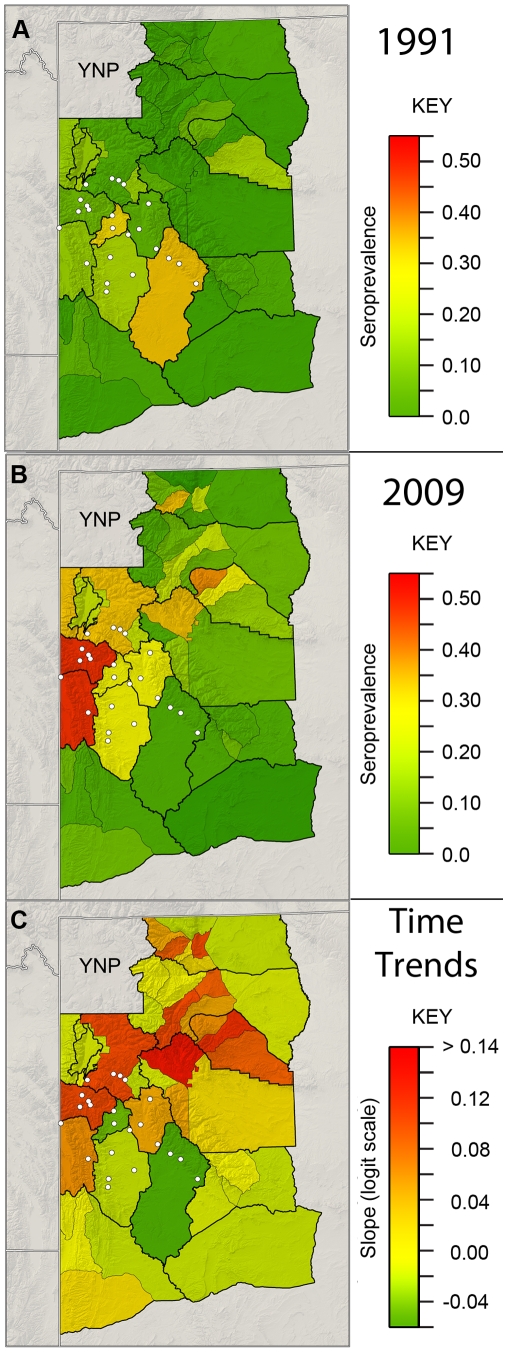
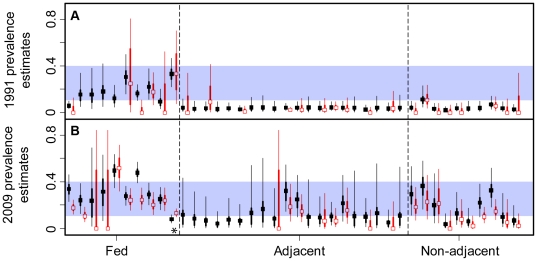
The relationship between host density and parasite transmission is central to the effectiveness of many disease management strategies. Few studies, however, have empirically estimated this relationship particularly in large mammals. We applied hierarchical Bayesian methods to a 19-year dataset of over 6400 brucellosis tests of adult female elk (Cervus elaphus) in northwestern Wyoming. Management captures that occurred from January to March were over two times more likely to be seropositive than hunted elk that were killed in September to December, while accounting for site and year effects. Areas with supplemental feeding grounds for elk had higher seroprevalence in 1991 than other regions, but by 2009 many areas distant from the feeding grounds were of comparable seroprevalence. The increases in brucellosis seroprevalence were correlated with elk densities at the elk management unit, or hunt area, scale (mean 2070 km(2); range = [95-10237]). The data, however, could not differentiate among linear and non-linear effects of host density. Therefore, control efforts that focus on reducing elk densities at a broad spatial scale were only weakly supported. Additional research on how a few, large groups within a region may be driving disease dynamics is needed for more targeted and effective management interventions. Brucellosis appears to be expanding its range into new regions and elk populations, which is likely to further complicate the United States brucellosis eradication program. This study is an example of how the dynamics of host populations can affect their ability to serve as disease reservoirs.
宿主密度与寄生虫传播之间的关系是许多疾病管理策略有效性的核心。然而,很少有研究从经验上估计这种关系,特别是在大型哺乳动物中。我们应用分层贝叶斯方法分析了怀俄明州西北部超过 6400 次成年雌性麋鹿(Cervus elaphus)布鲁氏菌病检测的 19 年数据集。1 月至 3 月进行的管理捕获比 9 月至 12 月被猎杀的麋鹿更有可能呈血清阳性,同时考虑了地点和年份的影响。有麋鹿补充饲料场的地区在 1991 年的血清阳性率高于其他地区,但到 2009 年,许多远离饲料场的地区的血清阳性率相当。布鲁氏菌病血清阳性率的增加与 elk 管理单位或狩猎区(平均 2070 平方公里;范围=[95-10237])的 elk 密度有关。然而,数据无法区分宿主密度的线性和非线性影响。因此,仅在广泛的空间尺度上减少麋鹿密度的控制努力得到了微弱的支持。需要对该地区内少数大群体如何驱动疾病动态进行更多的研究,以便进行更有针对性和有效的管理干预。布鲁氏菌病似乎正在将其范围扩大到新的地区和麋鹿种群,这可能进一步使美国布鲁氏菌病根除计划复杂化。本研究是宿主种群动态如何影响其作为疾病储库的能力的一个例子。