Dinh Emily T N, Cauvin Allison, Orange Jeremy P, Shuman Rebecca M, Wisely Samantha M, Blackburn Jason K
1Spatial Epidemiology & Ecology Research Laboratory, Department of Geography, University of Florida, Gainesville, FL USA.
2Emerging Pathogens Institute, University of Florida, Gainesville, FL USA.
Mov Ecol. 2020 Mar 16;8:14. doi: 10.1186/s40462-020-00200-2. eCollection 2020.
Epizootic hemorrhagic disease virus (EHDV) is a pathogen vectored by midges that causes significant economic loss in the cervid farming industry and affects wild deer as well. Despite this, its ecology is poorly understood. Studying movement and space use by ruminant hosts during the transmission season may elucidate EHDV ecology by identifying behaviors that can increase exposure risk. Here we compared home ranges (HRs) and site fidelity metrics within HRs using the T-LoCoH R package and GPS data from collared deer.
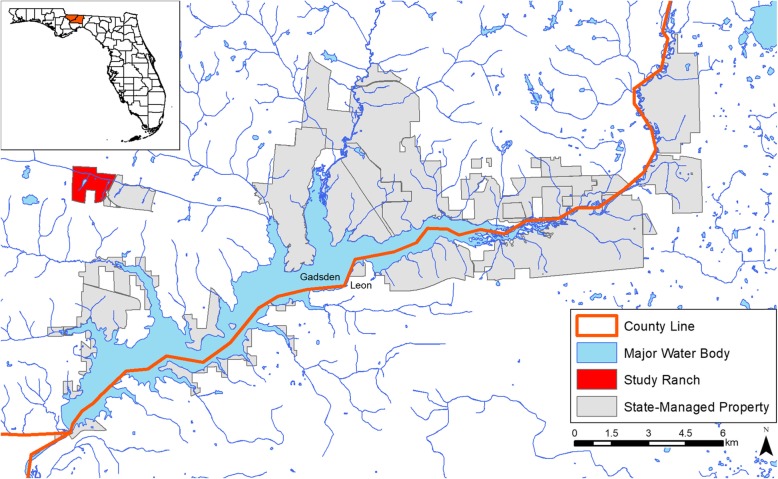
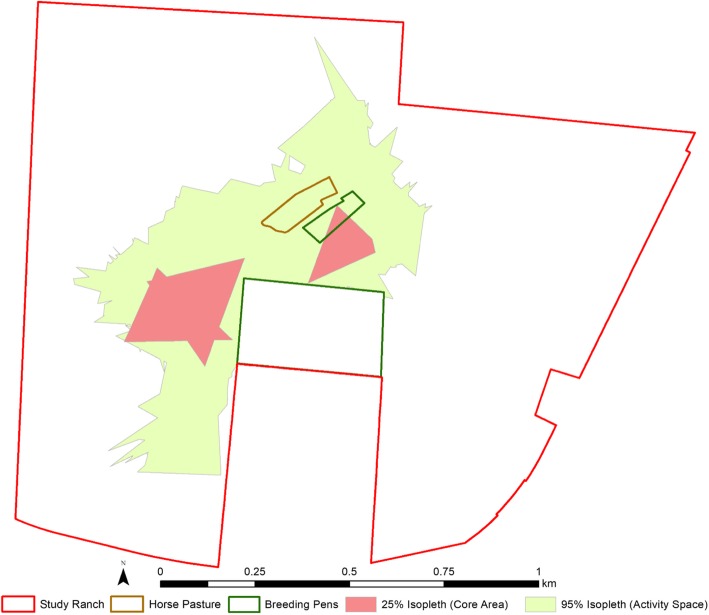
Here, we tested whether white-tailed deer () roaming within a high-fenced, private deer farm (ranched) and native deer from nearby state-managed properties (wild) exhibited differences in home range (HR) size and usage during the 2016 and 2017 EHDV seasons. We captured male and female individuals in both years and derived seasonal HRs for both sexes and both groups for each year. HRs were calculated using a time-scale distance approach in T-LoCoH. We then derived revisitation and duration of visit metrics and compared between years, sexes, and ranched and wild deer.
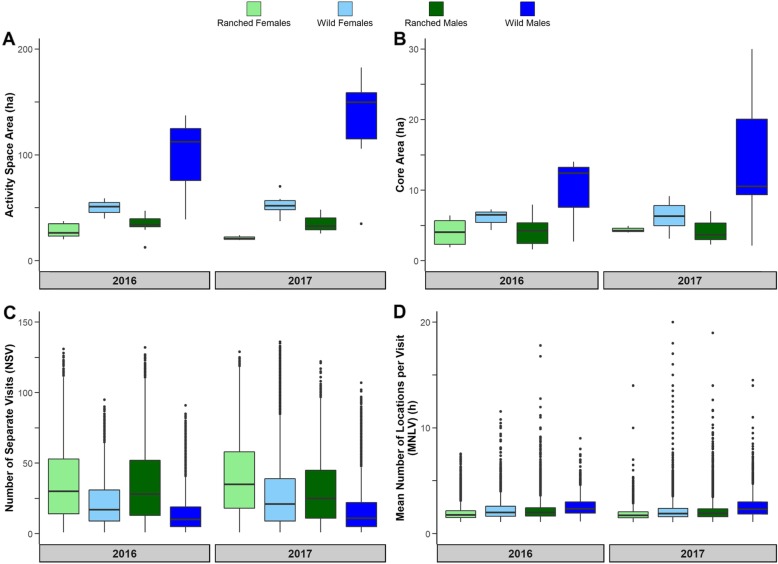
We found that ranched deer of both sexes tended to have smaller activity spaces (95% HR) and revisited sites within their HR more often but stayed for shorter periods than wild deer. However, core area (25% HR) sizes did not significantly differ between these groups.
The contrast in our findings between wild and ranched deer suggest that home range usage, rather than size, in addition to differences in population density, likely drive differences in disease exposure during the transmission period.
流行性出血病病毒(EHDV)是一种由蠓传播的病原体,可在鹿养殖业中造成重大经济损失,也会影响野生鹿群。尽管如此,人们对其生态学仍知之甚少。研究反刍动物宿主在传播季节的活动和空间利用情况,可能通过识别增加暴露风险的行为来阐明EHDV的生态学。在此,我们使用T-LoCoH R软件包和来自佩戴项圈鹿的GPS数据,比较了家域(HRs)以及HRs内的地点忠诚度指标。
在此,我们测试了在2016年和2017年EHDV季节期间,在有高围栏的私人养鹿场(圈养)内活动的白尾鹿以及来自附近州管理地产的野生鹿在家庭范围(HR)大小和使用情况上是否存在差异。我们在这两年中捕获了雄性和雌性个体,并计算了每年两组和两性的季节性HRs。HRs是使用T-LoCoH中的时间尺度距离方法计算的。然后,我们得出了重访和访问持续时间指标,并在年份、性别以及圈养鹿和野生鹿之间进行了比较。
我们发现,两性的圈养鹿往往活动空间(95% HR)较小,在其HR内更频繁地重访地点,但停留时间比野生鹿短。然而,这些组之间的核心区域(25% HR)大小没有显著差异。
我们在野生鹿和圈养鹿之间的研究结果对比表明,除了种群密度差异外,家域利用情况而非大小,可能在传播期驱动疾病暴露差异。