Department of Neurology and Center for Neuroscience & Regeneration Research, Yale University School of Medicine, New Haven, CT, USA.
Mol Pain. 2010 Apr 29;6:24. doi: 10.1186/1744-8069-6-24.
Two groups of gain-of-function mutations in sodium channel NaV1.7, which are expressed in dorsal root ganglion (DRG) neurons, produce two clinically-distinct pain syndromes - inherited erythromelalgia (IEM) and paroxysmal extreme pain disorder (PEPD). IEM is characterized by intermittent burning pain and skin redness in the feet or hands, triggered by warmth or mild exercise, while PEPD is characterized by episodes of rectal, ocular and mandibular pain accompanied with skin flushing, triggered by bowel movement and perianal stimulation. Most of the IEM mutations are located within channel domains I and II, while most of the PEPD mutations are located within domains III and IV. The structural dichotomy parallels the biophysical effects of the two types of mutations, with IEM mutations shifting voltage-dependence of NaV1.7 activation in a hyperpolarized direction, and PEPD mutations shifting fast-inactivation of NaV1.7 in a depolarized direction. While four IEM and four PEPD mutations are located within cytoplasmic linkers joining segments 4 and 5 (S4-S5 linkers) in the different domains (IEM: domains I and II; PEPD: domains III and IV), no S4-S5 linker has been reported to house both IEM and PEPD mutations thus far.
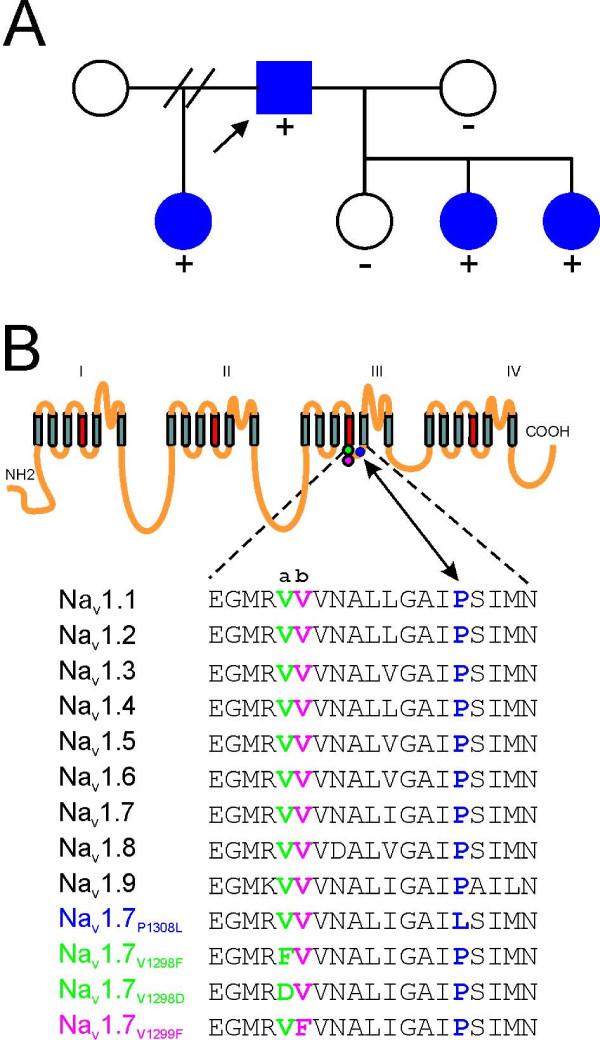
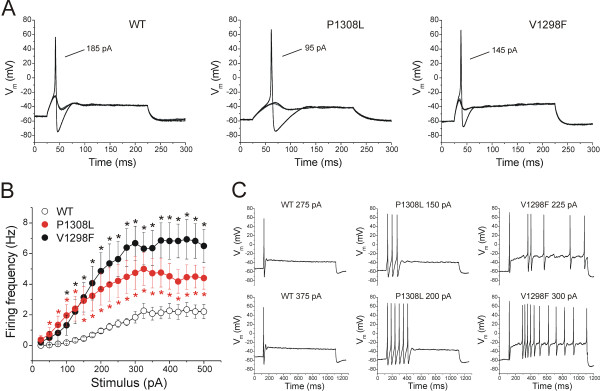
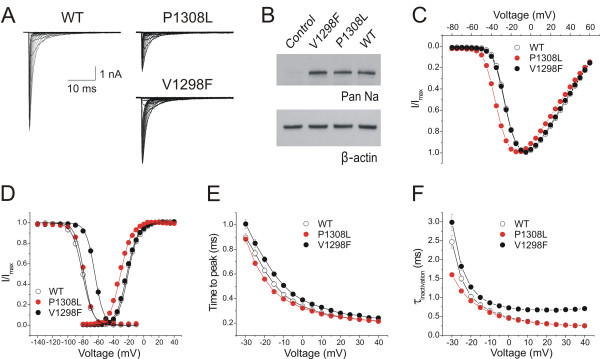
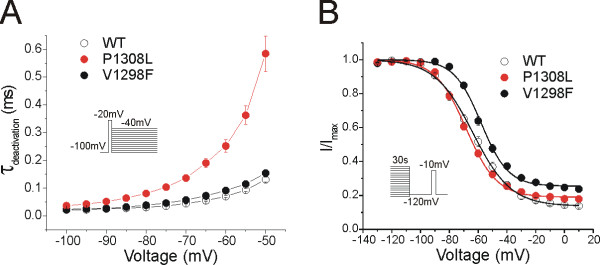
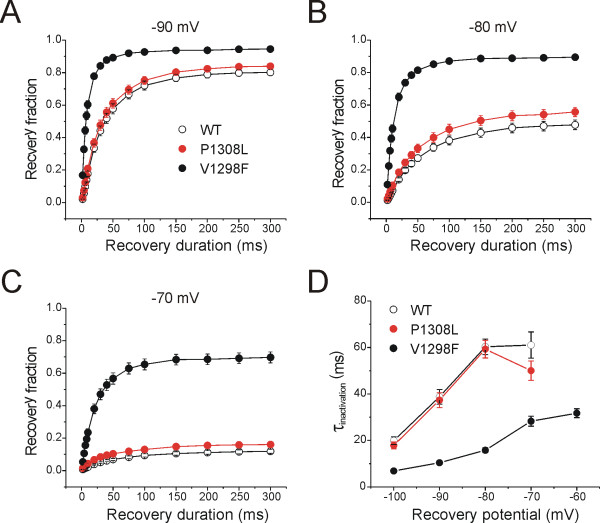
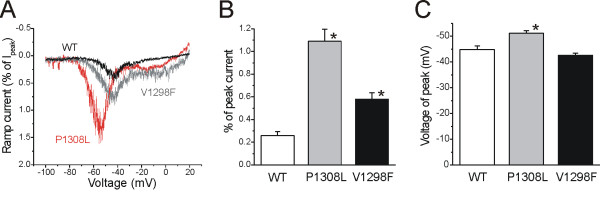
We have identified a new IEM mutation P1308L within the C-terminus of the DIII/S4-S5 linker of NaV1.7, ten amino acids from a known PEPD mutation V1298F which is located within the N-terminus of this linker. We used voltage-clamp to compare the biophysical properties of the two mutant channels and current-clamp to study their effects on DRG neuron excitability. We confirm that P1308L and V1298F behave as prototypical IEM and PEPD mutations, respectively. We also show that DRG neurons expressing either P1308L or V1298F become hyperexcitable, compared to DRG neurons expressing wild-type channels.
Our results provide evidence for differential roles of the DIII/S4-S5 linker N- and C-termini in channel inactivation and activation, and demonstrate the cellular basis for pain in patients carrying these mutations.
钠离子通道 NaV1.7 在背根神经节 (DRG) 神经元中表达,两组获得功能的突变可导致两种不同的临床疼痛综合征——遗传性红斑性肢痛症 (IEM) 和阵发性剧痛障碍 (PEPD)。IEM 的特征是间歇性灼烧样疼痛和手脚发红,由温暖或轻度运动引发,而 PEPD 的特征是直肠、眼部和下颌疼痛伴皮肤潮红,由肠道运动和肛周刺激引发。大多数 IEM 突变位于通道域 I 和 II 内,而大多数 PEPD 突变位于域 III 和 IV 内。这种结构二分法与两种类型的突变的生物物理效应平行,IEM 突变使 NaV1.7 的激活电压依赖性向超极化方向移动,而 PEPD 突变使 NaV1.7 的快速失活向去极化方向移动。虽然有四个 IEM 和四个 PEPD 突变位于不同域 (IEM:域 I 和 II;PEPD:域 III 和 IV) 连接节 4 和 5 (S4-S5 接头) 的胞质接头内,但迄今为止,没有报道 S4-S5 接头同时包含 IEM 和 PEPD 突变。
我们在 NaV1.7 的 DIII/S4-S5 接头的 C 末端发现了一个新的 IEM 突变 P1308L,该突变位于该接头的 N 末端的已知 PEPD 突变 V1298F 十个氨基酸内。我们使用电压钳比较了两种突变通道的生物物理特性,并使用电流钳研究了它们对 DRG 神经元兴奋性的影响。我们证实 P1308L 和 V1298F 分别表现为典型的 IEM 和 PEPD 突变。我们还表明,与表达野生型通道的 DRG 神经元相比,表达 P1308L 或 V1298F 的 DRG 神经元变得过度兴奋。
我们的结果为 DIII/S4-S5 接头的 N 和 C 末端在通道失活和激活中的不同作用提供了证据,并证明了携带这些突变的患者疼痛的细胞基础。