School of Health Sciences, University of Southampton, Highfield, Southampton, UK.
BMC Musculoskelet Disord. 2010 Apr 30;11:80. doi: 10.1186/1471-2474-11-80.
Many people suffer with Osteoarthritis (OA) and subsequent morbidity. Therefore, measuring outcome associated with OA is important. The Western Ontario and McMaster Universities Osteoarthritis Index (WOMAC) has been a widely used patient reported outcome in OA. However, there is relatively little evidence to support the use of the Visual Analogue Scale (VAS) version of the scale. We aimed to explore the internal validity and responsiveness of this VAS version of the WOMAC.
Patients with chronic hip or knee pain of mechanical origin, waiting for a hip or knee joint replacement completed the WOMAC as part of a study to investigate the effects of acupuncture and placebo controls. Validity was tested using factor analysis and Rasch analysis, and responsiveness using standardised response means.
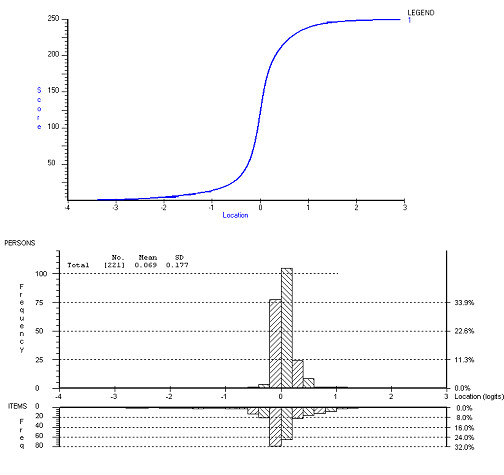
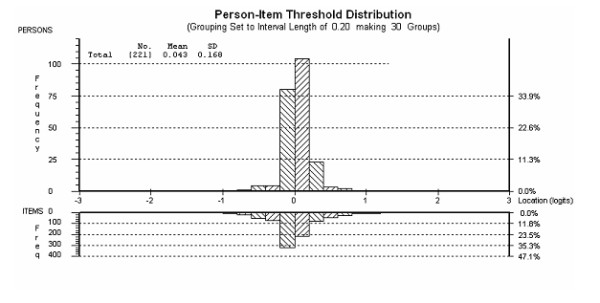
Two hundred and twenty one patients (mean age 66.8, SD 8.29, 58% female) were recruited. Factor and Rasch analysis confirmed unidimensional Pain and Physical Functioning scales, capable of transformation to interval scaling and invariant over time. Some Differential Item Functioning (DIF) was observed, but this cancelled out at the test level. The Stiffness scale fitted the Rasch model but adjustments for DIF could not be made due to the shortness of the scale. Using the interval transformed data, Standardised Response Means were smaller than when using the raw, ordinal data.
The WOMAC Pain and Physical Functioning subscales satisfied unidimensionality and ordinal scaling tests, and the ability to transform to an interval scale. Some Differential Item Functioning was observed, but this cancelled out at the test level and, by doing so, at the same time removed the disturbance of unidimensionality. The scaling characteristics of sets of items which use VAS require further analysis, as it would appear that they can lead to spurious levels of responsiveness and scale compression because they exaggerate the distortion of the ordinal scale.
UKCRN study ID: 4881 ISRCTN78434638.
许多人患有骨关节炎(OA)和随后的发病率。因此,测量与 OA 相关的结果很重要。西安大略省和麦克马斯特大学骨关节炎指数(WOMAC)一直是一种广泛用于 OA 的患者报告结果。然而,支持使用该量表的视觉模拟量表(VAS)版本的证据相对较少。我们旨在探讨这种 VAS 版本 WOMAC 的内部有效性和反应性。
患有机械性髋或膝关节疼痛的慢性患者,等待髋或膝关节置换,作为研究针灸和安慰剂对照效果的一部分完成 WOMAC。使用因子分析和 Rasch 分析测试有效性,使用标准化反应均值测试反应性。
共招募了 221 名患者(平均年龄 66.8,标准差 8.29,58%为女性)。因子和 Rasch 分析证实了疼痛和身体功能的单维量表,能够转化为区间量表,并且随时间不变。观察到一些差异项目功能(DIF),但在测试水平上抵消了。僵硬量表符合 Rasch 模型,但由于量表较短,无法进行 DIF 调整。使用间隔转换数据,标准化反应均值小于使用原始有序数据。
WOMAC 疼痛和身体功能子量表满足单维性和有序量表测试,以及转化为区间量表的能力。观察到一些差异项目功能,但在测试水平上抵消了,同时消除了单维性的干扰。使用 VAS 的项目集的标度特征需要进一步分析,因为它们似乎会导致虚假的反应性水平和标度压缩,因为它们夸大了有序标度的扭曲。
英国 CRN 研究 ID:4881 ISRCTN78434638。