Olds David L, Kitzman Harriet J, Cole Robert E, Hanks Carole A, Arcoleo Kimberly J, Anson Elizabeth A, Luckey Dennis W, Knudtson Michael D, Henderson Charles R, Bondy Jessica, Stevenson Amanda J
Department of Pediatrics, School of Medicine, University of Colorado Denver, 13121 E. 17th Avenue, Aurora, CO 80045, USA.
Arch Pediatr Adolesc Med. 2010 May;164(5):419-24. doi: 10.1001/archpediatrics.2010.49.
To test, among an urban primarily African American sample, the effects of prenatal and infancy home visiting by nurses on mothers' fertility, partner relationships, and economic self-sufficiency and on government spending through age 12 years of their firstborn child.
Randomized controlled trial.
Public system of obstetric and pediatric care in Memphis, Tennessee.
A total of 594 urban primarily African American economically disadvantaged mothers (among 743 who registered during pregnancy). Intervention Prenatal and infancy home visiting by nurses.
Mothers' cohabitation with and marriage to the child's biological father, intimate partner violence, duration (stability) of partner relationships, role impairment due to alcohol and other drug use, use and cost of welfare benefits, arrests, mastery, child foster care placements, and cumulative subsequent births.
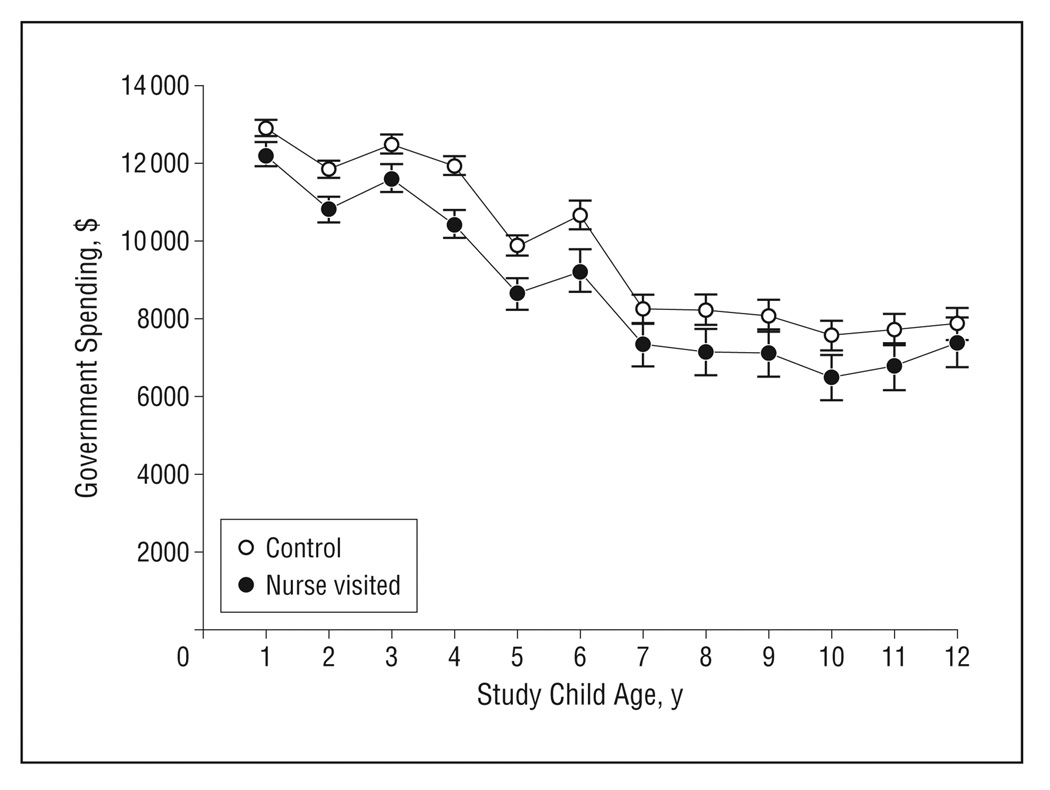
By the time the firstborn child was 12 years old, nurse-visited mothers compared with control subjects reported less role impairment owing to alcohol and other drug use (0.0% vs 2.5%, P = .04), longer partner relationships (59.58 vs 52.67 months, P = .02), and greater sense of mastery (101.04 vs 99.60, P = .005). During this 12-year period, government spent less per year on food stamps, Medicaid, and Aid to Families with Dependent Children and Temporary Assistance for Needy Families for nurse-visited than control families ($8772 vs $9797, P = .02); this represents $12 300 in discounted savings compared with a program cost of $11 511, both expressed in 2006 US dollars. No statistically significant program effects were noted on mothers' marriage, partnership with the child's biological father, intimate partner violence, alcohol and other drug use, arrests, incarceration, psychological distress, or reports of child foster care placements.
The program improved maternal life course and reduced government spending among children through age 12 years.
在以非裔美国人为主的城市样本中,测试护士进行产前和婴儿期家访对母亲生育情况、伴侣关系、经济自给自足的影响,以及对其第一个孩子12岁前政府支出的影响。
随机对照试验。
田纳西州孟菲斯市的公共产科和儿科护理系统。
共有594名以非裔美国人为主的城市经济弱势母亲(在孕期登记的743名母亲中)。干预措施为护士进行产前和婴儿期家访。
母亲与孩子生父的同居和婚姻情况、亲密伴侣暴力、伴侣关系的持续时间(稳定性)、因酒精和其他药物使用导致的角色受损、福利福利的使用和成本、逮捕情况、掌控感、儿童寄养安置情况以及随后的累计生育情况。
到第一个孩子12岁时,接受护士家访的母亲与对照组相比,因酒精和其他药物使用导致的角色受损更少(0.0%对2.5%,P = .04),伴侣关系持续时间更长(59.58对52.67个月,P = .02),掌控感更强(101.04对99.60,P = .005)。在这12年期间,与对照组家庭相比,接受护士家访的家庭政府每年在食品券、医疗补助以及对有受抚养子女家庭的援助和对贫困家庭的临时援助方面的支出更少(8772美元对9797美元,P = .02);与项目成本11511美元相比,这相当于节省了12300美元的贴现成本,两者均以2006年美元计算。在母亲的婚姻、与孩子生父的伴侣关系、亲密伴侣暴力、酒精和其他药物使用、逮捕情况、监禁、心理困扰或儿童寄养安置报告方面,未发现该项目有统计学上的显著效果。
该项目改善了母亲的人生历程,并在第一个孩子12岁前减少了政府支出。