Department of Community Health, School of Medicine, University of Benin, Benin City, Nigeria.
J Environ Public Health. 2010;2010:272896. doi: 10.1155/2010/272896. Epub 2010 Apr 29.
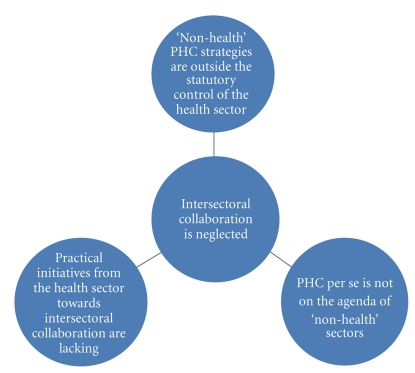
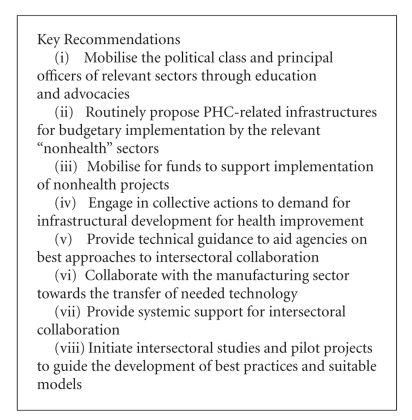
Many strategic challenges impeding the success of primary health care are rooted in weak strategic inputs, including intersectoral collaboration. Some encouraging evidence from programmes, projects, and studies suggests that intersectoral collaboration is feasible and useful. The strategy has the potential to fast-track the attainment of Millenium Development Goals. However, the strategy is not commonly utilised in developing countries. The health sector expects inputs from other sectors which may not necessarily subscribe to a shared responsibility for health improvement, whereas the public expects ''health" from the health sector. Yet, the health sector rarely takes on initiatives in that direction. The sector is challenged to mobilise all stakeholders for intersectoral collaboration through advocacy and programming. Pilot projects are advised in order to allow for cumulative experience, incremental lessons and more supportive evidence.
许多阻碍初级卫生保健成功的战略挑战源于薄弱的战略投入,包括部门间协作。一些来自方案、项目和研究的令人鼓舞的证据表明,部门间协作是可行和有用的。该战略有可能加快实现千年发展目标。然而,该战略在发展中国家并不常见。卫生部门期望其他部门提供投入,但这些部门不一定对改善卫生状况负有共同责任,而公众则期望从卫生部门获得“健康”。然而,卫生部门很少主动朝这个方向采取行动。该部门面临通过宣传和规划调动所有利益攸关方参与部门间协作的挑战。建议开展试点项目,以便积累经验、逐步吸取教训并提供更有力的证据。