Institute of Psychology, Leiden University, Leiden, The Netherlands.
Genes Brain Behav. 2010 Aug;9(6):615-20. doi: 10.1111/j.1601-183X.2010.00593.x. Epub 2010 May 3.
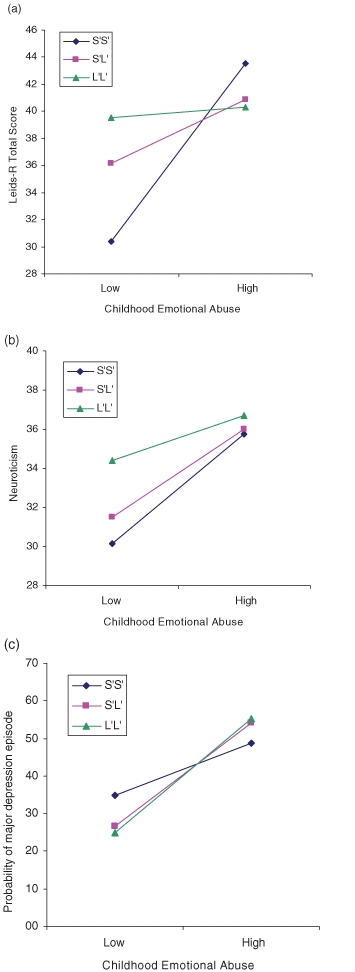
Meta-analyses evaluating the association between the serotonin transporter polymorphism (5-HTTLPR) with neuroticism and depression diagnosis as phenotypes have been inconclusive. We examined a gene-environment interaction on a cognitive vulnerability marker of depression, cognitive reactivity (CR) to sad mood. A total of 250 university students of European ancestry were genotyped for the 5-HTTLPR, including SNP rs25531, a polymorphism of the long allele. Association analysis was performed for neuroticism, CR and depression diagnosis (using a self-report measure). As an environmental pathogen, self-reported history of childhood emotional abuse was measured because of its strong relationship with depression. Participants with the homozygous low expressing genotype had high CR if they had experienced childhood emotional maltreatment but low CR if they did not have such experience. This interaction was strongest on the Rumination subscale of the CR measure. The interaction was not significant with neuroticism or depression diagnosis as outcome measures. Our results show that 5-HTTLPR is related to cognitive vulnerability to depression. Our findings provide evidence for a differential susceptibility genotype rather than a vulnerability genotype, possibly because of the relatively low levels of abuse in our sample. The selection of phenotype and environmental contributor is pivotal in investigating gene-environment interactions in psychiatric disorders.
元分析评估了 5-羟色胺转运体基因多态性(5-HTTLPR)与神经质和抑郁诊断作为表型之间的关联,结果尚无定论。我们研究了抑郁的认知易损性标志物,即对悲伤情绪的认知反应(CR)的基因-环境相互作用。共有 250 名欧洲血统的大学生接受了 5-HTTLPR 的基因分型,包括长等位基因的 SNP rs25531 多态性。对神经质、CR 和抑郁诊断(使用自我报告测量)进行了关联分析。由于童年情绪虐待与抑郁有很强的关系,因此将自我报告的童年情绪虐待史作为环境病原体进行了测量。如果经历过童年情绪虐待,具有低表达基因型纯合子的参与者会有较高的 CR,但如果没有这种经历,他们的 CR 会较低。这种相互作用在 CR 测量的反刍子量表上最为明显。该相互作用与神经质或抑郁诊断作为结果测量指标无关。我们的结果表明,5-HTTLPR 与抑郁的认知易损性有关。我们的研究结果提供了一种差异易感性基因型的证据,而不是一种易感性基因型,这可能是因为我们样本中的虐待水平相对较低。在精神疾病的基因-环境相互作用研究中,选择表型和环境贡献者至关重要。