School of Kinesiology and Health Studies, Queen's University, Kingston, ON, Canada.
Int J Behav Nutr Phys Act. 2010 May 11;7:36. doi: 10.1186/1479-5868-7-36.
To motivate individuals to adhere to a regular physical activity regime, guidelines must be supplemented with persuasive messages that are disseminated widely. While substantial research has examined effective strategies for disseminating physical activity messages, there has been no systematic effort to examine optimal message content. This paper reviews studies that evaluate the effectiveness of three approaches for constructing physical activity messages including tailoring messages to suit individual characteristics of message recipients (message tailoring), framing messages in terms of gains versus losses (message framing), and targeting messages to affect change in self-efficacy (i.e., a theoretical determinant of behavior change).
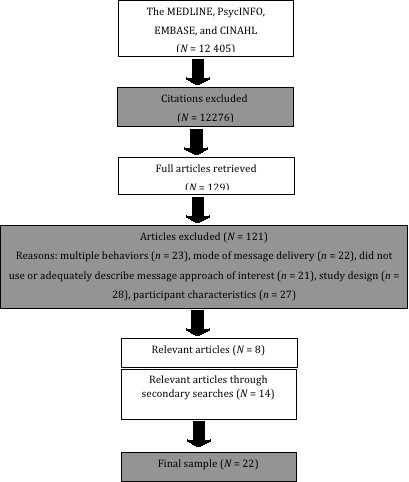
We searched the MEDLINE, PsycINFO, EMBASE and CINAHL databases up to July 2008. Relevant reference lists also were searched. We included intervention trials, field experiments, and laboratory-based studies that aimed to test the efficacy or effectiveness of tailored messages, framed messages and self-efficacy change messages among healthy adults. We used a descriptive approach to analyze emerging patterns in research findings. Based on this evidence we made recommendations for practice and future research.
Twenty-two studies were identified. Twelve studies evaluated message tailoring. In 10 of these studies, tailored messages resulted in greater physical activity than a control message. Six studies evaluated framed messages. Five of these studies demonstrated that gain-framed messages lead to stronger intentions to be active compared to a control message. Moreover, a gain-frame advantage was evident in three of the four studies that assessed physical activity. Four studies evaluated self-efficacy change messages. The two studies that used an experimental design provide a clear indication that individuals' beliefs can be affected by messages that incorporate types of information known to be determinants of self-efficacy. Overall, strong evidence to support definitive recommendations for optimal message content and structure was lacking.
Additional research testing the optimal content of messages used to supplement physical activity guidelines is needed. Tailored messages, gain-framed messages, and self-efficacy change messages hold promise as strategies for constructing physical activity messages and should be a focus of future research.
为了激励个人坚持定期进行身体活动,必须在指南的基础上补充有说服力的信息,以广泛传播。虽然大量研究已经检验了传播身体活动信息的有效策略,但尚未有系统的努力来检验最佳信息内容。本文综述了评估三种构建身体活动信息方法的有效性的研究,包括根据信息接收者的个体特征定制信息(信息定制)、根据收益与损失来构建信息(信息框架),以及针对信息来影响自我效能感的变化(即行为改变的理论决定因素)。
我们检索了 MEDLINE、PsycINFO、EMBASE 和 CINAHL 数据库,截至 2008 年 7 月。还检索了相关的参考文献列表。我们纳入了旨在测试健康成年人中定制信息、框架信息和自我效能变化信息的功效或有效性的干预试验、现场实验和基于实验室的研究。我们采用描述性方法来分析研究结果中的模式。基于这些证据,我们为实践和未来研究提出了建议。
确定了 22 项研究。12 项研究评估了信息定制。在这 10 项研究中,定制信息比对照信息导致更多的身体活动。6 项研究评估了框架信息。其中 5 项研究表明,与对照信息相比,收益框架信息会导致更强的活动意愿。此外,在评估身体活动的四项研究中有三项表明了收益框架的优势。四项研究评估了自我效能变化信息。使用实验设计的两项研究清楚地表明,信息可以通过纳入已知是自我效能决定因素的信息类型来影响个人的信念。总体而言,缺乏支持最佳信息内容和结构的明确建议的强有力证据。
需要进一步研究以检验补充身体活动指南的信息的最佳内容。定制信息、收益框架信息和自我效能变化信息作为构建身体活动信息的策略具有潜力,应成为未来研究的重点。