Seyedalmoosavi Mohammad M, Mielenz Manfred, Veldkamp Teun, Daş Gürbüz, Metges Cornelia C
Research Institute for Farm Animal Biology (FBN), Institute of Nutritional Physiology, 18196, Dummerstorf, Germany.
Wageningen UR, Livestock Research, P.O. Box 338, 6700AH, Wageningen, Netherlands.
J Anim Sci Biotechnol. 2022 May 5;13(1):31. doi: 10.1186/s40104-022-00682-7.
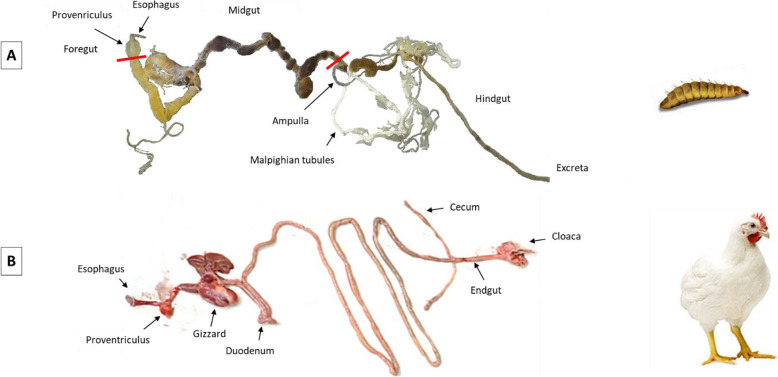
In recent years, interest in the larvae of black soldier fly (BSF) (Hermetia illucens) as a sustainable protein resource for livestock feed has increased considerably. However, knowledge on the nutritional and physiological aspects of this insect, especially compared to other conventional farmed animals is scarce. This review presents a critical comparison of data on the growth potential and efficiency of the BSF larvae (BSFL) compared to conventional monogastric livestock species. Advantages of BSFL over other monogastric livestock species includes their high growth rate and their ability to convert low-grade organic waste into high-quality protein and fat-rich biomass suitable for use in animal feed. Calculations using literature data suggest that BSFL are more efficient than broilers, pigs and fish in terms of conversion of substrate protein into body mass, but less efficient than broilers and fish in utilization of substrate gross energy to gain body mass. BSFL growth efficiency varies greatly depending on the nutrient quality of their dietary substrates. This might be associated with the function of their gastrointestinal tract, including the activity of digestive enzymes, the substrate particle characteristics, and their intestinal microbial community. The conceived advantage of BSFL having an environmental footprint better than conventional livestock is only true if BSFL is produced on low-grade organic waste and its protein would directly be used for human consumption. Therefore, their potential role as a new species to better close nutrient cycles in agro-ecological systems needs to be reconsidered, and we conclude that BSFL is a complementary livestock species efficiently utilizing organic waste that cannot be utilized by other livestock. In addition, we provide comparative insight into morpho-functional aspects of the gut, characterization of digestive enzymes, gut microbiota and fiber digestion. Finally, current knowledge on the nutritional utilization and requirements of BSFL in terms of macro- and micro-nutrients is reviewed and found to be rather limited. In addition, the research methods to determine nutritional requirements of conventional livestock are not applicable for BSFL. Thus, there is a great need for research on the nutrient requirements of BSFL.
近年来,作为一种可持续的家畜饲料蛋白质来源,黑水虻(Hermetia illucens)幼虫受到的关注大幅增加。然而,关于这种昆虫营养和生理方面的知识却很匮乏,尤其是与其他传统养殖动物相比。本综述对黑水虻幼虫(BSFL)与传统单胃家畜物种在生长潜力和效率方面的数据进行了批判性比较。BSFL相对于其他单胃家畜物种的优势包括其高生长速率以及将低质量有机废物转化为适合用于动物饲料的高质量蛋白质和富含脂肪的生物质的能力。利用文献数据进行的计算表明,就底物蛋白质转化为体重而言,BSFL比肉鸡、猪和鱼更高效,但在利用底物总能来增加体重方面比肉鸡和鱼效率更低。BSFL的生长效率因饮食底物的营养质量而有很大差异。这可能与其胃肠道功能有关,包括消化酶的活性、底物颗粒特征及其肠道微生物群落。只有当BSFL以低质量有机废物为原料生产且其蛋白质直接用于人类消费时,其在环境足迹方面比传统家畜更具优势的设想才成立。因此,需要重新审视它们作为一种能更好地闭合农业生态系统养分循环的新物种的潜在作用,我们得出结论,BSFL是一种能有效利用其他家畜无法利用的有机废物的互补性家畜物种。此外,我们对肠道的形态功能方面、消化酶的特性、肠道微生物群和纤维消化提供了比较性见解。最后,对目前关于BSFL在常量营养素和微量营养素方面的营养利用和需求的知识进行了综述,发现相当有限。此外,确定传统家畜营养需求的研究方法不适用于BSFL。因此,对BSFL营养需求的研究有很大需求。