Central & North West London NHS Foundation Trust, Greater London House, Hampstead Rd, London, NW1 7QY, UK.
Trials. 2010 May 13;11:53. doi: 10.1186/1745-6215-11-53.
Almost all of the 820,000 people in the UK with dementia will experience Behavioural and Psychological Symptoms of Dementia (BPSD). However, research has traditionally focused on treating cognitive symptoms, thus neglecting core clinical symptoms that often have a more profound impact on living with dementia. Recent evidence (Kales et al, 2007; Ballard et al, 2009) indicates that the popular approach to managing BPSD - prescription of anti-psychotic medication - can increase mortality and the risk of stroke in people with dementia as well as impair quality of life and accelerate cognitive decline. Consequently, there is a need to evaluate the impact that non-pharmacological interventions have on BPSD; we believe physical exercise is a particularly promising approach.
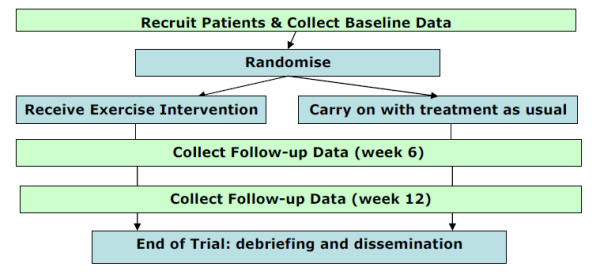
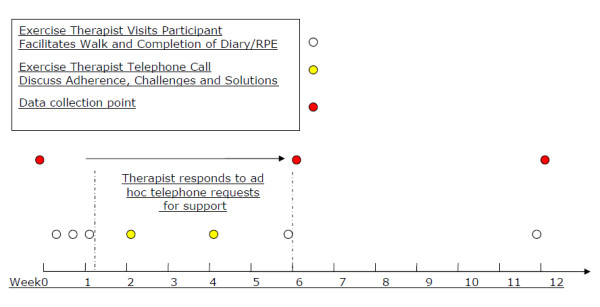
METHODS/DESIGN: We will carry out a pragmatic, randomised, single-blind controlled trial to evaluate the effectiveness of exercise (planned walking) on the behavioural and psychological symptoms of individuals with dementia. We aim to recruit 146 people with dementia and their carers to be randomized into two groups; one will be trained in a structured, tailored walking programme, while the other will continue with treatment as usual. The primary outcome (BPSD) will be assessed with the Neuropsychiatric Inventory (NPI) along with relevant secondary outcomes at baseline, 6 and 12 weeks.
Designing this study has been challenging both ethically and methodologically. In particular to design an intervention that is simple, measurable, safe, non-invasive and enjoyable has been testing and has required a lot of thought. Throughout the design, we have attempted to balance methodological rigour with study feasibility. We will discuss the challenges that were faced and overcome in this paper.
ISRCTN01423159.
在英国,几乎所有 82 万患有痴呆症的人都会经历行为和心理症状的痴呆症(BPSD)。然而,研究传统上侧重于治疗认知症状,从而忽略了对痴呆症患者生活影响更深远的核心临床症状。最近的证据(Kales 等人,2007 年;Ballard 等人,2009 年)表明,管理 BPSD 的流行方法 - 开处方抗精神病药物 - 会增加痴呆症患者的死亡率和中风风险,同时降低生活质量并加速认知能力下降。因此,需要评估非药物干预对 BPSD 的影响;我们认为体育锻炼是一种特别有前途的方法。
方法/设计:我们将开展一项实用、随机、单盲对照试验,以评估锻炼(计划散步)对痴呆症个体行为和心理症状的有效性。我们旨在招募 146 名痴呆症患者及其照顾者,将他们随机分为两组;一组将接受结构化、量身定制的散步计划培训,而另一组将继续接受常规治疗。主要结局(BPSD)将使用神经精神疾病问卷(NPI)以及基线、6 周和 12 周的相关次要结局进行评估。
在伦理和方法学方面,设计这项研究具有挑战性。特别是设计一种简单、可衡量、安全、非侵入性且令人愉快的干预措施一直是一个挑战,需要进行大量思考。在整个设计过程中,我们试图在方法学严谨性和研究可行性之间取得平衡。我们将在本文中讨论所面临的挑战以及如何克服这些挑战。
ISRCTN01423159。