Department of Infectious Diseases, University of Gothenburg, SE-416 85, Göteborg, Sweden.
Clin Orthop Relat Res. 2010 Oct;468(10):2781-8. doi: 10.1007/s11999-010-1370-0. Epub 2010 May 15.
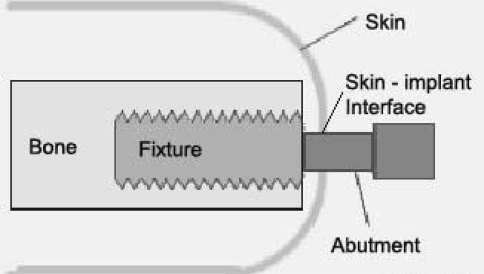
The concept of osseointegration involves direct contact between titanium implant and bone. This transcutaneous prosthetic system for amputees is intended to assure stable long-term fixation. Most metal transcutaneous implants have failed, primarily owing to infection.
QUESTIONS/PURPOSES: We determined the frequency and describe the presentation of infectious complications with this novel method. We also evaluated the bacterial flora at the skin-penetration area and its relation to the development of local and implant-related infection.
We prospectively followed 39 patients with arm and leg amputations fitted with transcutaneous osseointegrated titanium implants a mean of 56 months earlier (range, 132-133 months). There were 33 femoral, one tibial, four ulnar, four radial, and three humeral implants. Patients were selected during a 6-month period in 2005 and identically reevaluated after 3 years. Implant infection was defined as definite, probable, or possible based on clinical, radiologic, and microbiologic evidence.
The frequency of implant infection was 5% at inclusion and 18% at followup. One patient with infection recovered owing to antibiotic treatment and another patient had the implant removed. Most implant infections had low infectious activity, and in five of the seven patients with infections, prosthetic use was not affected. The most common bacteria in superficial and deep cultures were Staphylococcus aureus and coagulase-negative staphylococci.
Despite frequent colonization around the skin-implant interface by potentially virulent bacteria such as Staphylococcus aureus and bacteria associated with biomedical device infections such as coagulase-negative staphylococci, this titanium implant system for bone-anchored prostheses caused few infections leading to disability or implant removal.
Level IV, therapeutic study. See the Guidelines for Authors for a complete description of levels of evidence.
骨整合的概念涉及钛植入物与骨骼的直接接触。这种用于截肢者的经皮假体系统旨在确保稳定的长期固定。大多数金属经皮植入物已经失败,主要是由于感染。
问题/目的:我们确定了这种新方法感染并发症的频率并描述了其表现。我们还评估了皮肤穿透区域的细菌菌群及其与局部和植入物相关感染发展的关系。
我们前瞻性地随访了 39 名接受过经皮骨整合钛植入物的手臂和腿部截肢患者,这些患者在 56 个月前(范围为 132-133 个月)平均接受了治疗。有 33 个股骨植入物,1 个胫骨植入物,4 个尺骨植入物,4 个桡骨植入物和 3 个肱骨植入物。患者是在 2005 年的 6 个月期间选择的,并在 3 年后进行了相同的评估。根据临床,影像学和微生物学证据,将植入物感染定义为明确,可能或可能。
纳入时的感染发生率为 5%,随访时为 18%。一名感染患者因抗生素治疗而康复,另一名患者则取出了植入物。大多数植入物感染的感染活性较低,在七名感染患者中,有五名患者的假体使用未受影响。浅表和深部培养中最常见的细菌是金黄色葡萄球菌和凝固酶阴性葡萄球菌。
尽管在皮肤-植入物界面周围经常定植有金黄色葡萄球菌等潜在毒力细菌和与生物医学设备感染相关的细菌,例如凝固酶阴性葡萄球菌,但这种用于骨锚定假体的钛植入物系统很少引起感染导致残疾或植入物去除。
IV 级,治疗研究。有关证据水平的完整描述,请参见作者指南。