Department of Paediatrics, University of Lagos and Lagos University Teaching Hospital, Idi-Araba, Nigeria.
J Int AIDS Soc. 2010 May 18;13:17. doi: 10.1186/1758-2652-13-17.
Limited data is available on kidney function in HIV-infected children in sub-Saharan Africa. In addition, malnutrition in these children further reduces the utility of diagnostic methods such as creatinine-based estimates of glomerular filtration rate. We determined the serum cystatin C level and estimated glomerular filtration rate of 60 antiretroviral-naïve, HIV-infected children and 60 apparently healthy age and sex matched children.
Serum cystatin C level was measured using enzyme-linked immunosorbent assay technique, while glomerular filtration rate was estimated using Filler's serum cystatin C formula. Student t test, Mann Whitney U test, Pearson chi square and Fisher's exact test were used, where appropriate, to test difference between groups.
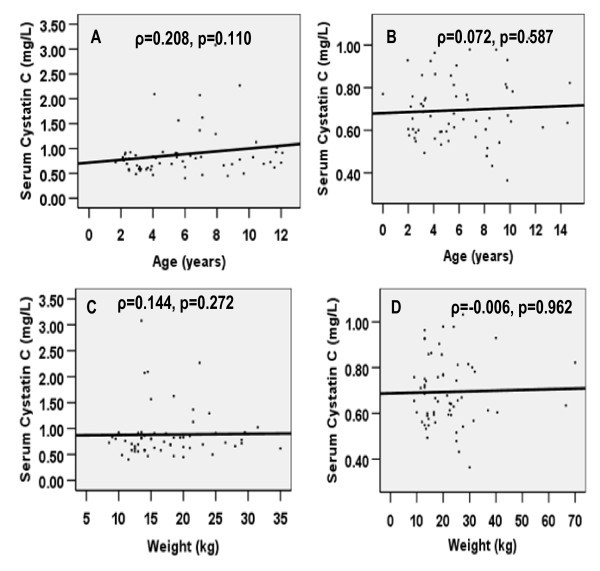
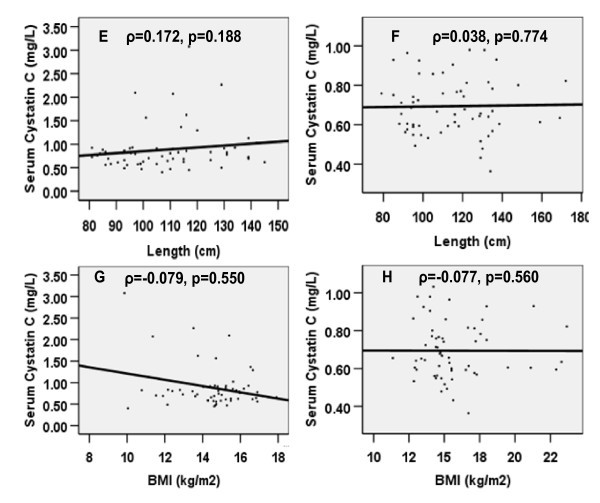
Compared to the controls, the HIV-infected group had significantly higher median (interquartile range) serum cystatin C levels {0.77 (0.29) mg/l versus 0.66 (0.20) mg/l; p = 0.025} and a higher proportion of children with serum cystatin C level >1 mg/l {10 (16.7%) versus one (1.7%); p = 0.004}. The HIV-infected children had a mean (+/- SD) eGFR of 96.8 (+/- 36.1) ml/min/1.73 m2 compared with 110.5 (+/- 27.8) ml/min/1.73 m2 in the controls (p = 0.021). After controlling for age, sex and body mass index, only the study group (HIV infected versus control) remained a significant predictor of serum cystatin C level (beta = -0.216, p = 0.021). The proportion of HIV-infected children with eGFR <60 ml/min/1.73 m2 was eight (13.3%) versus none (0%) in the control group (p = 0.006). However, the serum cystatin C level, eGFR and proportions of children with serum cystatin C level >1 mg/l and eGFR <60 ml/min/1.73 m2 were not significantly different between the HIV-infected children with advanced disease and those with milder disease.
HIV-infected children in Nigeria have higher serum cystatin C level and lower eGFR compared to age and sex matched controls.
在撒哈拉以南非洲的 HIV 感染儿童中,有关肾功能的数据有限。此外,这些儿童的营养不良进一步降低了肌酐估算肾小球滤过率等诊断方法的效用。我们测定了 60 例抗逆转录病毒初治、HIV 感染儿童和 60 例年龄和性别匹配的健康对照儿童的血清胱抑素 C 水平和估算肾小球滤过率。
采用酶联免疫吸附试验技术测定血清胱抑素 C 水平,采用 Filler 血清胱抑素 C 公式估算肾小球滤过率。采用 Student t 检验、Mann-Whitney U 检验、Pearson 卡方检验和 Fisher 确切概率检验,适当比较组间差异。
与对照组相比,HIV 感染组的血清胱抑素 C 中位数(四分位间距)更高[0.77(0.29)mg/L 比 0.66(0.20)mg/L;p = 0.025],且血清胱抑素 C 水平>1mg/L 的儿童比例更高[10 例(16.7%)比 1 例(1.7%);p = 0.004]。HIV 感染儿童的平均(+/-SD)eGFR 为 96.8(+/-36.1)ml/min/1.73m2,而对照组为 110.5(+/-27.8)ml/min/1.73m2(p = 0.021)。在校正年龄、性别和体重指数后,只有研究组(HIV 感染与对照组)仍为血清胱抑素 C 水平的显著预测因子(β=-0.216,p = 0.021)。eGFR<60ml/min/1.73m2 的 HIV 感染儿童比例为 8 例(13.3%),而对照组为 0 例(0%)(p = 0.006)。然而,在疾病严重程度不同的 HIV 感染儿童中,血清胱抑素 C 水平、eGFR 以及血清胱抑素 C 水平>1mg/L 和 eGFR<60ml/min/1.73m2 的儿童比例并无显著差异。
与年龄和性别匹配的对照组相比,尼日利亚的 HIV 感染儿童血清胱抑素 C 水平更高,eGFR 更低。