
在生长缓慢的海洋蓝藻聚球藻中,短 RNA 的半衰期较短。
Short RNA half-lives in the slow-growing marine cyanobacterium Prochlorococcus.
机构信息
Massachusetts Institute of Technology, Department of Civil and Environmental Engineering, Cambridge, MA 02139, USA.
出版信息
Genome Biol. 2010;11(5):R54. doi: 10.1186/gb-2010-11-5-r54. Epub 2010 May 19.
BACKGROUND
RNA turnover plays an important role in the gene regulation of microorganisms and influences their speed of acclimation to environmental changes. We investigated whole-genome RNA stability of Prochlorococcus, a relatively slow-growing marine cyanobacterium doubling approximately once a day, which is extremely abundant in the oceans.
RESULTS
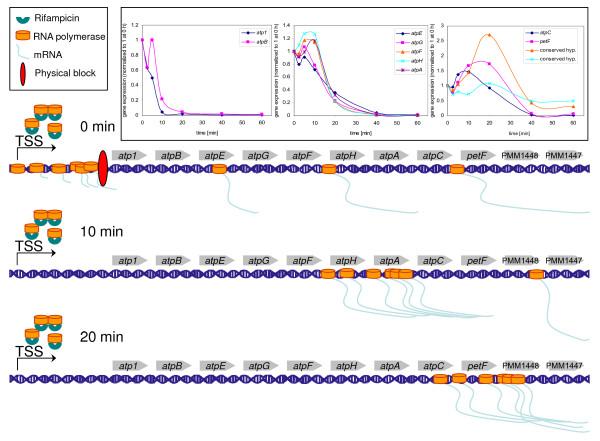
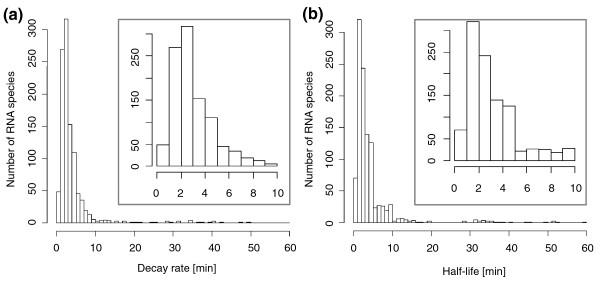
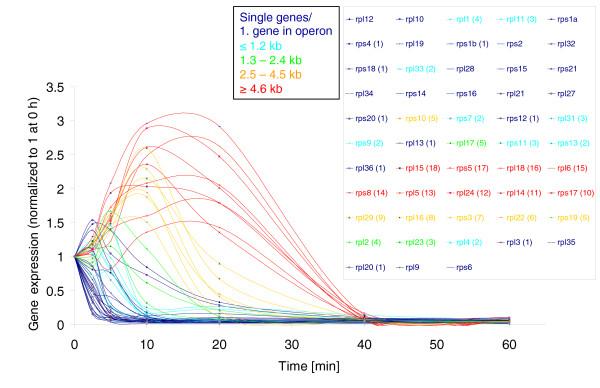
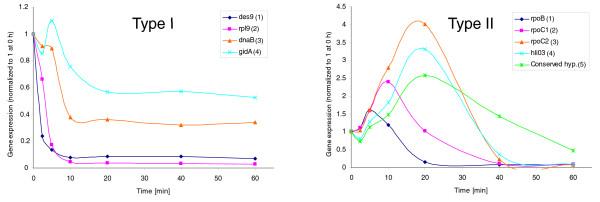
Using a combination of microarrays, quantitative RT-PCR and a new fitting method for determining RNA decay rates, we found a median half-life of 2.4 minutes and a median decay rate of 2.6 minutes for expressed genes - twofold faster than that reported for any organism. The shortest transcript half-life (33 seconds) was for a gene of unknown function, while some of the longest (approximately 18 minutes) were for genes with high transcript levels. Genes organized in operons displayed intriguing mRNA decay patterns, such as increased stability, and delayed onset of decay with greater distance from the transcriptional start site. The same phenomenon was observed on a single probe resolution for genes greater than 2 kb.
CONCLUSIONS
We hypothesize that the fast turnover relative to the slow generation time in Prochlorococcus may enable a swift response to environmental changes through rapid recycling of nucleotides, which could be advantageous in nutrient poor oceans. Our growing understanding of RNA half-lives will help us interpret the growing bank of metatranscriptomic studies of wild populations of Prochlorococcus. The surprisingly complex decay patterns of large transcripts reported here, and the method developed to describe them, will open new avenues for the investigation and understanding of RNA decay for all organisms.
背景
RNA 周转在微生物的基因调控中起着重要作用,并影响它们适应环境变化的速度。我们研究了相对生长缓慢的海洋蓝藻聚球藻的全基因组 RNA 稳定性,其细胞倍增时间约为一天一次,在海洋中极为丰富。
结果
我们使用微阵列、定量 RT-PCR 和一种新的拟合方法来确定 RNA 衰减率,发现表达基因的中位数半衰期为 2.4 分钟,中位数衰减率为 2.6 分钟——比任何已报道的生物快两倍。最短的转录物半衰期(33 秒)是一个未知功能的基因,而一些最长的半衰期(约 18 分钟)是转录水平较高的基因。操纵子中的基因表现出有趣的 mRNA 衰减模式,例如稳定性增加,以及与转录起始位点的距离越远,衰减开始的时间越晚。在单个探针分辨率大于 2 kb 的基因上也观察到了相同的现象。
结论
我们假设聚球藻的快速周转相对于缓慢的代时可能使其能够通过快速回收核苷酸来快速应对环境变化,这在营养贫瘠的海洋中可能是有利的。我们对 RNA 半衰期的理解不断加深,将有助于我们解释对聚球藻野生种群的越来越多的宏转录组学研究。这里报告的大转录物令人惊讶的复杂衰减模式,以及开发的描述它们的方法,将为所有生物的 RNA 衰减的研究和理解开辟新的途径。



 Zotero 插件