UPMC-Université Paris 06, Station Biologique, Place Georges Teissier, Roscoff, France.
BMC Microbiol. 2010 Jul 29;10:204. doi: 10.1186/1471-2180-10-204.
The marine cyanobacterium Prochlorococcus is very abundant in warm, nutrient-poor oceanic areas. The upper mixed layer of oceans is populated by high light-adapted Prochlorococcus ecotypes, which despite their tiny genome (approximately 1.7 Mb) seem to have developed efficient strategies to cope with stressful levels of photosynthetically active and ultraviolet (UV) radiation. At a molecular level, little is known yet about how such minimalist microorganisms manage to sustain high growth rates and avoid potentially detrimental, UV-induced mutations to their DNA. To address this question, we studied the cell cycle dynamics of P. marinus PCC9511 cells grown under high fluxes of visible light in the presence or absence of UV radiation. Near natural light-dark cycles of both light sources were obtained using a custom-designed illumination system (cyclostat). Expression patterns of key DNA synthesis and repair, cell division, and clock genes were analyzed in order to decipher molecular mechanisms of adaptation to UV radiation.
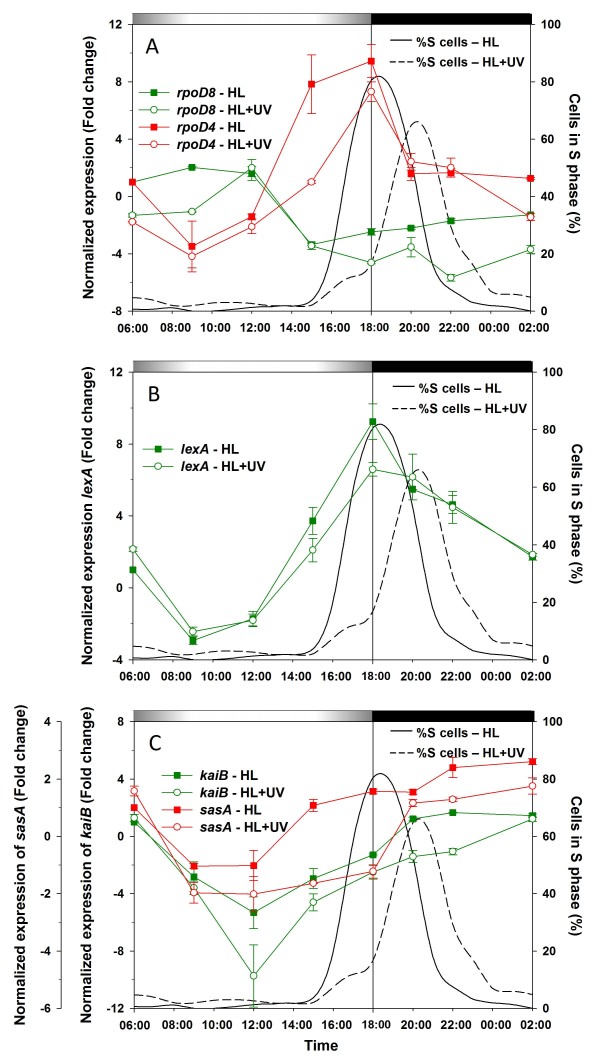
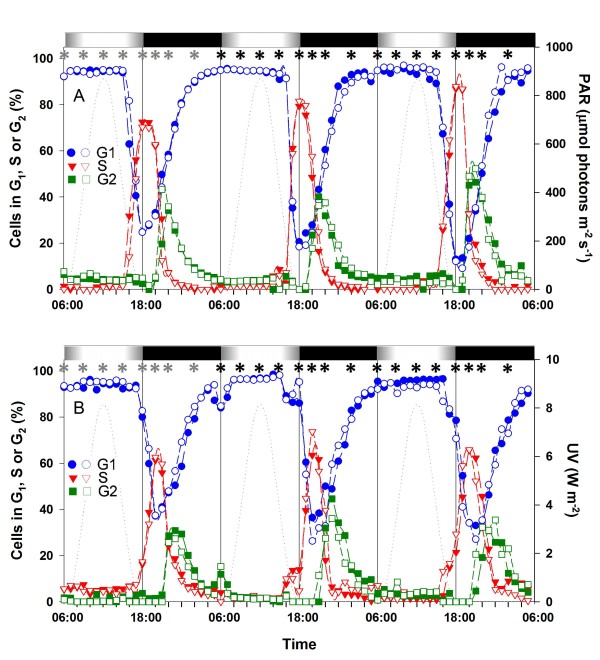
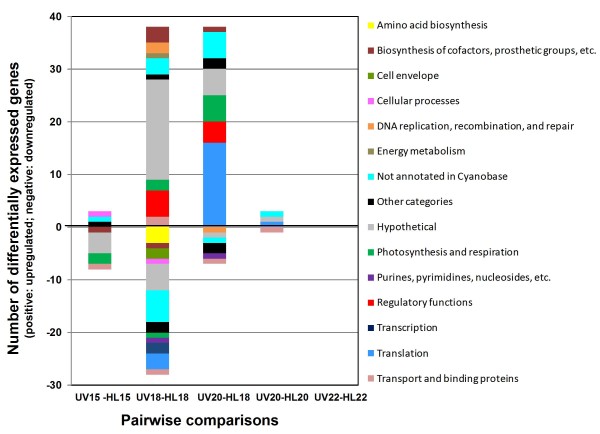
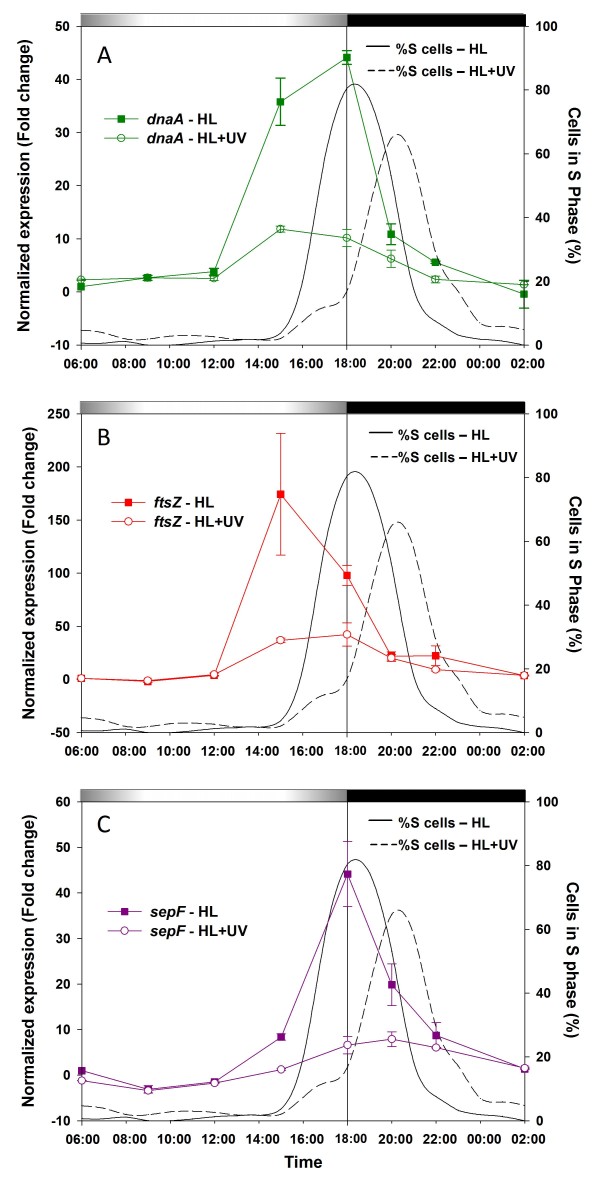
The cell cycle of P. marinus PCC9511 was strongly synchronized by the day-night cycle. The most conspicuous response of cells to UV radiation was a delay in chromosome replication, with a peak of DNA synthesis shifted about 2 h into the dark period. This delay was seemingly linked to a strong downregulation of genes governing DNA replication (dnaA) and cell division (ftsZ, sepF), whereas most genes involved in DNA repair (such as recA, phrA, uvrA, ruvC, umuC) were already activated under high visible light and their expression levels were only slightly affected by additional UV exposure.
Prochlorococcus cells modified the timing of the S phase in response to UV exposure, therefore reducing the risk that mutations would occur during this particularly sensitive stage of the cell cycle. We identified several possible explanations for the observed timeshift. Among these, the sharp decrease in transcript levels of the dnaA gene, encoding the DNA replication initiator protein, is sufficient by itself to explain this response, since DNA synthesis starts only when the cellular concentration of DnaA reaches a critical threshold. However, the observed response likely results from a more complex combination of UV-altered biological processes.
海洋蓝藻原绿球藻在温暖、贫营养的海洋区域非常丰富。海洋上层混合层中生活着高光适应的原绿球藻生态型,尽管它们的基因组很小(约 1.7Mb),但似乎已经发展出了有效的策略来应对光合作用和紫外线(UV)辐射的应激水平。在分子水平上,对于这种极简微生物如何维持高生长速度并避免 DNA 受到潜在的有害、UV 诱导的突变,我们知之甚少。为了解决这个问题,我们研究了在高光通量下生长的海洋原绿球藻 PCC9511 细胞的细胞周期动态,同时存在或不存在 UV 辐射。使用定制设计的照明系统(循环培养器)获得了接近自然光-暗周期的近自然光-暗周期。为了解析适应 UV 辐射的分子机制,分析了关键 DNA 合成和修复、细胞分裂和时钟基因的表达模式。
海洋原绿球藻 PCC9511 的细胞周期被日夜周期强烈同步。细胞对 UV 辐射的最显著反应是染色体复制延迟,DNA 合成高峰推迟到暗期约 2 小时。这种延迟似乎与 DNA 复制(dnaA)和细胞分裂(ftsZ、sepF)的基因强烈下调有关,而大多数参与 DNA 修复的基因(如 recA、phrA、uvrA、ruvC、umuC)在高光下已经被激活,它们的表达水平仅受到额外的 UV 暴露的轻微影响。
原绿球藻细胞修改了 S 期的时间以应对 UV 暴露,从而降低了在细胞周期这个特别敏感的阶段发生突变的风险。我们为观察到的时间推移找到了几种可能的解释。其中,编码 DNA 复制起始蛋白的 dnaA 基因的转录水平急剧下降本身就足以解释这种反应,因为只有当细胞内 DnaA 浓度达到临界阈值时,DNA 合成才会开始。然而,观察到的反应可能是由更复杂的 UV 改变的生物过程的组合引起的。