Department of Molecular and Cell Biology, University of California, Berkeley, California 94720, USA.
Nature. 2010 Jun 3;465(7298):641-4. doi: 10.1038/nature08974.
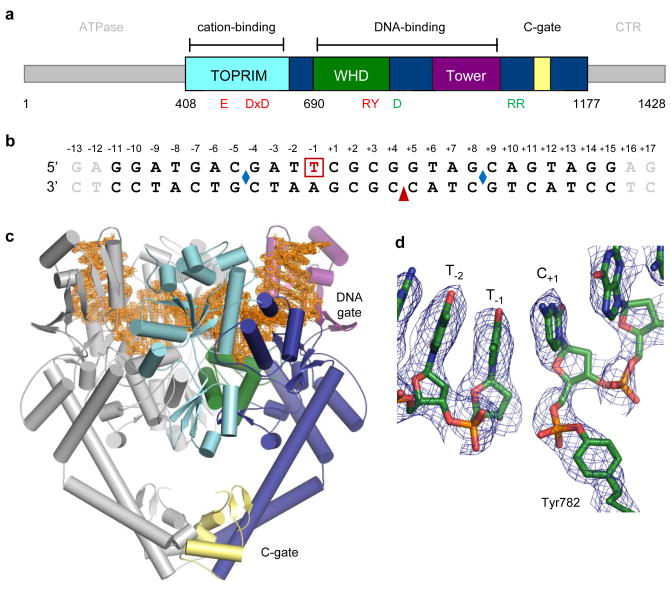
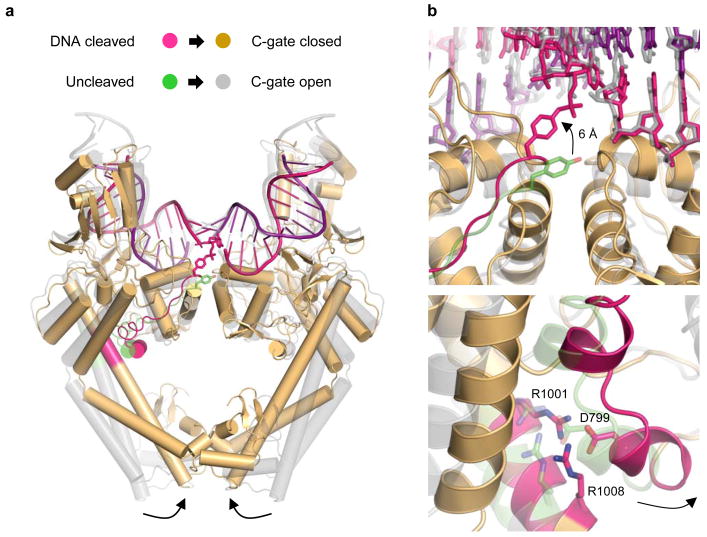
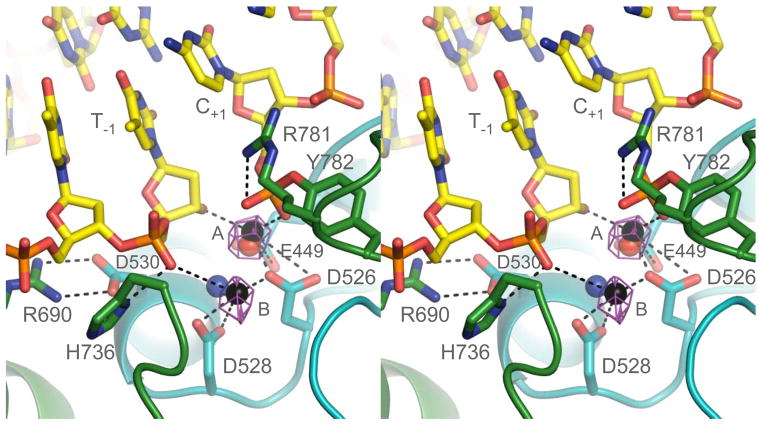
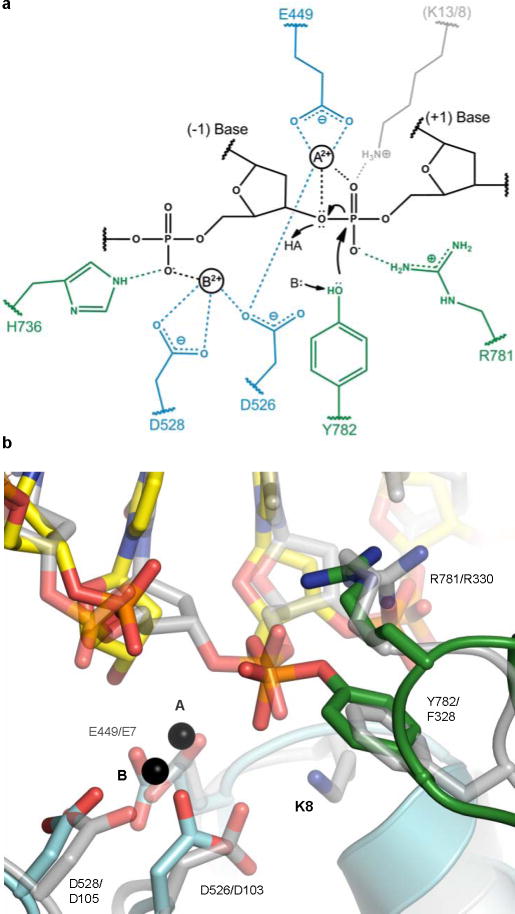
Type II topoisomerases are required for the management of DNA tangles and supercoils, and are targets of clinical antibiotics and anti-cancer agents. These enzymes catalyse the ATP-dependent passage of one DNA duplex (the transport or T-segment) through a transient, double-stranded break in another (the gate or G-segment), navigating DNA through the protein using a set of dissociable internal interfaces, or 'gates'. For more than 20 years, it has been established that a pair of dimer-related tyrosines, together with divalent cations, catalyse G-segment cleavage. Recent efforts have proposed that strand scission relies on a 'two-metal mechanism', a ubiquitous biochemical strategy that supports vital cellular processes ranging from DNA synthesis to RNA self-splicing. Here we present the structure of the DNA-binding and cleavage core of Saccharomyces cerevisiae topoisomerase II covalently linked to DNA through its active-site tyrosine at 2.5A resolution, revealing for the first time the organization of a cleavage-competent type II topoisomerase configuration. Unexpectedly, metal-soaking experiments indicate that cleavage is catalysed by a novel variation of the classic two-metal approach. Comparative analyses extend this scheme to explain how distantly-related type IA topoisomerases cleave single-stranded DNA, unifying the cleavage mechanisms for these two essential enzyme families. The structure also highlights a hitherto undiscovered allosteric relay that actuates a molecular 'trapdoor' to prevent subunit dissociation during cleavage. This connection illustrates how an indispensable chromosome-disentangling machine auto-regulates DNA breakage to prevent the aberrant formation of mutagenic and cytotoxic genomic lesions.
II 型拓扑异构酶对于管理 DNA 扭结和超螺旋至关重要,也是临床抗生素和抗癌药物的靶点。这些酶催化 ATP 依赖性地将一个 DNA 双链体(转运或 T 片段)穿过另一个 DNA 双链体(门或 G 片段)中的瞬时双链断裂,通过一组可分离的内部界面或“门”,在蛋白质中引导 DNA。二十多年来,人们已经确定一对二聚体相关的酪氨酸与二价阳离子共同催化 G 片段的切割。最近的研究提出,链的断裂依赖于“双金属机制”,这是一种普遍存在的生化策略,支持从 DNA 合成到 RNA 自我剪接等重要的细胞过程。在这里,我们以 2.5A 的分辨率展示了酿酒酵母拓扑异构酶 II 的 DNA 结合和切割核心与通过其活性位点酪氨酸共价连接的 DNA 的结构,首次揭示了具有切割能力的 II 型拓扑异构酶构象的组织。出乎意料的是,金属浸泡实验表明,切割是由经典双金属方法的一种新型变体催化的。比较分析将该方案扩展到解释如何解释远缘的 I 型拓扑异构酶如何切割单链 DNA,从而统一了这两种必需酶家族的切割机制。该结构还突出了一个迄今为止未被发现的变构接力,该接力激活了分子“活门”,以防止在切割过程中亚基解离。这种联系说明了不可或缺的染色体解缠结机器如何自我调节 DNA 断裂以防止形成致突变和细胞毒性的基因组损伤。