Niklas Jens, Gopta Oxana, Epel Boris, Lubitz Wolfgang, Antonkine Mikhail L
Appl Magn Reson. 2010 May;38(2):187-203. doi: 10.1007/s00723-009-0112-5. Epub 2009 Dec 31.
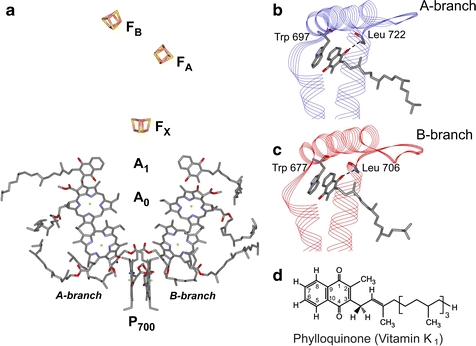
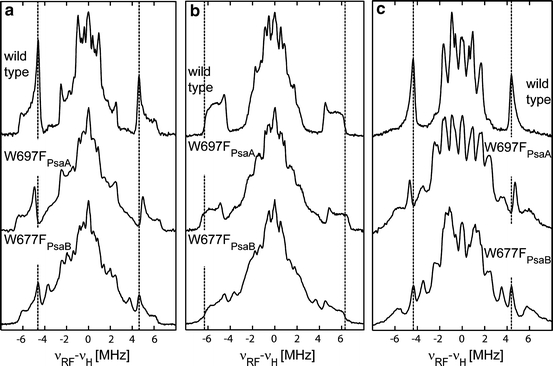
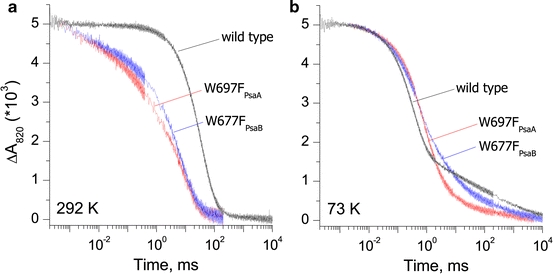
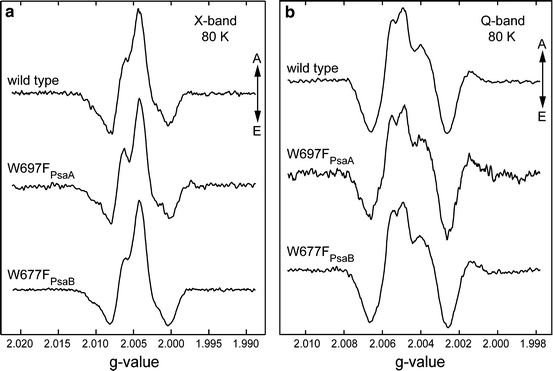
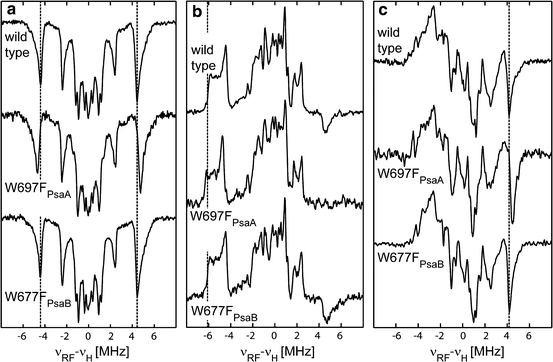
Photosystem I (PS I) contains two symmetric branches of electron transfer cofactors. In both the A- and B-branches, the phylloquinone in the A(1) site is pi-stacked with a tryptophan residue and is H-bonded to the backbone nitrogen of a leucine residue. In this work, we use optical and electron paramagnetic resonance (EPR) spectroscopies to investigate cyanobacterial PS I complexes, where these tryptophan residues are changed to phenylalanine. The time-resolved optical data show that backward electron transfer from the terminal electron acceptors to P(700) (.+) is affected in the A- and B-branch mutants, both at ambient and cryogenic temperatures. These results suggest that the quinones in both branches take part in electron transport at all temperatures. The electron-nuclear double resonance (ENDOR) spectra of the spin-correlated radical pair P(700) (.+)A(1) (.-) and the photoaccumulated radical anion A(1) (.-), recorded at cryogenic temperature, allowed the identification of characteristic resonances belonging to protons of the methyl group, some of the ring protons and the proton hydrogen-bonded to phylloquinone in the wild type and both mutants. Significant changes in PS I isolated from the A-branch mutant are detected, while PS I isolated from the B-branch mutant shows the spectral characteristics of wild-type PS I. A possible short-lived B-branch radical pair cannot be detected by EPR due to the available time resolution; therefore, only the A-branch quinone is observed under conditions typically employed for EPR and ENDOR spectroscopies.
光系统I(PS I)包含两个对称的电子传递辅因子分支。在A分支和B分支中,A(1)位点的叶醌与一个色氨酸残基形成π堆积,并与一个亮氨酸残基的主链氮原子形成氢键。在这项工作中,我们使用光学和电子顺磁共振(EPR)光谱来研究蓝藻PS I复合物,其中这些色氨酸残基被替换为苯丙氨酸。时间分辨光学数据表明,在室温和低温下,从末端电子受体到P(700)(.+)的反向电子传递在A分支和B分支突变体中均受到影响。这些结果表明,两个分支中的醌在所有温度下都参与电子传输。在低温下记录的自旋相关自由基对P(700)(.+)A(1)(.-)和光积累自由基阴离子A(1)(.-)的电子-核双共振(ENDOR)光谱,使得能够识别属于野生型和两个突变体中甲基质子、一些环质子以及与叶醌形成氢键的质子的特征共振。从A分支突变体分离得到的PS I检测到显著变化,而从B分支突变体分离得到的PS I显示出野生型PS I的光谱特征。由于可用的时间分辨率,EPR无法检测到可能的短寿命B分支自由基对;因此,在通常用于EPR和ENDOR光谱的条件下,只能观察到A分支醌。