Genetics Division, National Cancer Center Research Institute, Tokyo, Japan.
Clin Cancer Res. 2010 Jul 15;16(14):3533-8. doi: 10.1158/1078-0432.CCR-09-3169. Epub 2010 May 25.
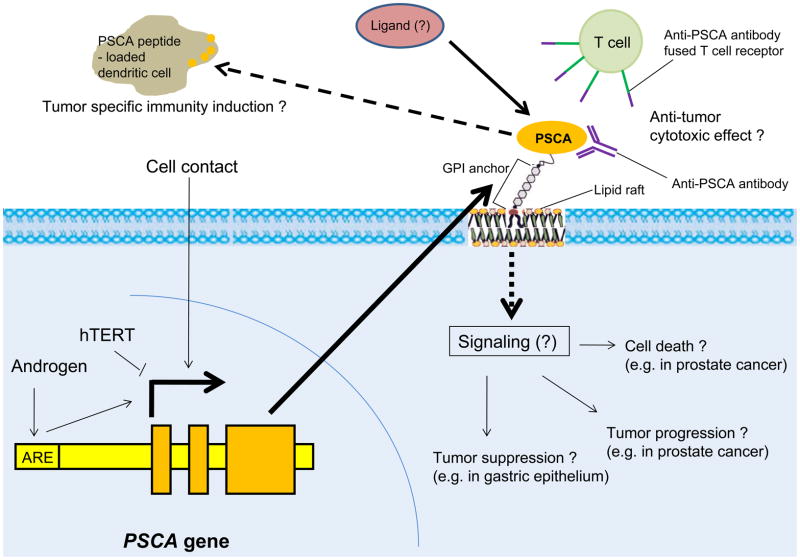
Prostate stem cell antigen (PSCA) is a glycosylphosphatidylinositol (GPI)-anchored cell surface protein. Although PSCA is thought to be involved in intracellular signaling, much remains unknown about its physiological function and regulatory mechanism in normal and cancer cells. It is up-regulated in several major cancers including prostate, bladder, and pancreatic cancers. The expression of PSCA is positively correlated with advanced clinical stage and metastasis in prostate cancers and is also associated with malignant progression of premalignant prostate lesions. Therefore, PSCA has been proposed as a biomarker of diagnosis and prognosis, as well as a target of therapy for these cancers. In addition, PSCA has also shown clinical potential in immunotherapy as a prostate-specific antigen, which, when presented by dendritic cells, may elicit strong tumor-specific immunity. In contrast, PSCA is down-regulated in esophageal and gastric cancer and may have a tumor-suppressing function in the gastric epithelium. Recent exciting findings that genetic variations of PSCA conferred increased risks of gastric cancer and bladder cancer have opened up a new avenue of research about the pathological function of PSCA. PSCA seems to be a Jekyll and Hyde molecule that plays differential roles, tumor promoting or suppressing, depending on the cellular context.
前列腺干细胞抗原(PSCA)是一种糖基磷脂酰肌醇(GPI)锚定的细胞表面蛋白。虽然 PSCA 被认为参与细胞内信号转导,但它在正常和癌细胞中的生理功能及其调节机制仍知之甚少。它在包括前列腺癌、膀胱癌和胰腺癌在内的几种主要癌症中上调。PSCA 的表达与前列腺癌的晚期临床分期和转移呈正相关,也与癌前前列腺病变的恶性进展有关。因此,PSCA 已被提议作为这些癌症的诊断和预后的生物标志物,以及治疗的靶点。此外,PSCA 在免疫治疗中也显示出了临床潜力,作为一种前列腺特异性抗原,当被树突状细胞呈递时,可能会引发强烈的肿瘤特异性免疫。相比之下,PSCA 在食管癌和胃癌中下调,并且在胃上皮中可能具有肿瘤抑制功能。最近令人兴奋的发现,PSCA 的遗传变异增加了胃癌和膀胱癌的风险,为 PSCA 的病理功能研究开辟了新的途径。PSCA 似乎是一个双重人格的分子,根据细胞环境的不同,发挥促进肿瘤或抑制肿瘤的作用。