Department of Radiology, Xijing Hospital, Fourth Military Medical University, Xian, China.
PLoS One. 2012;7(6):e38350. doi: 10.1371/journal.pone.0038350. Epub 2012 Jun 27.
Tumor antigen (TA)-targeted monoclonal antibody (mAb) immunotherapy can be effective for the treatment of a broad range of cancer etiologies; however, these approaches have demonstrated variable clinical efficacy for the treatment of patients with prostate cancer (PCa). An obstacle currently impeding translational progress has been the inability to quantify the mAb dose that reaches the tumor site and binds to the targeted TAs. The coupling of mAb to nanoparticle-based magnetic resonance imaging (MRI) probes should permit in vivo measurement of patient-specific biodistributions; these measurements could facilitate future development of novel dosimetry paradigms wherein mAb dose is titrated to optimize outcomes for individual patients.
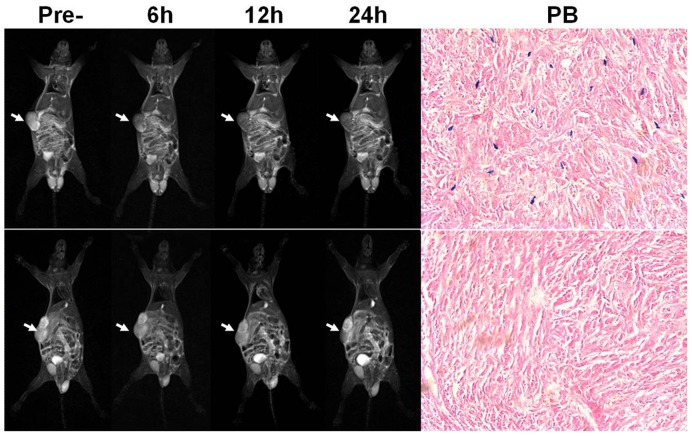
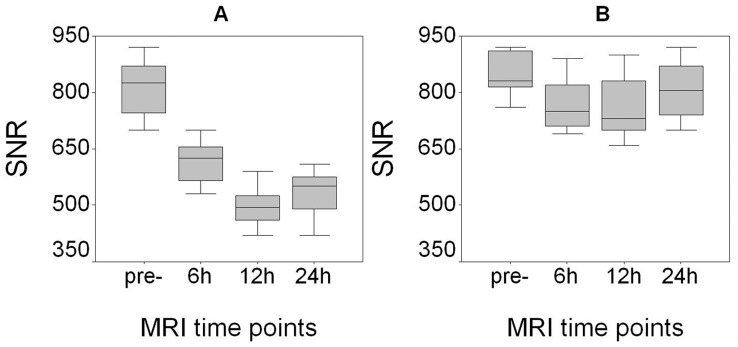
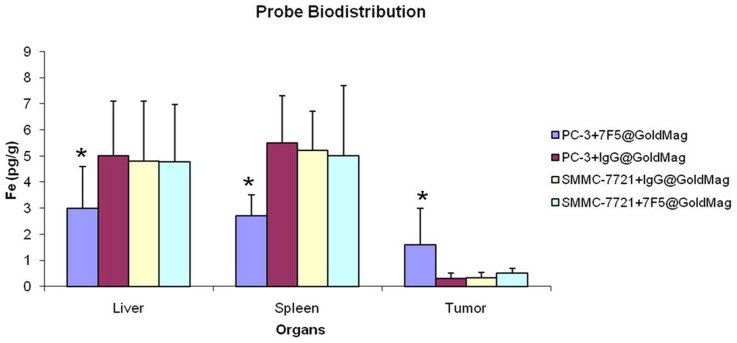
The prostate stem cell antigen (PSCA) is broadly expressed on the surface of prostate cancer (PCa) cells. Anti-human PSCA monoclonal antibodies (mAb 7F5) were bound to Au/Fe(3)O(4) (GoldMag) nanoparticles (mAb 7F5@GoldMag) to serve as PSCA-specific theragnostic MRI probe permitting visualization of mAb biodistribution in vivo. First, the antibody immobilization efficiency of the GoldMag particles and the efficacy for PSCA-specific binding was assessed. Next, PC-3 (prostate cancer with PSCA over-expression) and SMMC-7721 (hepatoma cells without PSCA expression) tumor-bearing mice were injected with mAb 7F5@GoldMag for MRI. MRI probe biodistributions were assessed at increasing time intervals post-infusion; therapy response was evaluated with serial tumor volume measurements.
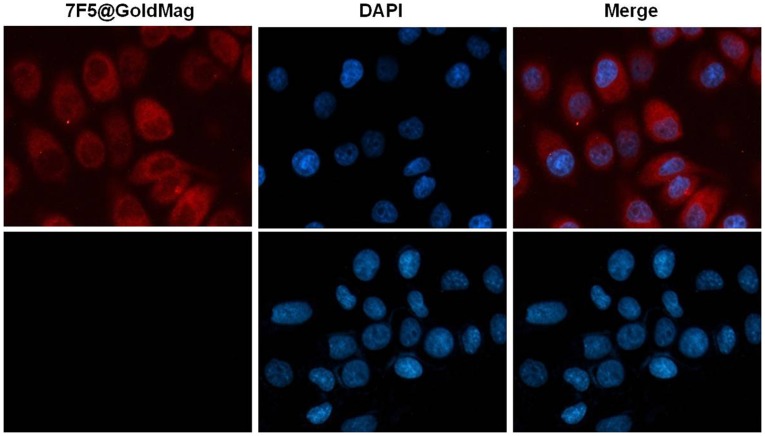
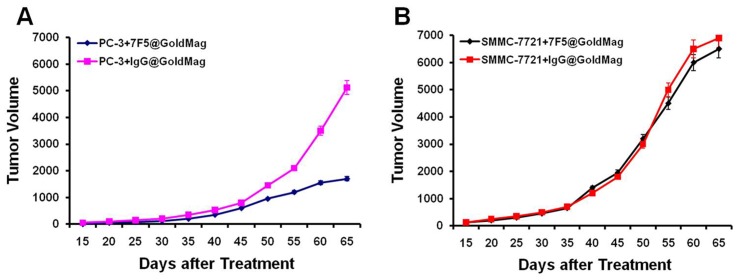
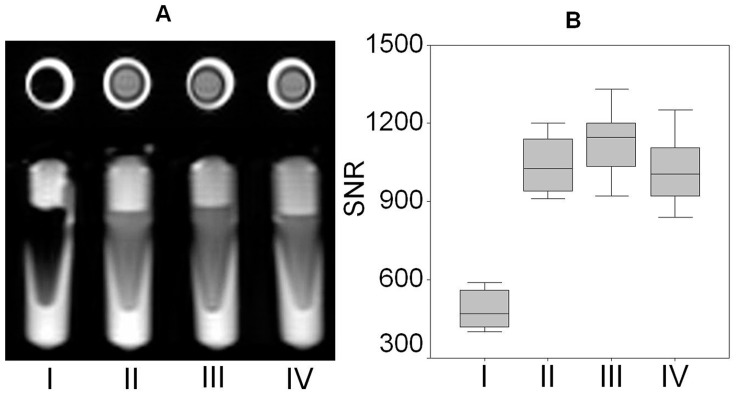
Targeted binding of the mAb 7F5@GoldMag probes to PC-3 cells was verified using optical images and MRI; selective binding was not observed for SMMC-7721 tumors. The immunotherapeutic efficacy of the mAb 7F5@GoldMag in PC-3 tumor-bearing mice was verified with significant inhibition of tumor growth compared to untreated control animals.
Our promising results suggest the feasibility of using mAb 7F5@GoldMag probes as a novel paradigm for the detection and immunotherapeutic treatment of PCa. We optimistically anticipate that the approaches have the potential to be translated into the clinical settings.
肿瘤抗原(TA)靶向单克隆抗体(mAb)免疫疗法可有效治疗广泛的癌症病因;然而,这些方法在治疗前列腺癌(PCa)患者方面显示出不同的临床疗效。目前阻碍转化进展的一个障碍是无法量化到达肿瘤部位并与靶向 TA 结合的 mAb 剂量。将 mAb 与基于纳米颗粒的磁共振成像(MRI)探针偶联应允许在体测量患者特异性生物分布;这些测量可以促进新的剂量测定范式的发展,其中 mAb 剂量被滴定以优化个体患者的结果。
前列腺干细胞抗原(PSCA)广泛表达于前列腺癌细胞表面。抗人 PSCA 单克隆抗体(mAb 7F5)与 Au/Fe(3)O(4)(GoldMag)纳米颗粒(mAb 7F5@GoldMag)结合,作为 PSCA 特异性治疗性 MRI 探针,允许体内可视化 mAb 生物分布。首先,评估了 GoldMag 颗粒的抗体固定效率和 PSCA 特异性结合的功效。接下来,向 PC-3(前列腺癌,PSCA 过表达)和 SMMC-7721(肝癌细胞,无 PSCA 表达)荷瘤小鼠注射 mAb 7F5@GoldMag 进行 MRI。在输注后增加的时间间隔评估 MRI 探针的生物分布;通过连续的肿瘤体积测量评估治疗反应。
使用光学图像和 MRI 验证了 mAb 7F5@GoldMag 探针对 PC-3 细胞的靶向结合;未观察到 SMMC-7721 肿瘤的选择性结合。与未治疗的对照动物相比,mAb 7F5@GoldMag 在 PC-3 肿瘤荷瘤小鼠中的免疫治疗效果得到了验证,肿瘤生长受到显著抑制。
我们有希望的结果表明,mAb 7F5@GoldMag 探针作为检测和免疫治疗前列腺癌的新范式是可行的。我们乐观地预计,这些方法有可能转化为临床环境。