Laboratory of Stem Cell Biology and Engineering, Department of Animal Sciences, University of Illinois at Urbana-Champaign, 1207 West Gregory Drive, Urbana, 61801, Illinois, USA.
Stem Cell Res Ther. 2010 Mar 30;1(1):7. doi: 10.1186/scrt7.
The objective of this study was to find highly reliable internal-control genes (ICGs) for normalization of qPCR data from porcine adult mesenchymal stem cells induced to differentiate toward adipogenic and osteogenic lineages.
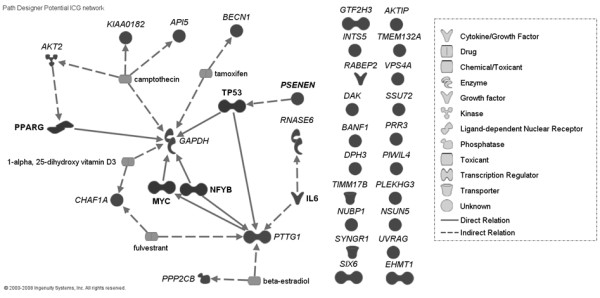
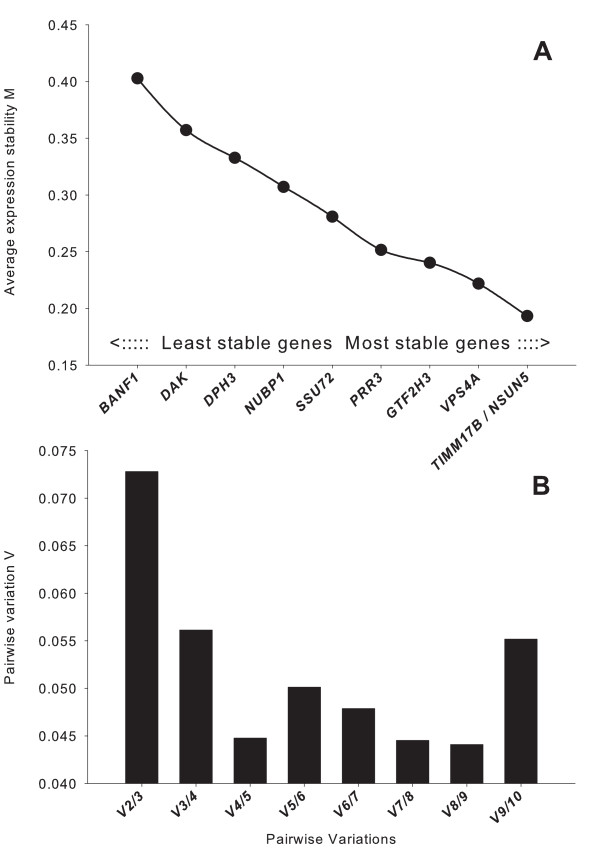
Stem cells were acquired from subcutaneous back fat and bone marrow of three castrated Yorkshire crossbred male pigs. Adipose and bone marrow-derived stem cells (ADSCs and BMSCs) were cultured in vitro with specific osteogenic or adipogenic differentiation medium for 4 weeks. Total RNA was extract for microarray (13,000 oligonucleotides) and qPCR analyses. Microarray data were used to uncover the most stably expressed genes (that is, potential ICGs). Co-regulation among potential ICGs was evaluated with Ingenuity Pathway Analysis. qPCR was performed on the non-coregulated ICGs candidates and on specific osteogenic (COL1A1) and adipogenic (DBI) genes. geNorm was used to uncover the most reliable ICGs by using qPCR data and the optimal number of ICGs to be used to calculate the normalization factor.
Microarray data analysis revealed 27 potential ICGs. Among those, 10 genes without known co-regulation were selected to perform qPCR. geNorm performed on qPCR data uncovered high stability in expression ratio among the selected ICGs. However, especially reliable normalization was obtained by geometric mean of NSUN5, TIMM17B, and VPS4A. The effect of normalization, assessed on specific osteogenic (COL1A1) and adipogenic (DBI) genes, was apparent for the adipogenic and less apparent for the osteogenic differentiation.
The combination of microarray data and pairwise gene analysis allowed identification of novel and highly reliable ICGs for qPCR data normalization of adult porcine stem cells induced to differentiate to adipogenic and osteogenic lineages.
本研究的目的是寻找高度可靠的内参基因(ICGs),用于对猪成体间充质干细胞向成脂和成骨谱系诱导分化的 qPCR 数据进行归一化。
从 3 头去势约克夏杂交公猪的皮下背部脂肪和骨髓中获得干细胞。将脂肪和骨髓来源的干细胞(ADSCs 和 BMSCs)在体外分别用特定的成骨或成脂分化培养基培养 4 周。提取总 RNA 进行微阵列(13000 个寡核苷酸)和 qPCR 分析。微阵列数据用于发现最稳定表达的基因(即潜在的 ICGs)。通过 Ingenuity 通路分析评估潜在 ICGs 之间的共调控关系。对非共调控的 ICGs 候选基因和特定的成骨(COL1A1)和成脂(DBI)基因进行 qPCR 检测。使用 qPCR 数据和最佳 ICG 数量来计算归一化因子,geNorm 用于发现最可靠的 ICGs。
微阵列数据分析显示有 27 个潜在的 ICGs。在这些基因中,选择了 10 个没有已知共调控关系的基因进行 qPCR。对 qPCR 数据进行 geNorm 分析发现,所选 ICGs 的表达比率具有很高的稳定性。然而,NSUN5、TIMM17B 和 VPS4A 的几何平均值可获得最佳的归一化效果。对特定的成骨(COL1A1)和成脂(DBI)基因进行归一化效果评估表明,该方法对成脂分化的效果明显,而对成骨分化的效果不明显。
微阵列数据和基因对分析的组合可用于鉴定新型且高度可靠的 ICGs,用于对猪成体干细胞向成脂和成骨谱系诱导分化的 qPCR 数据进行归一化。