Laboratories for Integrative Neuroscience and Endocrinology, Department of Clinical Sciences at South Bristol, University of Bristol, Whitson Street, Bristol BS1 3NY, United Kingdom.
J Biol Chem. 2010 Aug 6;285(32):24360-71. doi: 10.1074/jbc.M110.115964. Epub 2010 May 27.
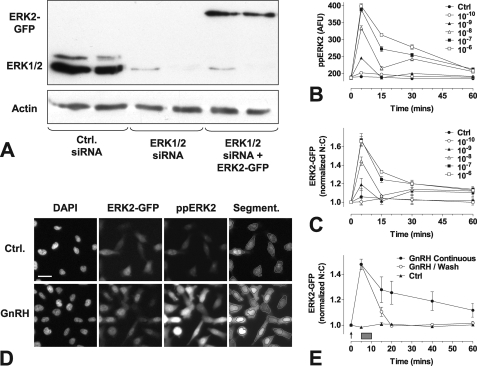
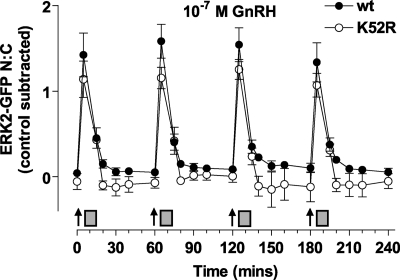
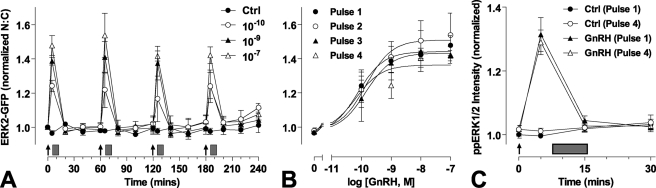
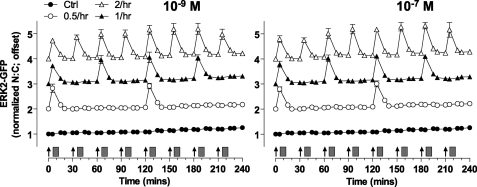
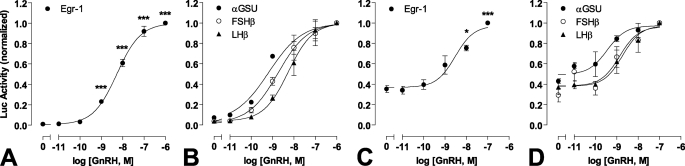
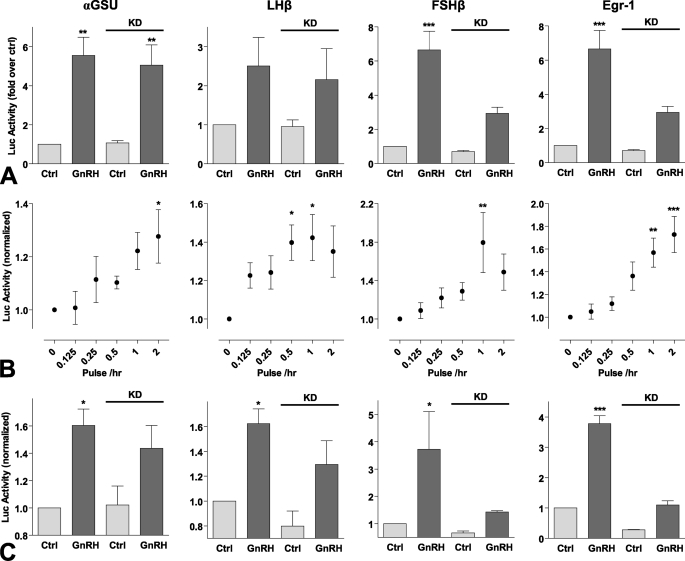
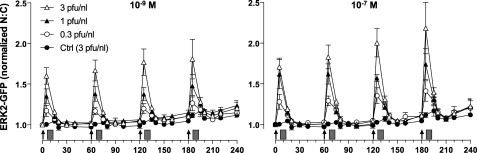
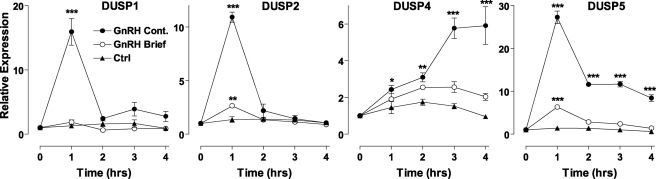
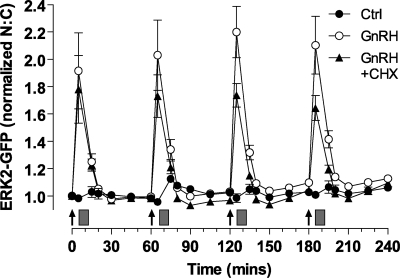
Gonadotropin-releasing hormone (GnRH) acts via G-protein-coupled receptors on gonadotrophs to stimulate synthesis and secretion of luteinizing hormone and follicle-stimulating hormone. It is secreted in pulses, and its effects depend on pulse frequency, but decoding mechanisms are unknown. Here we have used an extracellular signal regulated kinase-green fluorescent protein (ERK2-GFP) reporter to monitor GnRH signaling. GnRH caused dose-dependent ERK2-GFP translocation to the nucleus, providing a live-cell readout for activation. Pulsatile GnRH caused dose- and frequency-dependent ERK2-GFP translocation. These responses were rapid and transient, showed only digital tracking, and did not desensitize under any condition tested (dose, frequency, and receptor number varied). We also tested for the effects of cycloheximide (to prevent induction of nuclear-inducible MAPK phosphatases) and used GFP fusions containing ERK mutations (D319N, which prevents docking domain-dependent binding to MAPK phosphatases, and K52R, which prevents catalytic activity). These manipulations had little or no effect on the translocation responses, arguing against a role for MAPK phosphatases or ERK-mediated feedback in shaping ERK activation during pulsatile stimulation. GnRH also caused dose- and frequency-dependent activation of the alpha-gonadotropin subunit-, luteinizing hormone beta-, and follicle-stimulating hormone beta- luciferase reporters, and the latter response was inhibited by ERK1/2 knockdown. Moreover, GnRH caused frequency-dependent activation of an Egr1-luciferase reporter, but the response was proportional to cumulative pulse duration. Our data suggest that frequency decoding is not due to negative feedback shaping ERK signaling in this model.
促性腺激素释放激素(GnRH)通过与促性腺激素细胞上的 G 蛋白偶联受体结合发挥作用,刺激黄体生成素和卵泡刺激素的合成和分泌。它以脉冲的形式分泌,其作用取决于脉冲频率,但解码机制尚不清楚。在这里,我们使用细胞外信号调节激酶-绿色荧光蛋白(ERK2-GFP)报告基因来监测 GnRH 信号。GnRH 导致 ERK2-GFP 依赖剂量的核转位,为激活提供了活细胞读出。脉冲 GnRH 导致 ERK2-GFP 依赖剂量和频率的核转位。这些反应迅速而短暂,仅显示数字跟踪,并且在任何测试条件下(剂量、频率和受体数量变化)都不会脱敏。我们还测试了环已酰亚胺(以防止诱导核诱导的 MAPK 磷酸酶)的作用,并使用包含 ERK 突变的 GFP 融合(D319N,阻止与 MAPK 磷酸酶结合的对接域依赖性结合,以及 K52R,阻止催化活性)。这些操作对转位反应几乎没有影响,这表明在脉冲刺激期间,MAPK 磷酸酶或 ERK 介导的反馈在塑造 ERK 激活中没有作用。GnRH 还导致 alpha-促性腺激素亚基、黄体生成素β和卵泡刺激素β-荧光素酶报告基因的剂量和频率依赖性激活,而后者的反应被 ERK1/2 敲低所抑制。此外,GnRH 导致 Egr1-荧光素酶报告基因的频率依赖性激活,但反应与累积脉冲持续时间成正比。我们的数据表明,在这种模型中,频率解码不是由于负反馈对 ERK 信号的塑造。