17 El-emam Moslem street, Tanta, Egypt.
BMC Anesthesiol. 2010 May 28;10:7. doi: 10.1186/1471-2253-10-7.
Central nervous system changes, circulatory and electrolyte imbalances are the main complications of endoscopic transurethral resection of the prostate (TURP) which is known as transurethral resection (TUR) syndrome, which occurs as result of excessive absorption of irrigating fluid. We compare glycine 1.5% versus glucose 5% and normal saline 0.9% as irrigating solutions during TURP in patients with moderate to severe bladder outlet obstruction due to benign prostatic hyperplasia (BPH).
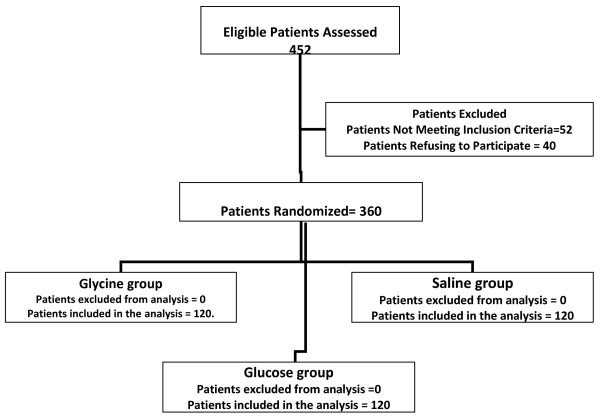
Three hundred sixty patients with symptomatic BPH were randomized into a prospective, controlled trial comparing the three irrigation modalities. One-hundred twenty patients used glycine 1.5% solution as irrigating fluid (glycine group), 120 patients used glucose 5% solution (glucose group) and 120 patients used normal saline 0.9% solution (saline group). Patient's demographics, operation time, hospital stay, postoperative amino acid glycine assay, postoperative serum cardiac troponin I and perioperative complications were noted.
No difference was found between the groups in the immediate postoperative levels of hemoglobin and hematocrite. A high glycine level was associated with the TUR syndrome. Seventeen patients had TUR syndrome; all were in glycine group and they had the highest postoperative amino acid glycine levels. Slight increase in serum sodium (142.6 +/- 12.6 mmol/l) was detected in saline group. Transient Hyperglycemia (170 +/- 35.9 mg/dl) and hypokalemia (3.67 +/- 0.92 mmol/l) occurred in the immediate postoperative period in the glucose group.
Endoscopic TURP performed using either glucose 5% or saline 0.9% irrigating solution during and after surgery is associated with lower incidence of TUR syndrome, lower catheterization period, shorter hospital stay and no cardiac toxicity in comparison with glycine 1.5% solution.
This clinical trail had been approved and registered in PACT Registry; with identification number for the registry is ATMR2010010001793131.
经尿道前列腺电切术(TURP)是治疗良性前列腺增生(BPH)的常用手术,其术后并发症主要包括中枢神经系统改变、循环和电解质失衡等,这些并发症通常被称为 TUR 综合征,是由于灌洗液过度吸收所致。本研究比较了在接受经尿道前列腺电切术(TURP)治疗的中重度膀胱出口梗阻患者中,使用甘氨酸 1.5%、葡萄糖 5%和生理盐水 0.9%作为灌洗液的效果。
将 360 例有症状的 BPH 患者随机分为前瞻性、对照试验,比较三种灌洗方式。120 例患者使用甘氨酸 1.5%溶液作为灌流液(甘氨酸组),120 例患者使用葡萄糖 5%溶液(葡萄糖组),120 例患者使用生理盐水 0.9%溶液(生理盐水组)。记录患者的人口统计学资料、手术时间、住院时间、术后氨基酸甘氨酸测定、术后血清肌钙蛋白 I 和围手术期并发症。
三组患者术后即刻血红蛋白和血细胞比容无差异。甘氨酸水平升高与 TUR 综合征有关。17 例患者出现 TUR 综合征,均在甘氨酸组,且术后氨基酸甘氨酸水平最高。生理盐水组术后血清钠略有升高(142.6±12.6mmol/L)。葡萄糖组术后即刻出现短暂性高血糖(170±35.9mg/dl)和低钾血症(3.67±0.92mmol/L)。
与甘氨酸 1.5%溶液相比,在手术期间和手术后使用葡萄糖 5%或生理盐水 0.9%灌洗液进行经尿道 TURP 与 TUR 综合征发生率较低、导管插入时间较短、住院时间较短和无心脏毒性相关。
本临床试验已在 PACT 注册中心获得批准和注册;注册号为 ATMR2010010001793131。