Department of Neuropediatrics, University Medical Center Schleswig-Holstein (UKSH), Schwanenweg 20, 24105 Kiel, Germany.
Mol Cell Neurosci. 2010 Sep;45(1):47-58. doi: 10.1016/j.mcn.2010.05.008. Epub 2010 May 25.
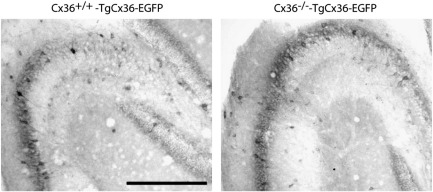
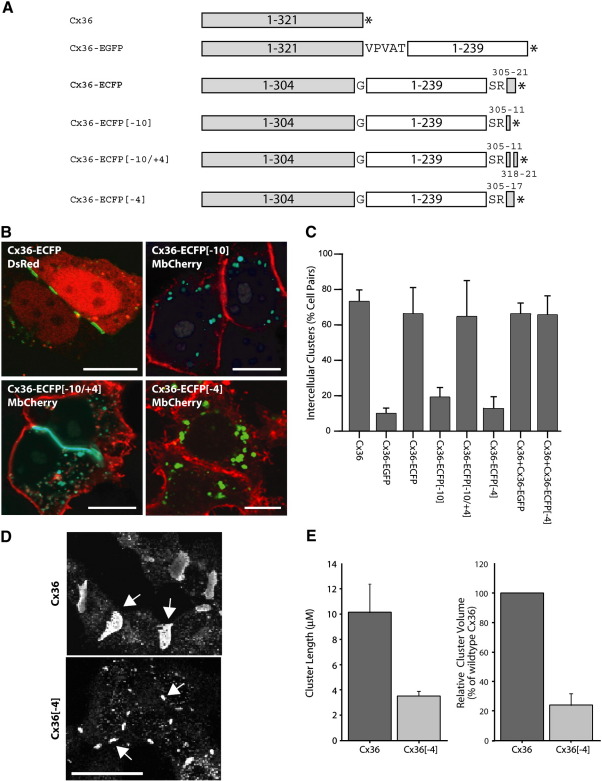
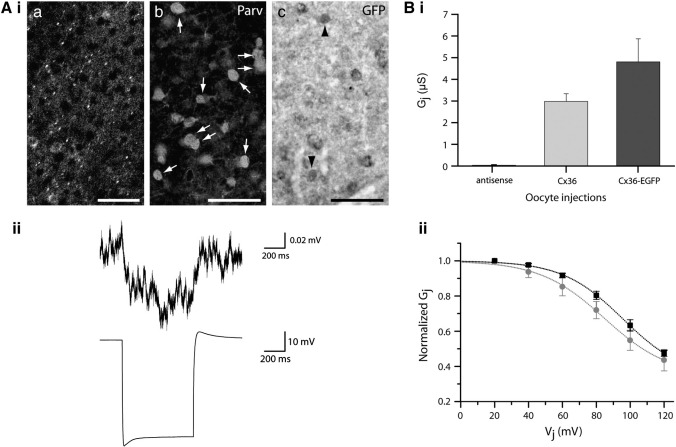
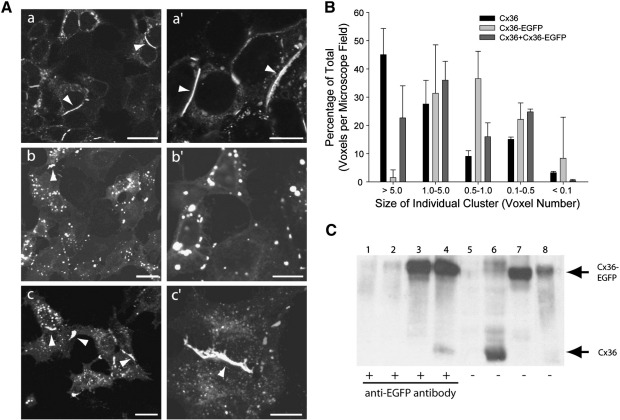
Connexin 36 (Cx36)-containing electrical synapses contribute to the timing and amplitude of neural responses in many brain regions. A Cx36-EGFP transgenic was previously generated to facilitate their identification and study. In this study we demonstrate that electrical coupling is normal in transgenic mice expressing Cx36 from the genomic locus and suggest that fluorescent puncta present in brain tissue represent distributed electrical synapses. These qualities emphasize the usefulness of the Cx36-EGFP reporter as a tool for the detailed anatomical characterization of electrical synapses in fixed and living tissue. However, though the fusion protein is able to form gap junctions between Xenopus laevis oocytes it is unable to restore electrical coupling to interneurons in the Cx36-deficient mouse. Further experiments in transgenic tissue and non-neural cell lines reveal impaired transport to the plasma membrane as the possible cause. By analyzing the functional deficits exhibited by the fusion protein in vivo and in vitro, we identify a motif within Cx36 that may interact with other trafficking or scaffold proteins and thereby be responsible for its incorporation into electrical synapses.
连接蛋白 36(Cx36)- 含有电突触有助于许多脑区的神经反应的时间和幅度。先前生成了一种 Cx36-EGFP 转基因,以方便它们的鉴定和研究。在这项研究中,我们证明了在表达 Cx36 的转基因小鼠中,电耦联是正常的,并且表明脑组织中的荧光斑点代表分布的电突触。这些特性强调了 Cx36-EGFP 报告基因作为固定和活体组织中电突触详细解剖特征的工具的有用性。然而,尽管融合蛋白能够在非洲爪蟾卵母细胞之间形成缝隙连接,但它不能将电耦合恢复到 Cx36 缺陷型小鼠的中间神经元。在转基因组织和非神经细胞系中的进一步实验揭示了向质膜的运输受损可能是原因。通过分析融合蛋白在体内和体外表现出的功能缺陷,我们确定了 Cx36 内可能与其他运输或支架蛋白相互作用的模体,从而负责其整合到电突触中。