Department of Pathology, Tokai University School of Medicine, 143 Shimokasuya, Isehara, Kanagawa 259-1193, Japan.
Acta Histochem Cytochem. 2010 May 1;43(2):33-44. doi: 10.1267/ahc.09034. Epub 2010 Apr 7.
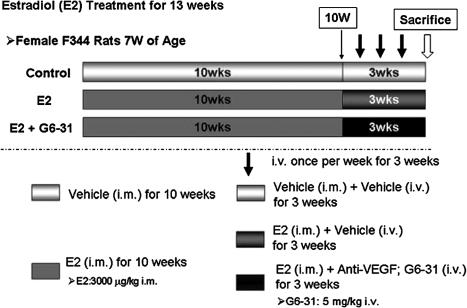
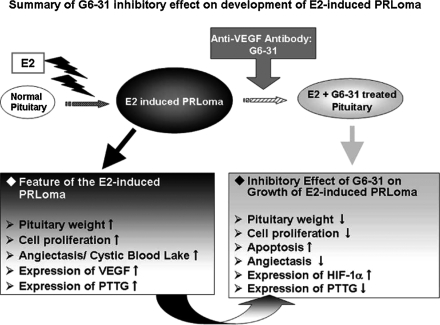
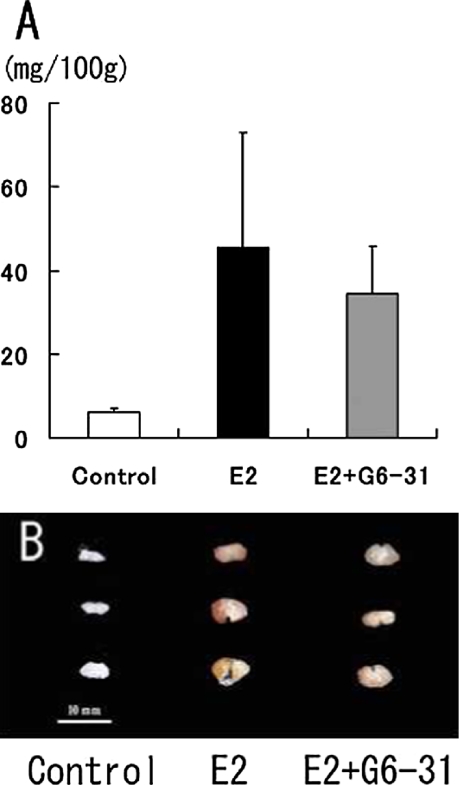
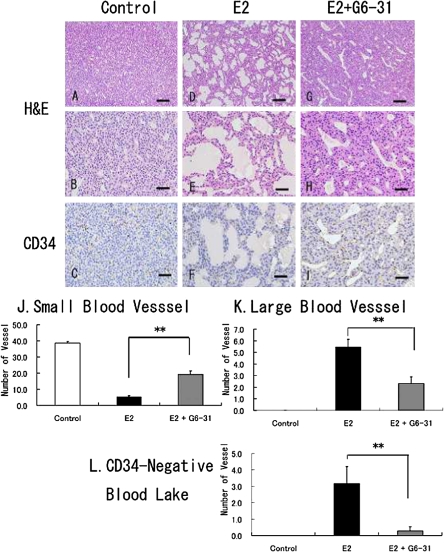
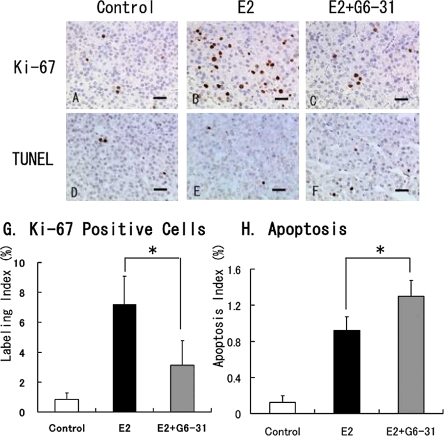
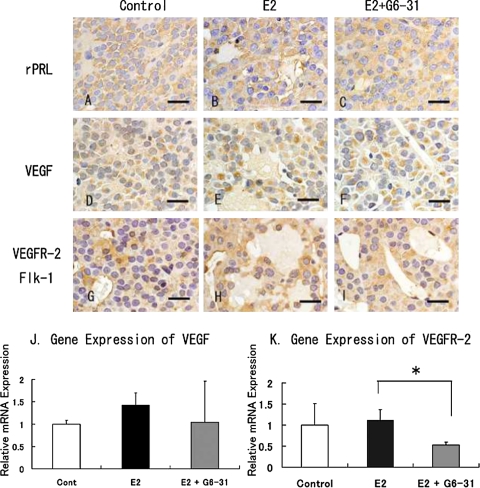
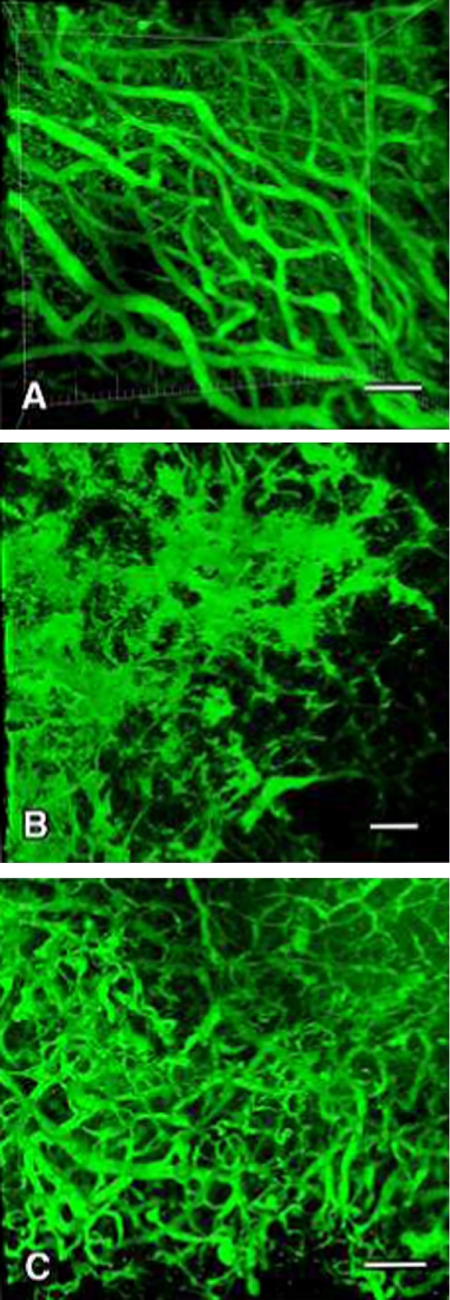
Estrogen-induced pituitary prolactin-producing tumors (PRLoma) in F344 rats express a high level of vascular endothelial growth factor (VEGF) associated with marked angiogenesis and angiectasis. To investigate whether tumor development in E2-induced PRLoma is inhibited by anti-VEGF monoclonal antibody (G6-31), we evaluated tumor growth and observed the vascular structures. With simultaneous treatment with G6-31 for the latter three weeks of the 13-week period of E2 stimulation (E2+G6-31 group), the following inhibitory effects on the PRLoma were observed in the E2+G6-31 group as compared with the E2-only group. In the E2+G6-31 group, a tendency to reduction in pituitary weight was observed and significant differences were observed as (1) reductions in the Ki-67-positive anterior cells, (2) increases in TUNEL-positive anterior cells, and (3) repair of the microvessel count by CD34-immunohistochemistry. The characteristic "blood lakes" in PRLomas were improved and replaced by repaired microvascular structures on 3D observation using confocal laser scanning microscope. These inhibitory effects due to anti-VEGF antibody might be related to the autocrine/paracrine action of VEGF on the tumor cells, because VEGF and its receptor are co-expressed on the tumor cells. Thus, our results demonstrate that anti-VEGF antibody exerted inhibitory effects on pituitary tumorigenesis in well-established E2 induced PRLomas.
雌激素诱导的 F344 大鼠垂体泌乳素瘤(PRLoma)表达高水平的血管内皮生长因子(VEGF),与明显的血管生成和血管扩张有关。为了研究抗 VEGF 单克隆抗体(G6-31)是否抑制 E2 诱导的 PRLoma 肿瘤的发展,我们评估了肿瘤的生长并观察了血管结构。在 E2 刺激的 13 周期间的最后三周同时用 G6-31 进行治疗(E2+G6-31 组),与仅用 E2 处理的 E2 组相比,E2+G6-31 组对 PRLoma 具有以下抑制作用。在 E2+G6-31 组中,观察到垂体重量有减少的趋势,并且观察到以下差异:(1)Ki-67 阳性前细胞减少;(2)TUNEL 阳性前细胞增加;(3)通过 CD34 免疫组织化学修复微血管计数。在使用共聚焦激光扫描显微镜进行 3D 观察时,PRLoma 中的特征性“血湖”得到改善,并被修复的微血管结构所取代。抗 VEGF 抗体的这些抑制作用可能与 VEGF 对肿瘤细胞的自分泌/旁分泌作用有关,因为 VEGF 和其受体在肿瘤细胞上共同表达。因此,我们的结果表明,抗 VEGF 抗体对已建立的 E2 诱导的 PRLoma 中的垂体肿瘤发生具有抑制作用。