National Institute for Public Health and the Environment, Postbus 1 3720 BA, Bilthoven, The Netherlands.
BMC Public Health. 2010 Jun 1;10:295. doi: 10.1186/1471-2458-10-295.
Publichealth care providers, stakeholders and policy makers request a rapid insight into health status and needs of the affected population after disasters. To our knowledge, there is no standardized rapid assessment tool for European countries. The aim of this article is to describe existing tools used internationally and analyze them for the development of a workable rapid assessment.
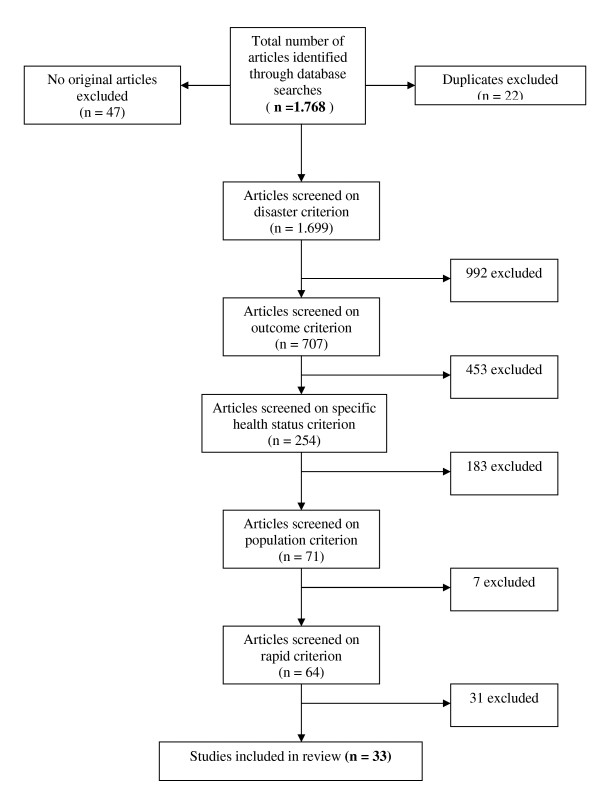
A review was conducted, including original studies concerning a rapid health and/or needs assessment. The studies used were published between 1980 and 2009. The electronic databasesof Medline, Embase, SciSearch and Psychinfo were used.
Thirty-three studies were included for this review. The majority of the studies was of US origin and in most cases related to natural disasters, especially concerning the weather. In eighteen studies an assessment was conducted using a structured questionnaire, eleven studies used registries and four used both methods. Questionnaires were primarily used to asses the health needs, while data records were used to assess the health status of disaster victims.
Methods most commonly used were face to face interviews and data extracted from existing registries. Ideally, a rapid assessment tool is needed which does not add to the burden of disaster victims. In this perspective, the use of existing medical registries in combination with a brief questionnaire in the aftermath of disasters is the most promising. Since there is an increasing need for such a tool this approach needs further examination.
公共卫生保健提供者、利益相关者和政策制定者要求快速了解灾害后受灾人群的健康状况和需求。据我们所知,欧洲国家没有标准化的快速评估工具。本文的目的是描述国际上使用的现有工具,并对其进行分析,以开发出一种可行的快速评估方法。
我们进行了一项综述,包括有关快速健康和/或需求评估的原始研究。研究的发表时间在 1980 年至 2009 年之间。我们使用了 Medline、Embase、SciSearch 和 Psychinfo 这四个电子数据库。
本综述共纳入 33 项研究。其中大多数研究来自美国,而且多数与自然灾害有关,尤其是与天气有关。在 18 项研究中,使用了结构化问卷进行评估,11 项研究使用了登记册,4 项研究同时使用了这两种方法。问卷主要用于评估健康需求,而数据记录则用于评估灾害受害者的健康状况。
最常用的方法是面对面访谈和从现有登记册中提取数据。理想情况下,需要一种不会给灾害受害者增加负担的快速评估工具。在这方面,在灾害发生后结合使用现有的医疗登记册和简短问卷是最有前途的方法。由于对这种工具的需求不断增加,因此需要进一步研究这种方法。