Institute of Genomics and Integrative Biology (CSIR), Delhi, India.
PLoS One. 2010 May 24;5(5):e10772. doi: 10.1371/journal.pone.0010772.
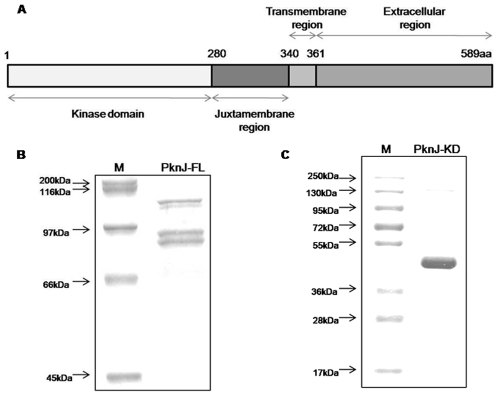
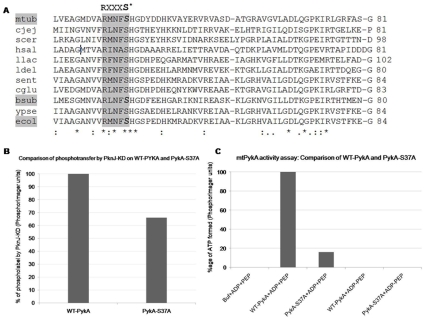
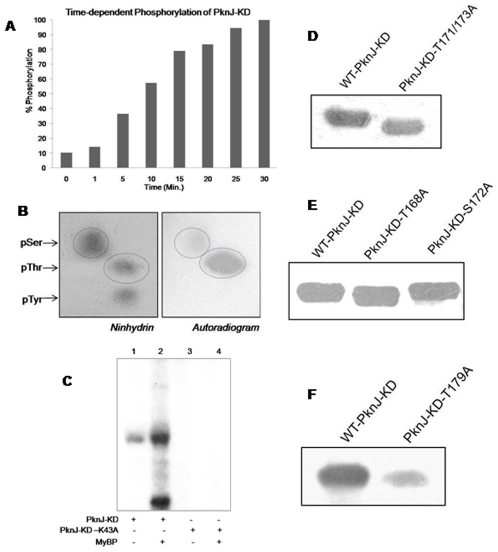
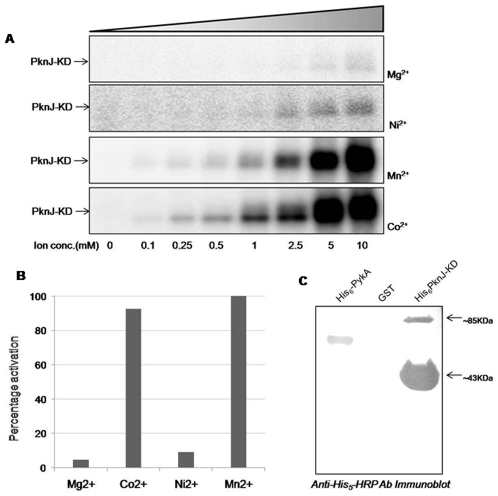
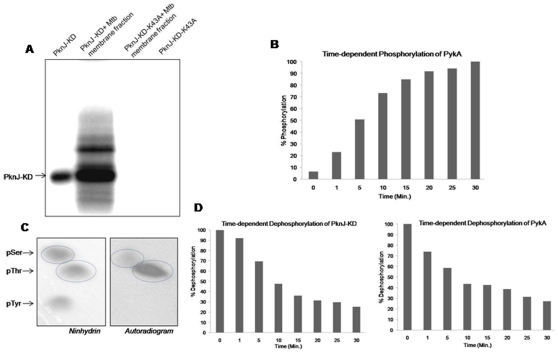
Reversible protein phosphorylation is a prevalent signaling mechanism which modulates cellular metabolism in response to changing environmental conditions. In this study, we focus on previously uncharacterized Mycobacterium tuberculosis Ser/Thr protein kinase (STPK) PknJ, a putative transmembrane protein. PknJ is shown to possess autophosphorylation activity and is also found to be capable of carrying out phosphorylation on the artificial substrate myelin basic protein (MyBP). Previous studies have shown that the autophosphorylation activity of M. tuberculosis STPKs is dependent on the conserved residues in the activation loop. However, our results show that apart from the conventional conserved residues, additional residues in the activation loop may also play a crucial role in kinase activation. Further characterization of PknJ reveals that the kinase utilizes unusual ions (Ni(2+), Co(2+)) as cofactors, thus hinting at a novel mechanism for PknJ activation. Additionally, as shown for other STPKs, we observe that PknJ possesses the capability to dimerize. In order to elucidate the signal transduction cascade emanating from PknJ, the M. tuberculosis membrane-associated protein fraction is treated with the active kinase and glycolytic enzyme Pyruvate kinase A (mtPykA) is identified as one of the potential substrates of PknJ. The phospholabel is found to be localized on serine and threonine residue(s), with Ser(37) identified as one of the sites of phosphorylation. Since Pyk is known to catalyze the last step of glycolysis, our study shows that the fundamental pathways such as glycolysis can also be governed by STPK-mediated signaling.
蛋白质可逆磷酸化是一种普遍的信号机制,可调节细胞代谢以响应不断变化的环境条件。在这项研究中,我们专注于以前未表征的结核分枝杆菌丝氨酸/苏氨酸蛋白激酶(STPK)PknJ,一种假定的跨膜蛋白。研究表明 PknJ 具有自身磷酸化活性,并且还能够对人工底物髓鞘碱性蛋白(MyBP)进行磷酸化。先前的研究表明,结核分枝杆菌 STPK 的自身磷酸化活性依赖于激活环中的保守残基。然而,我们的结果表明,除了常规的保守残基外,激活环中的其他残基也可能在激酶激活中发挥关键作用。对 PknJ 的进一步表征表明,激酶利用不寻常的离子(Ni(2+)、Co(2+))作为辅助因子,这暗示了 PknJ 激活的一种新机制。此外,与其他 STPK 一样,我们观察到 PknJ 具有二聚化的能力。为了阐明源自 PknJ 的信号转导级联,用活性激酶处理结核分枝杆菌膜相关蛋白部分,并鉴定出糖酵解酶丙酮酸激酶 A(mtPykA)是 PknJ 的潜在底物之一。磷酸化标记被发现定位于丝氨酸和苏氨酸残基上,其中 Ser(37)被鉴定为磷酸化位点之一。由于 Pyk 已知催化糖酵解的最后一步,我们的研究表明,糖酵解等基本途径也可以受到 STPK 介导的信号的控制。