Department of Clinical Sciences, Swedish University of Agricultural Sciences, P,O, Box 7054, SE-750 07 Uppsala, Sweden.
Acta Vet Scand. 2010 Jun 4;52(1):37. doi: 10.1186/1751-0147-52-37.
Bovine respiratory syncytial virus (BRSV) and bovine corona virus (BCV) affects cattle worldwide. Our objective was to evaluate the effects of these infections on general health and reproduction parameters measurable on herd level and to explore the association between antibody status and some herd characteristics.
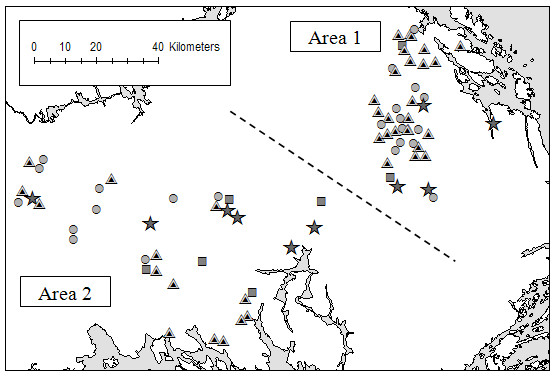
We collected a pooled milk sample from five primiparous cows from 79 Swedish dairy herds in September 2006. The samples were analysed for immunoglobulin G antibodies to BCV and BRSV with indirect enzyme-linked immunosorbent assays. Herd level data from 1 September 2005 to 30 August 2006 were accessed retrospectively. The location of the herds was mapped using a geographical information system.
Ten herds were antibody negative to both viruses and were compared with 69 herds positive to BCV or BRSV or both. Positive herds had a higher (P=0.001) bulk tank milk somatic cell count (BMSCC) compared with negative herds. The medians for all other analyzed health and reproductive parameters were consistently in favour of the herds negative to both viruses although the differences were not statistically significant. A higher proportion (P=0.01) of herds used professional technicians for artificial insemination, rather than farm personnel, amongst the 33 herds negative to BCV compared with the 46 positive herds.
Our result shows that herds that were antibody positive to BCV and/or BRSV had a higher BMSCC compared with herds negative to BCV and BRSV. There was also tendency that negative herds had a better general herd health compared with positive. A higher proportion amongst the BCV negative herds used external technicians for AI instead of farm personnel, indicating that it is possible to avoid infection although having regular visits. Negative herds were located in close proximity to positive herds, indicating that local spread and airborne transmission between herds might not be of great importance and that herds can stay free from these infection transmission although virus is circulating in the area.
牛呼吸道合胞体病毒(BRSV)和牛冠状病毒(BCV)影响全球的牛群。我们的目的是评估这些感染对可在群体水平上测量的一般健康和繁殖参数的影响,并探讨抗体状态与一些群体特征之间的关联。
我们于 2006 年 9 月从 79 个瑞典奶牛场的 5 头初产奶牛中收集了一份混合牛奶样本。使用间接酶联免疫吸附试验分析了针对 BCV 和 BRSV 的免疫球蛋白 G 抗体。回顾性地获取了 2005 年 9 月 1 日至 2006 年 8 月 30 日的群体水平数据。使用地理信息系统对群体的位置进行了映射。
10 个群体针对两种病毒均呈抗体阴性,并与 69 个针对 BCV 或 BRSV 或两者均呈抗体阳性的群体进行了比较。阳性群体的牛群奶体细胞计数(BMSCC)更高(P=0.001)。尽管差异无统计学意义,但所有其他分析的健康和繁殖参数的中位数均有利于两种病毒均呈抗体阴性的群体。在 33 个针对 BCV 呈抗体阴性的群体中,使用专业技术人员进行人工授精的比例(P=0.01)高于针对 46 个阳性群体的比例。
我们的结果表明,针对 BCV 和/或 BRSV 呈抗体阳性的群体的 BMSCC 高于针对 BCV 和 BRSV 均呈抗体阴性的群体。针对 BCV 呈抗体阴性的群体的一般群体健康状况也较好,这一趋势更为明显。在针对 BCV 呈抗体阴性的群体中,使用外部技术人员进行 AI 的比例较高(P=0.01),而非农场人员,这表明尽管定期访问,但仍有可能避免感染。针对 BCV 呈抗体阴性的群体与针对 BCV 呈抗体阳性的群体的位置相近,这表明在群体之间,本地传播和空气传播可能并不重要,并且尽管该地区存在病毒传播,但群体仍可以避免这些感染的传播。